What is 'Thirteen' about?
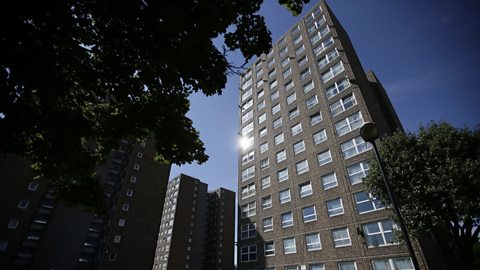
Thirteen by Caleb Femi was published in 2020 in Femi's first poetry collection called Poor.
Through poetry and photography, Femi draws on his own upbringing to explore what influences Black boys growing up in areas of deprivation in the 21st century.
In the A short piece of introductory text that comes before the main text. to Poor, Femi describes it as "an ode to a troubled yet enchanted world, and to the Black boys raised in it”.
The poem Thirteen is about a young Black boy being stopped by the police.
Comparing poems: 'Thirteen' and 'Like an Heiress'
Listen to a podcast comparing 'Like an Heiress' by Grace Nichols and 'Thirteen' by Caleb Femi.
ANNOUNCER: BBC Sounds. Music, radio, podcasts.
TESTAMENT: Welcome to the Bitesize Poetry Podcast. I'm Testament a writer, rapper and poet. And in this series I'll be comparing poems and looking at language, form, structure, theme and context. Make sure you've got a pen to make notes because I'm gonna be giving you some really good quotes to use. And if you haven't listened to the first three episodes in this series you really should.
There’s some super useful tips to analyse poetry, and make you feel more confident about getting your head around all those texts, and some of the best approaches. So if you're good to go, let's go.
TESTAMENT: In this episode we're comparing two poems, 'Like an Heiress' by Grace Nichols and 'Thirteen' by Caleb Femi. We're gonna talk about what happens in the poems, and we're going to look at three key points of comparison. One, the theme, which is the differences between expectation and reality. Two, the wider social issues that the poems touch on, the climate and racism. And three, a bit about the form of each poem.
To help us to do this I'm joined by the amazing poet and writer Dean Atta, Dean you good?
DEAN: Yeah I'm really good.
TESTAMENT: Cool let's get into it. We're gonna start with 'Thirteen' by Caleb Femi. In this poem we have a young boy who is cornered by police officers who tell him that he fits the description of a man wanted for a robbery. But he's not a man, he's a boy, and he tells the police that he's –
DEAN: That he's 13 so, you know, just like the title he's not actually a man but he's being treated like a man.
TESTAMENT: And we're gonna be taking a look at 'Like an Heiress' by Grace Nichols. The speaker of that poem feels drawn back to the place she grew up. This is the Atlantic Ocean and Grace Nichols herself grew up in Guyana which is on the Atlantic. But what happens when she gets there?
DEAN: Well it's not really the way she remembers it being when she was a little girl, when she was living there. Rubbish everywhere, it's like become the world's rubbish tip.
TESTAMENT: Okay, now our first point of comparison. Let's look at what both poems do with the theme the gap between expectation and reality. In both poems the expectation belongs to a child. We've got this boy stopped by the police, meanwhile the boy remembers this police officer, this police officer came to give a talk at his primary school.
So that would be a time when the police were friendly, and they've gone into the school to tell children that they can be anything that they want to be. There's actually a really good quote here about this. That same police officer who now thinks that he's a criminal we hear that he said, you know, these children could be, here's the quote, "The biggest and brightest stars".
DEAN: That is such a wonderful thing to say to a child. Biggest brightest the super nova, and the word that's repeated in this poem, the super nova. You know, it has the word super in it so it kind of makes you feel like I'm gonna be super. When he meets this same person again he's being treated with suspicion, he's being treated as if he may have done something wrong. And as if he is an adult and not a boy which he still is. A 13-year-old is still a boy. It must really hurt, I feel like that must really hurt the speaker of this poem.
TESTAMENT: The biggest and brightest stars. Well there's alliteration there, biggest and brightest, the repetition of the b sound b, b. The biggest brightest stars versus how it actually makes the speaker of the poem feel, becoming black holes. So these two lines are great thematic bookends to the poem. And this is an extended, metaphor meaning the metaphor repeats and develops throughout the poem.
DEAN: Yes.
TESTAMENT: Okay so let's look at 'Like an Heiress' now. So the first line of this poem is the same as the title, Like an Heiress. What does that mean Dean?
DEAN: Heiress being someone that's gonna inherit something, and heiress is for a female so if it were a male it would be heir. So it lets us know that the speaker is a woman. And the fact that it's, like an heiress. But that's a simile so there's not necessarily this kind of like inheritance of loads of money or a castle or something like that.
TESTAMENT: But the contrast is later on in the poem actually she feels, quote, "like a tourist".
DEAN: Yeah. I think they're great lines to pull out and compare cos we've got the like a, like a. It says the heiress kind of has a sense of entitlement. And I don't mean that in a bad way. I actually mean it in like, you know, you've lived your life expecting something good to come. And then a tourist is a passing person that comes and goes.
And when you're a tourist you pay for your holiday. You go and you do your thing, you buy your trinkets, and you go back home, wherever home is.
TESTAMENT: Like if an heiress is in a palace you would probably assume that the heiress owns the palace or they're going to own the palace. Where if a tourist goes to a palace it's like oh you're just gonna go there, take some photos. [D: Exactly.] You don't belong there. [D: No.] You're just visiting.
DEAN: But yeah and a tourist doesn't have to care for somewhere in the same way that the person, the owner, or the local person would have to, um, take care of somewhere.
TESTAMENT: Let's look at our second key comparison. Both these poems use a personal story to shine a light on a wider societal problem, global issues really. Pollution in 'Like an Heiress', and racism in ‘Thirteen’. So in ‘Thirteen’ we have an example of structural or institutional racism.
That means that there's an organisation or an institution that has got racism going on, embedded in it. So I want to talk about stop and search cos this stop and search is a power that the police have to stop you and to search you if they suspect a crime has taken place. And unfortunately this happens disproportionately to black people.
DEAN: Yeah I mean growing up I saw that happen a lot to my friends when I was at school. So, a lot of my, you know, group of friends were black boys, and they would regularly get stopped, you know, even when we were in school uniform. And it would get people really riled up and, because if it happens to you over and over again it's not always about that single incident, it's the fact that it's happened many times.
Whereas I think in this poem it's maybe the first time it's happening to the speaker of this poem so it's actually the shock of it.
TESTAMENT: I grew up in Manchester, and I was stopped on my own street just walking down my own street. And that was a bit of a shock to me as well because, normally if I – if I'm having an interaction with the police officer I might be asking them for directions something like that. But then to be stopped and viewed suspiciously, ah, it was not pleasant. And it's something that statistically is much more likely to happen to people of dark skin.
Caleb Femi is writing this based in London, where there have been a number of reports which have come out and said, actually the police force here have got a problem with racism and they need to sort it out. Okay you're gonna need a quote, here's a simple one but I think it's a good one, "Cornered by an officer". Because it gives us that sense of being trapped.
And let's turn to 'Like an Heiress'. So she gets back to the Atlantic, to this beach, to the sea. And it's not what she remembers, it's polluted. There's a quote, "Wave of rubbish", let's talk about this image.
DEAN: What the poet then does is, using the rule of three, so having used car tyres, plastic bottles and Styrofoam cups gives us some concrete things to hold onto –
TESTAMENT: What's the rule of three?
DEAN: Repeating, using three things, doing things three times. That is enough so that we remember it, and not too much that we kind of like lose track of it.
TESTAMENT: Finally I want to talk about form. Both poems use free verse. What's free verse Dean, what does it do?
DEAN: It does what it wants. [laughs] No, free verse doesn't follow any strict rhyme scheme, it can have any number of lines and, yeah the lines can be as long and short as you want them to be as well. So free verse is completely free.
TESTAMENT: [overlap] And does it rhyme?
DEAN: No, it wouldn't usually rhyme, or it wouldn't have to rhyme. And if it does rhyme it's not in any strict pattern.
TESTAMENT: So why do you think Caleb Femi uses free verse in ‘Thirteen’?
DEAN: Cos I think it's a time when you're young of possibility, of openness, of new experiences. So you're not set in your final form as a person, you're still growing, you're still figuring yourself out.
TESTAMENT: So 'Like an Heiress' is interesting, cos although it uses free verse it actually starts with iambic pentameter. This is ten syllables a line and those of you who study Shakespeare will recognise it a dadum, dadum, dadum. But the poem doesn't stay in iambic pentameter. It changes to free verse. Why do you think Grace Nichols is doing that?
DEAN: I think she does that to show there was a certain expectation and it hasn't been met. So it starts off a certain way and you think, you may think it's gonna carry on that way. And it has a shadow or a ghost of the sonnet in there because it also has 14 lines and so –
TESTAMENT: [overlap] Oh cos a sonnet has 14 lines right?
DEAN: – a sonnet has 14 lines so, there is still that kind of unmet expectation of like it being a Shakespearian or an old-style sonnet. But we don't get our expectations met, like the speaker of the poem has had her expectations dashed to the sea.
TESTAMENT: So before we go let's recap what we've learned and go over the quotes. We've got two poems about very different experiences, but they both share the theme of disappointment. In 'Like an Heiress' the speaker realises she is –
DEAN: "Like a tourist".
TESTAMENT: And in ‘Thirteen’ a boy finds out he is not –
DEAN: "The biggest and brightest stars".
TESTAMENT: In fact he and boys like him are "becoming black holes". Both poems use personal stories to reveal something about why they're societal issues. In 'Like an Heiress' we have environmental destruction, as shown by the line –
DEAN: "Wave of rubbish".
TESTAMENT: And in Caleb Femi's poem ‘Thirteen’ we have a powerful image of structural racism, as the boy is –
DEAN: "Cornered by an officer".
TESTAMENT: And finally remember to talk about form. Both poems use free verse, but 'Like an Heiress' starts with iambic pentameter and then breaks away from it.
TESTAMENT: Dean! Oh thank you so much for talking to us and helping us show that poetry can be a mirror that we can hold up to society. What we expect versus some ugly realities. Perhaps poems like these can show us we can change for good.
TESTAMENT: Remember to check out the Bitesize website for more information on the poems you're studying for your GCSE. Thank you so much for listening to the Bitesize Poetry Podcast, the rest of this series is available now on BBC Sounds. Peace.
In the poetry section of your English Literature exam, you will be asked to compare two poems. Listen to this podcast to hear an example of how you could approach this task.
In this episode, writer and rapper Testament and guest poet and writer Dean Atta compare the themes, wider social issues and form of Thirteen by Caleb Femi and Like An Heiress by Grace Nichols.
Listen on BBC Sounds
What happens in 'Thirteen'?

Context
Caleb Femi was born in Nigeria but moved to London when he was around seven years old. He grew up in a housing estate in North Peckham.
Femi was an English teacher at a school in Tottenham, London, before he became a film-maker, photographer and poet.
In 2016, he was the first ever young people’s poet laureate for London. As poet laureate, his role was to inspire young people to love poetry, as well as advise on issues and priorities for young people's literature.
The poem
Thirteen is based on a real experience that Femi had when he was 13 years old.
It tells the story of a young boy who is four minutes away from home when he is stopped by two police officers. They say he fits the description of a man who has just committed a robbery in the area. The boy laughs and tells them that he is only 13 years old.
In the second A set of lines grouped together in a poem., the boy recognises one of the officers. He remembers him visiting his primary school in the past and calling the pupils "little stars" and “An extremely bright explosion of a star when it reaches the end of its lifespan.”. He tries to smile to remind the officer that they’ve met before.
In the final stanza, the boy feels frightened and asks the officers if they remember giving an assembly at his primary school. He then remembers his teacher telling the class that supernovas are actually dying stars.
Reflecting on the experience in an interview, Femi has said: “What was really striking about that moment for me was this sense of not being afforded the privilege – not even the privilege, the fact – of being a kid.”

Question
In Thirteen, why did the police officers say they stopped the 13-year-old boy?
Answer
The police officers say that he fits the description of a man who committed a robbery 40 minutes ago in the area.
Themes
Racism
One interpretation of Thirteen is that it explores Structural racism refers to laws or rules that support continued harmful treatment of some people, based on race. It can result in unfair disadvantages for some and unfair advantage for others.. Structural racism refers to laws or rules that support continued harmful treatment of some people, based on race. It can result in unfair disadvantages for some and unfair advantages for others.
Although never stated, it is When a deeper meaning is suggested but not directly said. that the police stop the boy because of his skin colour. Femi says the boy is “cornered”, “patted” on the shoulder and told that he fits the description of a “man” despite being only 13 years old.
A government study between 2021 and 2022, revealed statistics showing that, in England and Wales, Black individuals were stopped and searched by police officers significantly more than any other ethnic group. Femi could be reflecting on this in Thirteen and drawing attention to the experiences of Black boys.
It could also be suggested that the police officers in ThirteenTo treat a child as if they are older than they are, usually in a harmful way. the boy because they treat him as older than he is. It is again implied that this is due to his skin colour, possibly highlighting once more the impact of structural racism on young Black boys.
You can listen to writer, rapper and poet Testament, and poet and writer Dean Atta, discussing their personal experiences of being stopped and searched on this BBC Bitesize podcast.
Growing up
In Thirteen, there is a To place two contrasting things closely together. between how the police officer treated the boy in primary school, compared to how he is treating the boy as a teenager.
In primary school, the police officer smiled and said that the children were “supernovas” suggesting that they were bright, explosive and full of energy: “the biggest and brightest stars”.
Afterwards, the children learnt that supernovas are in fact “dying stars / on the verge of becoming black holes” which suggests a darker, less optimistic path for their futures.
The police officer’s approach to the boy now that he has reached The period between being a child and an adult., could reflect racial inequalities and Treating someone differently based on something they cannot change like their race or gender. found in wider society.
Power
In Thirteen, the boy seems to feel that the police officers misuse their power by stopping and searching him and denying him the right to walk home in peace.
Femi suggests that the boy also feels his power taken away as he imagines himself through the police officers’ eyes as “powerless – plump”. Femi writes, “You will watch the two men cast lots for your organs” suggesting that the boy feels To take away the features that make a person human, such as free will or dignity.. He imagines the officers are viewing him more like an object or a prize to be claimed and shared out. He seems to feels completely at their mercy.
In an interview, Femi explains how this is a reflection on the “general lack of a sense of relationship between the community and the police” that he observed growing up.
Question
What does "cast lots" mean?
Answer
In the bible, "casting lots" referred to a decision that was made by chance – like gambling – but the outcome was believed to reveal the will of God. Femi’s use of this phrase could suggest that the officers are unjustly ‘playing God’.
Mini quiz
Language
Language is anything to do with words and the way they are used.
Negative semantic field
There is a negative Semantic field refers to groups of words which have similar meanings or are about a similar topic. throughout the poem which could mirror the boy’s negative feelings about the interaction. For instance, “powerless”, “fear” and “dying”.
This contrasts with the positive language which is used when the boy remembers his past in primary school: “stars”, “horizon”, “brightest” and “warmth”.
Femi might use these juxtaposing semantic fields to contrast the dream the boy was sold about his potential, with the reality of facing racial prejudice as a teenager.
Extended metaphor
When the police officer visited the primary school, the boy remembers him using A metaphor is a word or a phrase used for dramatic effect, to describe something as if it were something else. to describe the children. He called them “supernovas” and “stars” implying that they have bright futures ahead of them.
The boy then learns from his teacher that supernovas are “dying stars/on the verge of becoming black holes.” This extends the metaphor, but could suggest a more negative future for the children and perhaps that the police officer may have been purposefully misleading in his praise.
It could be seen to A literary technique that gives a subtle hint about something that will develop later in the story. the racism that the boy experiences in the poem once he becomes a teenager.

Structure
In poetry, structure is anything to do with layout and organisation.
Future tense
Thirteen is written in the future tense. The future tense is used to talk about things that haven't happened yet, for example:
You will be four minutes from home
when you are cornered.
The A verb that expresses a degree of possibility, such as ‘should’, ‘might’ or ‘could’. “will” suggests certainty. Femi uses it repeatedly throughout the poem, perhaps to express his experience of the inevitability of being stopped by police if you’re Black and male.
Question
Does the poem use past tense too?
Yes.Thirteen does switch to past tense when the protagonist remembers being visited by the police officer when he was in primary school: “This same officer had an horizon in the east / of his smile”.
Femi may have done this to highlight the contrast between how the officer saw the protagonist as a child compared to how he sees him now.
Rhetorical questions
A rhetorical question is a question asked for effect with no answer expected.
Femi uses two examples of rhetorical questions in the poem:
“You fit the description of a man?”
“Don’t you remember me?”
These questions show the boy’s shock and confusion throughout his interaction with the police officers.
After the first rhetorical question, in the first stanza, the boy laughs in disbelief. By the second one, in the final stanza, the boy’s disbelief has turned to fear as he realises that the police officers are serious about the interrogation and do not remember him.
Repetition
In the first stanza, the word “thirteen” is repeated twice:
Thirteen, you’ll tell him: you’re thirteen.
This repetition contrasts with the police officer’s use of the word “man”. It helps to emphasise one of the key messages that the poem could be trying to convey - that Black boys are sometimes seen as older by the police and so stopped and searched more.
Form
Form refers to the type of poem that the writer chose to write.
Second person
Second person means that the speaker or writer speaks directly to the person or character they are addressing.
Femi's use of second person in Thirteen helps to create closeness. It is as though he is speaking directly to the reader using the A word that can be substituted for a name or noun. “you”. This helps to create empathy as the reader is placed in the boy’s position and encouraged to imagine how unfair the situation might feel.
Femi’s use of second person also encourages the reader to question who the speaker actually is. Perhaps Femi wanted to deliberately create the feeling that this sort of interaction could happen to anyone, and explore how it makes young Black men feel to face prejudice.
Free verse
Femi’s use of Free verse is a poem with no set rhyme or rhythm. in Thirteen makes the poem feel more like everyday speech, which is not restricted by rhythm or rhyme. It could mirror how the boy might recount the story to friends or family after the event.
This effect is emphasised by the use of A poetic device where a sentence continues beyond the end of the line or verse. which creates a sense of urgency and of being overwhelmed as the boy’s thoughts spill over each line. For example:
You will show the warmth of your teeth
praying he remembers the heat of your supernova
One event follows another in quick succession, making it obvious how little time the boy is given to process what is happening to him. In the first line he is nearly home, but by the fifth line he is being accused of being a grown-up criminal.
Femi’s use of direct speech, shown in italics, could also be seen to help create a feeling of authenticity and realism.
Mini quiz
Top tips (AQA)

Remember
Read the question carefully. Highlight the key words and focus of the question.
Make a plan. Annotate the poem or create a short list of points you could make, supported by evidence. This will help you to stay focused and relevant.
Analyse features. When you identify a feature, always consider why it has been used and what effect it creates.
Reread your answer. Keep checking that you are on topic throughout the writing process.
Making comparisons
You will need to write your response using comparative connectives, such as:
Similarly
Likewise
However
In contrast
In the exam
This poem could be assessed in the anthology poetry part of the exam.
You will be asked to compare a named poem with a poem of your choice. The choice must be from the cluster of poems you have studied.
The named poem will be provided.
This question assesses AO1, AO2 and AO3:
| AO1 | AO1 assesses how well you read, understand and respond to the text. This includes exploring thoughtful and relevant ideas and backing these up with evidence. |
| AO2 | AO2 assesses your ability to explore the language, form and structure used by a writer to create meanings and effects. |
| AO3 | AO3 looks at how you link the contextual background of the poem(s) into your ideas. |
Quiz
Test your understanding of the poem Thirteen by taking this quiz.
GCSE English literature revision podcasts. audio
Whether you're at home or on the go, listen to these podcasts by Bitesize and BBC Sounds to refresh your memory of key texts.

More on Poems
Find out more by working through a topic
- count2 of 5

- count3 of 5