What is 'Poppies' about?

Poppies was written by Jane Weir and tells the story of a parent reminiscing about their son’s life.
The poem is written in the form of a dramatic A speech given by a single character, often alone on the stage. The character speaks to the audience, usually giving his or her private thoughts aloud. from the perspective of a parent.
In 2009, A poet selected by royalty or the government who is asked to write poems for the organisation who selected them. Carol Ann Duffy, called for war poetry to be written about British soldiers fighting in Afghanistan and Iraq.
Poppies was Weir’s response to this and first appeared in a collection called Exit Wounds.
Comparing poems: 'The Charge of the Light Brigade' and 'Poppies'
Listen to a podcast comparing 'The Charge of the Light Brigade' by Alfred, Lord Tennyson and 'Poppies' by Jane Weir.
ANNOUNCER: BBC Sounds: music, radio, podcasts.
TESTAMENT: Hello and welcome to the Bitesize poetry podcast. I'm Testament, a writer, rapper and poet. In this series I'm gonna tell you how to write about poetry in your exam. It's a good idea to start at the beginning and listen to the first three episodes in this series, so make sure you check those out. In this episode I'm comparing two poems. Make sure you've got a pen handy because it's really useful to make some notes and write down some quotes as we go.
TESTAMENT: We're talking about 'The Charge of the Light Brigade' by Alfred Lord Tennyson and 'Poppies' by Jane Weir. Victorian poet Tennyson wrote 'The Charge of the Light Brigade' in 1854, so he's not around to answer my questions. But luckily Jane Weir is here with me to talk to you about her beautiful poem 'Poppies'. Hello, Jane.
JANE: Hi, Testament.
TESTAMENT: We're going to talk about three key points today: context – when and why the poems were written; form – how they are written; and theme – remembering those who were lost. While these poems are about commemorating, honouring, and remembering those who've died in war, they're very different. We'll start with ‘Charge of the Light Brigade’. Like I said, it's written in 1854. What's it about? Jane?
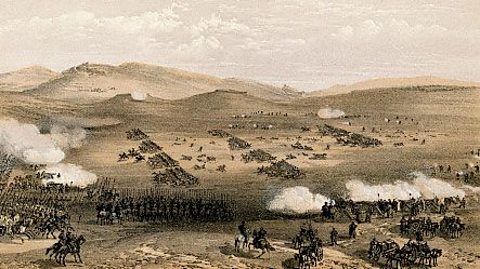
JANE: It's about a group of men riding into battle during the Crimean War. And it concentrates on the men and how they carried out their orders regardless of any kind of personal risk to themselves.
TESTAMENT: Right. So Tennyson wrote this to commemorate roughly six hundred men in battle in the Crimean War. And this battle was famously badly organised. It was a disaster. But Tennyson's point is that it doesn't stop these men being brave. I wanna turn now to your poem, Jane, 'Poppies'. Even though you wrote it, it's a bit more of a tricky question. What's happening in, in your poem?
JANE: Well, my poem isn't actually located in the battlefield like Tennyson's is. And it's about those people that are left behind. The child is remembered alive as well as possibly dead. That's important to say because you never really truly know in my poem. You could read the poem as a ghost poem or a premonition of a child's death. It's ambiguous.
TESTAMENT: That's an important point. Poems can be ambiguous. They can have more than one meaning or leave you with a feeling of uncertainty. So you the reader can decide what you think it's about. We want you to have your own opinions about poems, but you've always got to remember to back it up with a quote in the exam.
TESTAMENT: Okay, for our first key comparison, let's dig into the context a little more. Both these poems are about conflict and memory, and there's a really great quote you can use from 'The Charge of the Light Brigade'. This is a line from near the end of the poem, so it's a thought Tennyson wants to leave you with. And it says, "Honour the charge they made." It's like a command to the reader, isn't it? What do you think "honour" means here, Jane?
JANE: Er, meaning remember and respect. So for me when Tennyson talks of honour he's speaking of it in an impersonal way.
TESTAMENT: And if you can't remember the whole line, "Honour the charge they made," you can just remember the word "honour". Write it down, underline it, because honour is so central to this poem. Thinking about memory, Jane, your poem is called 'Poppies', and we wear poppies to honour and remember. Jane, is there a quote from your poem 'Poppies' that you'd like to talk about?
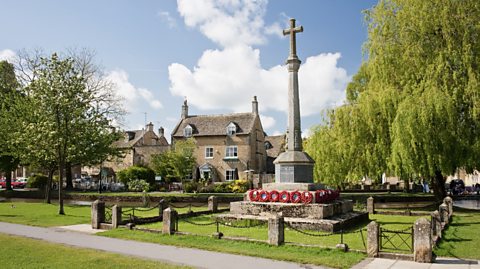
JANE: "I traced the inscriptions on the war memorial, leaned against it like a wishbone." I think that's a way of thinking about the dead, recording them in some way. I mean, it's an intimate moment for the mother. She walks up through the graveyard and she stands against – I call it the wishbone, which is specifically the war memorial, which often kind of looks like a wishbone if you-, if you know what one looks like.
TESTAMENT: What is a wishbone, for those who don't know?
JANE: You know when you get a chicken carcass? It sounds a bit bizarre.
TESTAMENT: It's like a roast chicken, yeah.
JANE: It's like a roast chicken. And you get that little bone at the back of it. We always used to take it out, pick it clean, and then I'd hold one end of it and my mum would hold the other, and then we'd pull on it and make a wish. And the wish in my poem is wishing the child back.
TESTAMENT: With multiple meanings.
JANE: Yeah.
TESTAMENT: So it looks like a wishbone. Also it-, it conjures up and it creates that image of pulling on a wishbone, a chicken bone, and making a wish for something better.
JANE: That's right. And it's an intimate act, something that connects people.
TESTAMENT: Okay, so now we've got some context we're now going to compare the form of these poems. Jane, your poem is a dramatic monologue. That means it's a poem where a character – the speaker – tells their story. Why did you choose this form?
JANE: I think dramatic monologues are… are brilliant because they're very, very direct and immediate, and you feel sometimes that you're actually completely inside the person or the character's head, and you can use a lot of creativity and play around with language and imagery and metaphor. So all those things are used in the line like, "I resisted the impulse to run my fingers through the gelled blackthorns of your hair." It's a sort of simple, tender act of play and love.
TESTAMENT: That's a really powerful one. I'm gonna repeat the quote again. "I resisted the impulse to run my fingers through the gelled blackthorns of your hair." Now, 'The Charge of the Light Brigade' is a ballade. A ballade is a really old poetic form and it tells a story. So, often, like in this case, it's a story of a real-life event. They were often used to commemorate historically significant events.
The interesting thing about this poem is that it just happened. And he wants to give this recent event significance and weight. He wants it to go down in history? Also important is that the poem is in six stanzas. A stanza is a group of lines in a poem. These can change length as the story changes, as it does here: as the men go towards danger, the final stanza is only two lines long – a short, sharp conclusion.
TESTAMENT: And for our last key comparison, let's dig more into a key difference between these poems. They both share a theme of remembering those who've died at war. Jane, your poem 'Poppies' is much more personal. We hear the word "you", whereas in 'The Charge of the Light Brigade' they're written about as "the noble six hundred." It's a really useful quote, isn't it?
JANE: And Tennyson repeats that: "the noble six hundred." I mean, I think he does it – in a weird way he's also trying to create maybe the sound of the battlefield? I think he's trying to create some kind of thunderous momentum in the poem.
TESTAMENT: With your poem, because it's so intimate we really feel that sense of loss that the mother has and what it means to her. There's no glorifying war here. There's a line in your poem, Jane, which I think shows this really well. Here it is. "Your playground voice." It's such a tender line.
JANE: A parent who loves and knows their child can often pick out their voice amongst a whole crowd in a playground. And I've tried to do that with the poem, to identify a single child out of a mass of other sounds and other voices, and to pick up on the softness of that. And I do that by using the language of textiles in my poems, both soft and hard textiles.
TESTAMENT: That's a massive contrast with ‘Charge of the Light Brigade’ where we've got the sounds of canons and flashing sabres – you know, which is a type of sword.
JANE: The missiles and the canon and the shot, they're also very hard s-, are kind of symbols of violence.
TESTAMENT: Okay, so we can go through the poems and find language that shows us the contrast between them. In 'Poppies' we've got the soft textile language. Words like "lapel", "blazer" and "hair" all support this intimate feeling of "your playground voice."
JANE: Mmm.
TESTAMENT: And we can contrast this with the impersonal line in Tennyson's poem: "noble six hundred." If we look through that poem, there are lots of hard metal words. Remember, just a word can be a good quote. So, you can use "guns", "canon", "shell". But Tennyson's poem can sometimes be seen as using this grand impersonal language to show that these men were heroes. However, there could be room for ambiguity here too. The men might be brave and noble, but the war ought not to be.
TESTAMENT: Okay, so let's quickly run through what we've learnt today to wrap this all up. 'The Charge of the Light Brigade' is a ballade written to commemorate the "noble six hundred." Why? Because…?
JANE: Someone had blundered.
TESTAMENT: While 'Poppies' is a dramatic monologue in which the speaker of the poem is a parent thinking about a child. The language is soft and personal. Quote?
JANE: "Run my fingers through the gelled blackthorns of your hair."
TESTAMENT: 'The Charge of the Light Brigade' is about, quote, "honour", while in 'Poppies' we're thinking more about longing for one specific person. Can you give us a quote, Jane?
JANE: "Traced the inscriptions on the war memorial, leaned against it like a wishbone."
TESTAMENT: Jane, thanks so much. You really helped to show what poetry can do. We've got two poems that are about the same thing, about remembrance, but are so different because of the intent of the poet and the meaning that is made with language, image and form. Thanks so much for listening to the Bitesize poetry podcast. Remember, you can check out the rest of our podcasts, and you can subscribe now on BBC Sounds.
In the poetry section of your English Literature exam, you will be asked to compare two poems. Listen to this podcast to hear an example of how you could approach this task.
In this episode, writer and rapper Testament and poet Jane Weir, compare the context, form and themes of the poems The Charge of the Light Brigade by Alfred, Lord Tennyson and Poppies by Jane Weir.
Listen on BBC Sounds
What happens in 'Poppies'?

Context
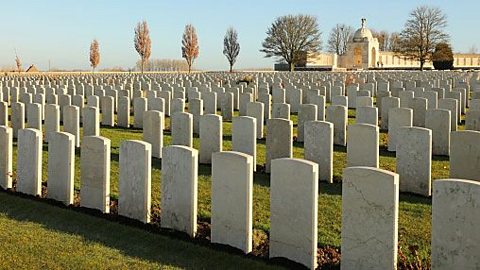
Poppies begins “Three days before An agreement or truce made by opposing sides in a war to stop fighting for a period of time. Sunday”. This is often called Remembrance Sunday and takes place every year on the second Sunday in November. It originally commemorated the end of World War One. It has since become about remembering all those lost in war.
Poppies grew on the fields in An area in Belgium where many soldiers died in World War One., Belgium, even after a lot of fighting there in World War One. In 1915, the poet, soldier and physician John McCrae, wrote a famous poem inspired by them called In Flander's Field. Poppies soon became a well-known symbol for remembering those lost in wars.
The poem
Poppies is about a parent reminiscing about their son – although it is Not having one obvious meaning. whether the son is alive or dead.
In the poem, the parent pins a poppy to their son’s blazer and gets rid of cat hairs on his clothes. They resist the urge to run their fingers through the boy’s hair before walking him to the front door. After the son leaves, the parent goes into his bedroom. The poem ends with the parent visiting a war memorial and tracing the names inscribed on it.
Jane Weir has two sons which may have inspired her to write about a parent and a son relationship in this poem. She also worked in textiles and frequently uses imagery of fabrics and fashion in her writing.
Interactive activity
Themes
Bravery
The parent in Poppies is brave in an unconventional way. Rather than facing physical pain as might be expected in war poetry, they experience emotional pain.
At the start of the poem, the parent holds back from treating the boy as if he is still a child. They want to “play at / being Eskimos like we did when / you were little” but resist the urge, knowing that the child is older now.
Likewise, rather than smother the boy with advice, they find their words “flattened, rolled” and “slowly melting” – the boy is old enough to make his own decisions and they don’t want to tell them what to do.
As the parent walks the boy to the door, they say “I was brave”. A simple sentence that emphasises the strength and love it takes to let their child grow up and make their own choices in life.

Love
The parent’s love for their child is Not depending on any conditions or rules.. The first two stanzas list special moments they have shared and build up an image of physical closeness and emotional dependency.
This contrasts with the second half of the poem, in which the parent is alone and more vulnerable: “without winter coat or reinforcements”. Even then, the parent is longing for their child. They lean against the war memorial which looks “like a wishbone” – suggesting the parent is wishing their child would come back.
It is unclear whether the boy is alive or not, the poem is deliberately ambiguous, but the memorial setting suggests he may have died at war. The parent is searching for a way to feel connected to him again and a place to channel their love.
Question
What is a wishbone?
Answer
A wishbone is the bone between the neck and breast of a bird. A popular tradition is for two people to pull either side of the bone until it breaks. The person with the bigger half is entitled to a wish.
Memories
Weir explores the parent’s Strong and clear., Relating to physical senses. The five senses are taste, touch, smell, sound and sight. memories in Poppies. Verbs like “pinned” and “smoothed” show the physical nature of their relationship.
Likewise, when the parent remembers cuddling their child, the memory is sensory – their noses “graze”.
"I wanted to graze my nose
across the tip of your nose, play at
being Eskimos like we did when
you were little”.
The When a vowel sound is repeated in words close together. in the repetition of “nose” and “Eskimos” is like an echo and reflects how important memories linger on and can be revisited time after time.
The poem ends with an aural memory – a wish to hear the son’s “playground voice catching on the wind” which is an intimate memory that emphasises the parent’s feeling of loss.
Mini quiz
Language
In poetry, language relates to anything in connection with words and the ways they are used.
Simile
A simile compares two things by saying they are alike in some way using “like” or “as”. For example:
the world overflowing like a treasure chest.
The idea of the world being an overflowing treasure chest suggests the excitement and potential that the future has for the son. It is full of riches and opportunities.
However, the fact that it is overflowing could suggest a sense of feeling overwhelmed for the parent. It suggests their uncontainable sadness at losing their child.
Metaphor
Weir uses a A metaphor is a word or a phrase used for dramatic effect, to describe something as if it were something else. in the third stanza of Poppies:
"After you’d gone I went into your bedroom,
released a song bird from its cage.”
This metaphor could be interpreted in a few ways.
“After you’d gone” could refer to the son leaving home, or the son dying – Weir leaves this as deliberately ambiguous.
The son could be the songbird. He has been “caged” with his mother and has now been set free.
Alternatively, the mother is the song bird and she is releasing her emotions – crying – at the loss of her son.
The full stop at the end of the metaphor suggests a sense of finality. It creates a deliberate pause to reflect the silence now that the parent is alone.
Sensory imagery
Weir’s use of sensory imagery throughout this poem helps to reinforce the parent’s vivid memories.
Touch is used. For example, the parent remembers “pinning” a badge to the child’s lapel, “smoothing” down their collar and tracing the Something marked on a surface or object. on the war memorial. The textile language of “lapel”, “blazer” and “hair” helps keep the feeling of intimacy between parent and child.
Sound is also used as the parent remembers how they “released a songbird” and listened for the child’s “playground voice”,
Question
What could you say about the use of touch and texture in this quote?
I resisted the impulse
to run my fingers through the gelled
blackthorns of your hair.
Answers
The parent longs to run their hands through their son’s hair. This is an intimate gesture and shows the close, physical bond that they share.
The fact that the parent resists doing this could show that they are trying to hide their sadness at the boy’s leaving.
It could also show an acceptance of the fact that he is growing up – his hair is “gelled” now and he doesn’t want it messed up.
“Blackthorns”, as their name suggests, are plants with dark coloured fruit and sharp thorns. This metaphor of the boy’s hair being “thorns” suggests that touching the boy’s hair might cause physical pain, as well as emotional pain, to the parent.
Structure
In poetry, structure relates to anything in connection to the layout and organisation.
Free verse
Free verse is a poem with no set rhyme or rhythm. This creates a feeling of freedom that is more similar to natural speech, so it sounds more like the parent is telling an authentic, personal story.
The lack of a set rhythm could also highlight the parent’s overwhelming emotions as their son leaves for war – it is unpredictable and unsteady.
Enjambment
A poetic device where a sentence continues beyond the end of the line or verse. is a poetic device in which a sentence continues beyond the end of the line or verse. For example:
“I was brave, as I walked
with you, to the front door, threw
it open, the world overflowing
like a treasure chest.”
Enjambment also makes the poem feel more like natural speech as it flows freely – unrestricted by line length.
In the example above, the parent is feeling particularly strong emotions about their child leaving and the use of enjambment could show the overflow of emotion and pain that they are feeling and struggling to contain.
Form
In poetry, form is the type of poem that the poet has chosen to write.
Dramatic monologue
A dramatic monologue is a speech or poem where one speaker describes their ideas, thoughts and feelings. Poppies uses this form as we learn about the parent’s thoughts and feelings from their own perspective.
Weir may have chosen this form to explore more closely how war affects the families of those who die. We are shown the feelings of a grieving parent, in detail yet in a soft and personal way.
Second person
Second person means that the speaker or writer speaks directly to the person or character they are addressing.
The parent in the poem speaks to their son throughout using the pronoun ‘you’. This creates a sense of closeness and familiarity – intimacy between parent and child.
Despite the parent speaking to their son throughout the poem, the son never replies. This creates a sense of sadness. The parent’s longing to be with their son again is clear, as is the feeling that the parent will, in many ways, never be able to fully let go of their child.
Top tips (AQA)

Remember
Read the question carefully. Highlight the key words and focus of the question.
Make a plan. Annotate the poem or create a short list of points you could make, supported by evidence. This will help you to stay focused and relevant.
Analyse features. When you identify a feature, always consider why it has been used and what effect it creates.
Reread your answer. Keep checking that you are on topic throughout the writing process.

Making comparisons
You will need to write your response using comparative connectives, such as:
Similarly
Likewise
However
In contrast
In the exam
This poem could be assessed in the anthology poetry part of the exam.
You will be asked to compare a named poem with a poem of your choice.
The choice must be from the cluster of poems you have studied. The named poem will be provided.
This question assesses AO1, AO2 and AO3:
| AO1 | AO1 assesses how well you can read, understand and respond to the text. This includes coming up with thoughtful and relevant ideas and backing these up with evidence. |
| AO2 | AO2 assesses your ability to explore the language, form and structure used by a writer to create meanings and effects. |
| AO3 | AO3 looks at how you can link the contextual background of the poem(s) into your ideas. |
Quiz
Test your understanding of the poem Poppies by taking this quiz
GCSE English literature revision podcasts. audio
Whether you're at home or on the go, listen to these podcasts by Bitesize and BBC Sounds to refresh your memory of key texts.

More on Poems
Find out more by working through a topic
- count3 of 5
- count1 of 5