Key points about festivals, customs and celebrations

There are many different festivals and celebrations in France and French-speaking countries.
French verbs are A verb that is not in the infinitive form but has been changed to match the subject of the verb, for example I go, he goes.meaning the verb ending changes to match the person doing the action.
The third person Refers to only one object or person.(on) and More than one of an item.(ils/elles) forms of the verb are useful for describing what people do when celebrating festivals.
This guide contains a video as well as listening and reading practice.
Video - Describing customs and traditions
Watch the video where Rachel visits the Belgian Comics Museum and eats Belgian waffles.
Rachel uses French verbs in the present tense to talk about customs and celebrations in Belgium
Aujourd'hui, nous visitons le Centre Belge de la Bande Dessinée.
Le centre a ouvert ses portes le 6 octobre 1989.
C'est dans les journaux et les magazines qu'on a vu une bande dessinée pour la première fois.
Quelle était la première bande dessinée ?
Les spécialistes ne sont pas tous d'accord mais on dit que c'est "The Yellow Kid".
Comme les bandes dessinées étaient imprimées sur du papier de mauvaise qualité, il était difficile de les préserver.
Avec plus de 700 artistes de bandes dessinées, la Belgique a plus d'artistes de bandes dessinées que n'importe quel autre pays dans le monde !
Maintenant qu’on a appris beaucoup de choses dans le Musée de la BD, j’ai un peu faim.
On va chercher un goûter ?
Le goûter traditionnel en Belgique c’est la gaufre.
Ils ont des crêpes en France et en Belgique nous avons les gaufres !!
Les Belges sont très fiers de leurs gaufres et ils aiment bien la fête.
Ils vont bientôt célébrer Halloween.
On le célèbre chaque année en octobre.
Le soir d’Halloween, j'ai l’habitude de regarder des films d’horreur avec mes amis.
Par contre, je n'aime pas avoir peur, parce que je ne peux pas dormir après !
Si c'est une fête un peu sinistre pour ceux qui n'aiment pas avoir peur, l'automne reste une très belle saison, ici en Belgique !
Bonjour, une gaufre à la cannelle, s’il vous plaît.
Merci beaucoup, au revoir.
C’est ma gaufre préférée mais il y a beaucoup de choix !
Qu’est-ce que tu mettrais sur ta gaufre ?
Translation
Today we’re visiting the Belgian Comic Strip Centre.
The centre opened its doors on October 6th 1989.
It was in newspapers and magazines that we saw a comic strip for the first time.
What was the first comic book?
The specialists don’t all agree but it’s said that it is "The Yellow Kid".
Since comics were printed on poor quality paper, it was difficult to preserve them.
With more than 700 comic strip authors, Belgium has more comic strip artists than any other country in the world!
After learning so much at the Comics Museum, I feel a bit peckish.
Should we go get a snack?
The traditional afternoon snack in Belgium is the waffle.
They have crêpes in France and in Belgium we have waffles !!
Belgian people are very proud of their waffles and they love a good celebration.
They'll soon celebrate Halloween.
We celebrate it every year in October.
On the evening of Halloween, I tend to watch horror movies with my friends.
On the other hand, I don't like being scared, because I can't sleep afterwards!
If it's a slightly sinister holiday for those who don't like to be afraid, autumn remains a very beautiful season here in Belgium!
Hello, can I have a cinnamon waffle please?
Thank you, goodbye.
This is my favourite waffle but there are lots of choices!
What would you choose on your waffle?
Useful vocabulary – Customs and celebrations
All vocabulary listed in this guide can be found on the vocabulary sheet below.
Useful vocabulary for talking about annual events and celebrations includes:
| French | English |
|---|---|
| Check your connection, refresh the page and try again. | Christmas |
| Check your connection, refresh the page and try again. | Christmas Eve |
| Check your connection, refresh the page and try again. | Easter |
| Check your connection, refresh the page and try again. | Valentine's Day |
| Check your connection, refresh the page and try again. | Tour de France |
| Check your connection, refresh the page and try again. | Bastille Day, French national holiday |
Useful vocabulary for describing other celebrations includes:
| French | English |
|---|---|
| Check your connection, refresh the page and try again. | bank holiday |
| Check your connection, refresh the page and try again. | party, festival |
| Check your connection, refresh the page and try again. | festival |
| Check your connection, refresh the page and try again. | wedding |
| Check your connection, refresh the page and try again. | civil partnership |
Other useful nouns and adjectives for describing celebrations include:
| French | English | French | English |
|---|---|---|---|
| Check your connection, refresh the page and try again./Check your connection, refresh the page and try again. | present/gift/presents/gifts | Check your connection, refresh the page and try again. | meal |
| Check your connection, refresh the page and try again. | to celebrate | Check your connection, refresh the page and try again. (masculine) | event |
| Check your connection, refresh the page and try again. | procession, parade | Check your connection, refresh the page and try again. | seafood |
| Check your connection, refresh the page and try again. | costume | Check your connection, refresh the page and try again. | to dance |
| Check your connection, refresh the page and try again. | to enjoy oneself, have a good time | Check your connection, refresh the page and try again. | show, fight |
| Check your connection, refresh the page and try again. | party, festival | Check your connection, refresh the page and try again. | tradition |
| Check your connection, refresh the page and try again. (masculine plural) | fireworks | Check your connection, refresh the page and try again. (masculine plural) | clothes |
Grammar - How to conjugate the third person of the verb

In French verbs are conjugated. This means the verb endings change to match the person doing the action. When describing what happens at festivals and celebrations, it is useful to use these parts of the verb:
on - one/you
ils/elles - they
For example:
On regarde des feux d’artifice. – One watches /you watch fireworks.
Elles célébrent dans la rue. – They (female) celebrate in the street.
Ils ouvrent des cadeaux. – They (male or mixed) open presents.

Remember
Use elles if the people in a group are all female and ils if they are all male or a mixture of male and female.
Regular verbs - Third person conjugation
Conjugating Something that follows the usual or ‘regular’ pattern. verbs in the present tense in the third person singular and plural:
| 3rd person singular/plural | er verbs | ir verbs | re verbs |
|---|---|---|---|
| regarder – to watch | ouvrir – to open | attendre – to wait for, to expect | |
| on - one/you | Check your connection, refresh the page and try again. - one watches | Check your connection, refresh the page and try again. - one opens | Check your connection, refresh the page and try again. - one waits for, expects |
| ils/elles - they | Check your connection, refresh the page and try again./Check your connection, refresh the page and try again. - they watch | Check your connection, refresh the page and try again./Check your connection, refresh the page and try again. - they open | Check your connection, refresh the page and try again./Check your connection, refresh the page and try again. - they wait for, expect |
Irregular verbs - Third person conjugation

Many commonly used verbs in French are Something that does not follow the usual or ‘regular’ pattern. including:
être - to be
avoir - to have
aller - to go
faire - to make/do
mettre - to put on
recevoir - to receive
For example:
On va en ville pour regarder les feux d’artifice. – One goes into town to watch the fireworks. / You go into town to watch the fireworks.
On reçoit des cartes de Valentin. – One receives Valentine cards. / You receive Valentine cards.
Les maisons sont décorées. – The houses are decorated.
Les gens font les défilés. – People hold (do) processions.
Click or tap on Show more to see how these key irregular verbs are conjugated in the third person singular and plural.
Être - to be
| Infinitive | English | 3rd person singular | 3rd person plural |
|---|---|---|---|
| être | to be | Check your connection, refresh the page and try again. - one is/you are | Check your connection, refresh the page and try again./Check your connection, refresh the page and try again. - they are |
| avoir | to have | Check your connection, refresh the page and try again. - one has/you have | Check your connection, refresh the page and try again./Check your connection, refresh the page and try again. - they have |
| aller | to go | Check your connection, refresh the page and try again. - one goes/you go | Check your connection, refresh the page and try again./Check your connection, refresh the page and try again. - they go |
| faire | to make/do | Check your connection, refresh the page and try again. - one makes/does/you make/do | Check your connection, refresh the page and try again./Check your connection, refresh the page and try again. - they make/do |
| mettre | to put on | Check your connection, refresh the page and try again. - one puts on/you put on | Check your connection, refresh the page and try again./Check your connection, refresh the page and try again. - they put on |
| recevoir | to receive | Check your connection, refresh the page and try again. - one receives/you receive | Check your connection, refresh the page and try again./Check your connection, refresh the page and try again. - they receive |
Using verbs in the third person - Mini quiz
Complete the sentence with the correct verb:
On _____ les cadeaux.
One gives / you give presents.
Donner - to give.
On donne des cadeaux.
Donner is a regular er verb and the on form ends in e.
Complete the sentence with the correct verb:
On _____ à l’église.
One goes / you go to church.
Aller - to go.
On va à l’église.
Aller is an irregular verb and the on form is va.
Complete the sentence with the correct verb:
Ils _______ dans les rues.
They dance in the streets.
Danser - to dance.
Ils dansent dans les rues.
Danser is a regular er verb so the ending in the ils is ent.
Complete the sentence with the correct verb:
Elles _____ des vêtements spéciaux.
They put on special clothes.
Mettre – to put on.
Elles mettent des vêtements spéciaux.
Mettre is an irregular verb and is mettent in the elles form.
Find out more about verbs in the present tense in the Present tense regular verbs and irregular verbs in French guides.
Listening practice
Listen to three people talking on a radio show about music festivals. For each speaker decide whether their opinion is positive or negative.
Click or tap on the purple START button when you are ready to begin the activity.
Vocabulary - Describing festivals
Useful vocabulary to describe festivals in France and the French-speaking world:
| French | English |
|---|---|
| J’adore Noël parce que j’aime donner et recevoir des cadeaux. | I love Christmas because I like to give and receive presents. |
| J’aime célébrer l’Aïd avec ma famille. | I like to celebrate Eid with my family. |
| À la Saint-Valentin, le 14 février, j’ai reçu deux cartes. | On Valentine’s Day, 14 February, I received two cards. |
| J’adore cette fête parce que j’aime la chasse aux œufs de Pâques. | I love this festival because I like Easter egg hunts. |
| J’adore regarder le défilé du 14 Juillet. | I love watching the parade on 14 July. |
| Le défilé a lieu le matin sur les Champs-Élysées. | The parade takes place in the morning on the Champs-Élysées. |
| Le Tour de France est un concours d'un mois pour les meilleurs cyclistes du monde. | The Tour de France is a month-long competition for the best cyclists in the world. |
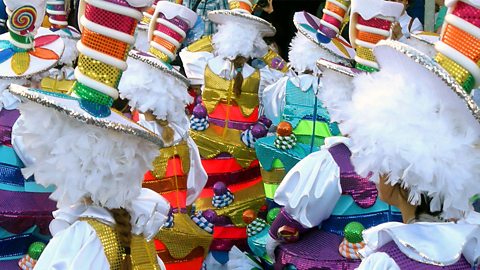
| Le Carnaval est une fête pleine de couleur et de bonheur. | Carnival is a celebration full of colour and happiness. |
Reading practice
Read the descriptions below and decide which festival is being described from the following options:
A. Noël
B. La Saint-Valentin
C. La Fête Nationale
D. Le Tour de France
E. Halloween
There is one option too many.
- Pendant l’été tous les ans en France il y a un grand concours de cyclisme. Les meilleurs cyclistes du monde, dans les équipes, y participent.
The answer is D – Le Tour de France – the Tour de France
Pendant l’été tous les ans en France il y a un grand concours de cyclisme. Les meilleurs cyclistes du monde, dans les équipes, y participent.
During the summer every year in France there is a big cycling competition. The best cyclists in the world, in teams, take part.
- Je n’aime pas cette fête parce que je n’ai pas de petite amie et je ne reçois jamais de cartes ni de cadeaux.
The answer is B – La Saint-Valentin – Valentine’s Day.
Je n’aime pas cette fête parce que je n’ai pas de petite amie et je ne reçois jamais de cartes ni de cadeaux.
I don’t like this festival because I don’t have a girlfriend and I never get any cards or presents.
- L’année dernière, je me suis déguisé en costume de fantôme et on m’a donné beaucoup de bonbons.
E – Halloween - Halloween.
L’année dernière, je me suis déguisé en costume de fantôme et on m’a donné beaucoup de bonbons.
Last year I dressed up in a ghost costume and I received lots of sweets.
- Le quatorze juillet est un jour férié en France. Il y a un défilé militaire sur les Champs-Elysées. On peut voir des feux d’artifices dans beaucoup de villes.
C – La Fête Nationale
Le quatorze juillet est un jour férié en France. Il y a un défilé militaire sur les Champs-Elysées. On peut voir des feux d’artifices dans beaucoup de villes.
July 14 is a public holiday in France. There is a military parade on the Champs-Elysées. You can see fireworks in many cities.
Vocabulary sheet
Click or tap on the image below to download for a list of useful vocabulary to use when describing festivals, customs and celebrations.

Now you have revised the important vocabulary and key grammar points for describing festival, customs and celebrations, why not have a look at the Describing the local area guide?
Revise for your exams with BBC Bitesize
Get ready for the GCSEs with quizzes, past papers, flashcards, podcasts and more resources!

More on Customs, festivals and celebrations
Find out more by working through a topic