Key points for religious celebrations and festivals in French

The ‘he’, ‘she’ and ‘they’ forms of the A word used to describe an action or state of being. are useful for describing how people celebrate religious festivals.
Use the ‘on’ form of the verb to mean ‘we’, ‘one’ or ‘they’ when describing the actions of other people.
Used to describe verbs and adjectives. describe verbs or An adjective is a word that describes a noun. In French, adjectives have different endings depending on whether the noun they are describing is masculine, feminine, singular or plural. and are useful for giving more detail about where, when or how something is done.
Vocabulary - Festivals and events
Useful vocabulary to describe different cultural and religious celebrations.
Cultural events
| French | English | French | English |
|---|---|---|---|
| une fête traditionnelle / historique | a traditional/historic festival | la Fête Nationale | Bastille Day, French national holiday |
| une fête locale / régionale / nationale / internationale | a local/regional/national/international festival | la Saint Valentin | Saint Valentine's Day |
| la Fête des Mères | Mother's day | un festival de musique | a music festival |
| la Fête des Pères | Father's day | un jour férié | a public holiday (bank holiday) |
| une expérience culturelle / spéciale | a cultural/special experience | le Nouvel An | New Year's Day |
For example:
J’aime envoyer des cartes de Saint Valentin le 14 février car c’est amusant ! - I like sending Valentine’s Day cards on 14 February because it’s fun!
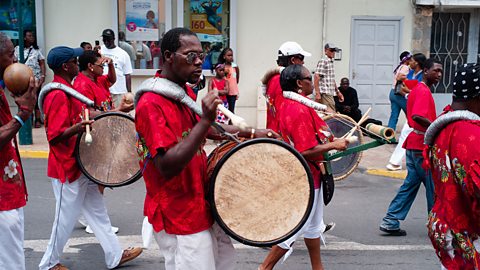
En France, on célèbre la Fête Nationale le 14 juillet – c’est un événement historique. - In France, they celebrate Bastille Day on 14 July – it’s an historical event.
Religious celebrations
| French | English | French | English |
|---|---|---|---|
| Check your connection, refresh the page and try again. | a Buddhist festival | Check your connection, refresh the page and try again. / Check your connection, refresh the page and try again. | the Festival of Lights/Diwali |
| Check your connection, refresh the page and try again. | a Christian festival | Check your connection, refresh the page and try again. (m) | Eid |
| Check your connection, refresh the page and try again. | a Jewish festival | Check your connection, refresh the page and try again. (m) | Hanukkah |
| Check your connection, refresh the page and try again. | a Muslim festival | Check your connection, refresh the page and try again. | a Hindu festival |
| Check your connection, refresh the page and try again. | a Sikh festival | Check your connection, refresh the page and try again. | Christmas |
| Check your connection, refresh the page and try again. | a religious event | Check your connection, refresh the page and try again. (f, pl) | Easter |

Remember
To say the date that something takes place, you don’t need a French word to translate ‘on’.
For example:
Le jour de Noël, c’est le 25 décembre. - Christmas Day is on 25 December.
Grammar - Using verbs to describe other people's actions

Use the il/elle/on (he/she/we) forms to talk about what he/she does or is doing or what we do or are doing.
For example:
Il mange trop de chocolat à Pâcques. - He eats too much chocolate at Easter.
Elle aime les fêtes traditionnelles. - She likes traditional festivals.
On célèbre toujours le Nouvel An ensemble. - We always celebrate New Year together.
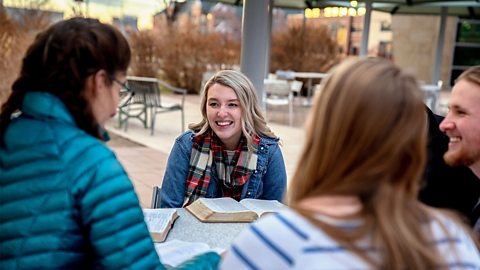
The on form is really useful as it can be used to mean ‘we’, ‘one’ or ‘they’ (in the sense of people generally).
For example:
Dans ma famille, on profite des jour fériés. - In my family, we make the most of bank holidays.
Use the ils/elles forms of verbs to talk about what 'they' do or are doing.
For example:
Ils vont au festival chaque année. - They go to the festival every year.
Elles préparent pour un événement religieux. - They are preparing for a religious event.
Common verbs in the 'he', 'she', 'they' forms
Remember that the present tense in French can also translate as ‘do’ or ‘are doing’ in English, depending on the context.
For example:
| French | English | French | English |
|---|---|---|---|
| il/elle est | he/she is | ils/elles sont | they are |
| il/elle a | he/she has | ils/elles ont | they have |
| il/elle va | he/she goes/is going | ils/elles vont | they go/are going |
| il/elle fait | he/she does/makes / is doing/making | ils/elles font | they makes/do / are doing/making |
| il/elle porte | he/she wears/is wearing | ils/elles portent | they wear/are wearing |
| il/elle mange | he/she eats/is eating | ils/elles mangent | they eat/are eating |
| il/elle regarde | he/she watches/is watching | ils/elles regardent | they watch/are watching |
| il/elle joue | he/she plays/is playing | ils/elles jouent | they play/are playing |
For example:
Elle mange du gâteau parce que c'est son anniversaire. - She is eating because it is her birthday.
Il va au festival de musique avec ses amis. - He is going to a music festival with his friends.
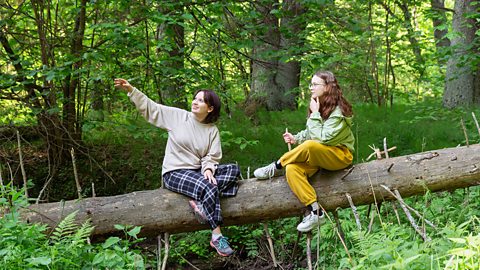
Elles font une promenade à la campagne car c'est un jour férié. - They are going for a walk in the countryside as it is a bank holiday.
Describing the actions of others - Mini quiz
Translate the following present tense verbs into French.
They go / are going.
Ils vont/Elles vont
Use elles for a feminine group of people and ils for a masculine or mixed group.
Ils vont/Elles vont can translate as ‘they go’ or ‘the are going’ in English.
She does/makes.
Elle fait.
This is the correct form of the verb to translate ‘she does/makes’ as well as ‘she is doing / is making’.
We are.
On est.
You can use on to mean ‘we’ as this form of the verb is often easier to remember than the nous form (eg nous sommes – we are).
He is wearing.
Il porte.
This is the correct form of the verb to translate ‘he is wearing’ as well as ‘he wears.
Reading practice

Read the descriptions below and decide which of the following festivals is being discussed by each person.
A. Christmas
B. Valentine's Day
C. Easter
D. Bastille Day
E. New Year's Day
There is one option too many.
- C’est ma fête préférée car ma famille me donne beaucoup de chocolat. Aussi, pour moi, c’est la fin de l’hiver et le début du printemps.
The answer is C - Easter.
Translation
It’s my favourite festival because my family gives me chocolate. Also, for me, it is the end of winter and the beginning of spring.
- Je n’aime pas cette fête d’amour parce que je n’ai pas de copine et je ne reçois jamais de cartes ou de cadeaux.
The answer is B - Valentine's Day.
Translation
I don’t like this festival of love because I don’t have a girlfriend and I never get any cards or presents.
- Ma famille célèbre le premier jour de l’année avec un grand repas. Ma sœur écrit toujours ses projets et ses espoirs pour les mois à venir. C’est un bon moment pour réfléchir.
The answer is E - New Year’s Day.
Translation
My family celebrate the first day of the year with a big meal. My sister always writes down her projects and hopes for the months to come. It’s a good time to reflect.
- Le 14 juillet, c’est la Fête Nationale pour les Français. C’est très historique. Les gens ne travaillent pas – c’est un jour férié.
The answer is D - Bastille Day (French national holiday).
Translation
The 14 July is a Bastille Day for the French. It’s very historic. People don’t work – it’s a public holiday.
Vocabulary - Places and activities
Useful vocabulary for describing how religious and cultural events are celebrated.
Places
| French | English |
|---|---|
| Check your connection, refresh the page and try again. | at church |
| Check your connection, refresh the page and try again. | at the mosque |
| Check your connection, refresh the page and try again. | at the synagogue |
| Check your connection, refresh the page and try again. | at the temple |
| Check your connection, refresh the page and try again. | in the streets |
| Check your connection, refresh the page and try again. | at home |
For example:
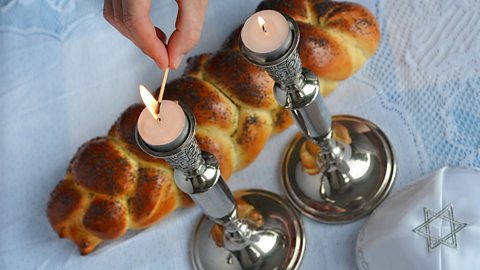
Pour célébrer l’Aïd, on prie à la mosquée et on donne des cadeaux aux enfants. – To celebrate Eid, we pray at the mosque and give presents to children.
Tous les vendredis, on mange un repas spécial ensemble et tous les samedis, on va à la synagogue. – Every Friday, we eat a special meal together and every Saturday, we go to the synagogue.
Activities
| French | English | French | English |
|---|---|---|---|
| regarder des feux (m, pl) d’artifice | watch fireworks | aller à un concert | go to a concert |
| chanter les chansons traditionelles | sing traditional songs | participer à un défilé | take part in a parade/procession |
| partager un grand repas | share a big meal | préparer un gâteau spécial | prepare a special cake |
| organiser une fête de famille | organise a family party | porter de nouveaux vêtements | wear new clothes |
| regarder un spectacle son et lumière | watch a sound and light show | donner et recevoir des cadeaux ou de l’argent | give and receive presents or money |
| danser avec des amis | dance with friends | prier à Dieu / aux dieux | pray to God / to the gods |
For example:
Pour le carnaval, nous dansons dans la rue et après, il y a des feux d’artifices. – For the carnival, we dance in the streets and afterwards, there are fireworks.
Remember
Une fête has two meanings:
festival
party
All Foundation Tier vocabulary listed in this guide can be found on the vocabulary sheet below.
Grammar - What are adverbs in French?
Used to describe verbs and adjectives. describe a A word used to describe an action or state of being. or An adjective is a word that describes a noun. In French, adjectives have different endings depending on whether the noun they are describing is masculine, feminine, singular or plural. , giving information about where, when or how something is done.
How to form regular adverbs
To make an adverb, take the feminine singular form of an adjective and add ment.
For example:
- finale (feminine singular of final, meaning final) becomes finalement (finally).
If an adjective ends in a vowel, use the masculine form and add ment.
Fo example:
- vrai (real) becomes vraiment (really)
If an adjective ends in ent, remove the ending and add emment.
For example:
- récent (recent) becomes récemment (recently)
If an adjective ends in ant, remove the ending and add amment.
For example:
- étonnant (surprising, amazing, incredible) becomes étonamment (surprisingly, amazingly, incredibly)
How to form irregular adverbs

The following adjectives are irregular when they become adverbs. Instead of adding ment, they become new words. For example;
bon (good) becomes bien (well)
mauvais (bad) becomes mal (badly)
meilleur (better) becomes mieux (better)
For example:
Il chante bien. - He sings well.
Hier, il a mal chanté parce qu’il était malade. - Yesterday, he sang badly because he was ill.
J’espère qu’il va mieux chanter demain. - I hope he will sing better tomorrow.
Adverbs of time and frequency
To give more information about when or how often something happened or is happening, use an adverb of time or frequency. These inlcude:
| French | English | Example |
|---|---|---|
| Check your connection, refresh the page and try again. | today | Aujourd’hui, c’est mon anniversaire. - Today it is my birthday. |
| Check your connection, refresh the page and try again. | soon | Elles vont arriver bientôt. - They are going to arrive soon. |
| Check your connection, refresh the page and try again. | tomorrow | Nous allons au temple demain. - We are going to the temple tomorrow. |
| Check your connection, refresh the page and try again. | at the moment | Je ne suis pas très content en ce moment. - I’m not very happy at the moment. |
| Check your connection, refresh the page and try again. | now | On est à la maison maintenant. - We are at home now. |
| Check your connection, refresh the page and try again. | yesterday | Il a prié hier. - He prayed yesterday. |
| Check your connection, refresh the page and try again. | often | Je vais souvent à l’église. - I often go to church. |
| Check your connection, refresh the page and try again. | always | Nous mangeons toujours ensemble. - We always eat together. |
Adverbs of place
Use an adverb of place to add information about where something happened or is happening. These include:
| French | English | Example |
|---|---|---|
| Check your connection, refresh the page and try again. | outside | Les enfants ne veulent pas jouer dehors parce qu’il pleut. - The children don’t want to play outside because it’s raining. |
| Check your connection, refresh the page and try again. | here | Il va venir nous voir ici. - He’ll come and see us here. |
| Check your connection, refresh the page and try again. / Check your connection, refresh the page and try again. | there/over there | Tu vois l’arbre là(-bas) ? - Do you see that tree (over) there? |
Adverbs - Mini quiz
Choose the adverb that is the odd one out from each set of options.
Press Start to begin the activity.
Find out more about using adverbs in the Adverbs in French guide.
Listening practice
Listen to Anaïs, Tosin and Alex talking about customs and festivals and choose the correct option to answer the questions.
- On Christmas Eve (24 December), where do Anaïs and her family eat?
| A | At their neighbours’ house. |
| B | At home. |
| C | At a restaurant. |
The answer is B.
On prépare un repas spécial à la maison et on invite nos voisins à manger chez nous. - We prepare a special meal at home and invite our neighbours to eat at our house.
- What do they do in the evening?
| A | Sing traditional songs. |
| B | Open all their presents. |
| C | go to church. |
The answer is C.
Nous allons toujours à l’église. - We always go to church.
Where does Tosin like to spend bank holidays?
| A | At home. |
| B | Shopping. |
| C | On an outing. |
The answer is C.
On part souvent en voiture pour passer la journée à la campagne ou à la mer. - We often drive to the countryside or to the seaside for the day.
- Who does Tosin see bank holidays as a good chance to spend time with?
| A | With friends. |
| B | With family. |
| C | On his own. |
The answer is B.
C’est une bonne occasion d’être ensemble en famille. - It’s a good opportunity to be together as a family.
- What does Alex do to celebrate New Year?
| A | Watches the fireworks on TV. |
| B | Goes out with her boyfriend. |
| C | Dances all night. |
The answer is C.
… à minuit et puis nous dansons jusqu’au petit déjeuner. - … at midnight and then we dance until breakfast.
- What happens every year?
| A | A show in the main square. |
| B | A dance competition. |
| C | There is free food. |
The answer is A.
Chaque année, il y a un spectacle son et lumière dans la place principale. - Every year, there is a sound and light show in the main square.
Click or tap on Show more to read the transcripts and translations.
Transcript
Salut. Je m’appelle Anaïs. Dans ma famille, Noël est un moment de plaisir parce qu’on est ensemble. Le 24 décembre, on prépare un repas spécial à la maison et on invite nos voisins à manger chez nous.
Le soir, nous allons toujours à l’église. C’est une tradition catholique. Puis, on ouvre seulement un de nos cadeaux avant de se coucher.
Translation
Hi, I’m called Anaïs. In my family, Christmas is a time of pleasure because we are together. On 24 December, we prepare a special meal at home and invite our neighbours to eat at our house. In the evening, we always go to church. It’s a Catholic tradition. Then, we open just one of our presents before going to bed.
Transcript
Moi, c’est Tosin. Nous, les Français, on adore les jours fériés. Tous les magasins sont fermés et c’est une bonne occasion d’être ensemble en famille. On part souvent en voiture pour passer la journée à la campagne ou à la mer.
Translation
I’m Tosin. We French people love bank holidays. All the shops are shut and it’s a good opportunity to be together as a family. We often drive to the countryside or to the seaside for the day.
Transcript
Je m’appelle Alex. Pour célébrer le Nouvel An, je sors en ville le 31 décembre avec mes copines. Chaque année, il y a un spectacle son et lumière sur la place principale. Nous regardons les feux d’artifice à minuit et puis nous dansons jusqu’au petit déjeuner !
Translation
I’m called Alex. To celebrate the New Year, I go out in town on 31 December with my girlfriends. Every year, there is a sound and light show in the main square. We watch the fireworks at midnight and then we dance until breakfast.
Vocabulary sheet
Click or tap on the image below for a list of useful vocabulary to use when describing religious festivals and celebrations.

Higher Tier - Vocabulary - Festivals and celebrations
Useful vocabulary for talking about religious festivals and celebrations includes:
| French | English |
|---|---|
| Check your connection, refresh the page and try again. | a Catholic festival |
| Check your connection, refresh the page and try again. | Festival of the Kings (Epiphany) |
For example:
En France, on célèbre la Fête des Rois. - In France, they celebrate the Festival of the Kings.

Did you know?
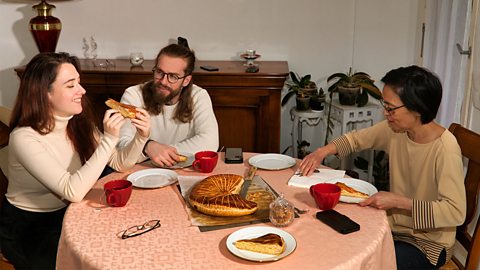
Epiphany (6 January) is known in France as la Fête des Rois - the Festival of the Kings.
Bakeries sell a cake called une Galette des Rois (a King’s Cake), which contains a hidden charm.
Whoever receives the piece of cake with the charm in it, becomes the king or queen for the day, and wears a cardboard crown.
All Higher Tier vocabulary listed in this guide can be found on the vocabulary sheet below.
Higher Tier - Vocabulary sheet
Click or tap on the image below for a list of useful Higher Tier vocabulary to use when describing religious festivals and celebrations.
Now you have revised the important vocabulary and key grammar points for describing religious festivals and celebrations, why not try have a look at the Describing issues in society and possible solutions guide?
Revise for your exams with BBC Bitesize
Get ready for the GCSEs with quizzes, past papers, flashcards, podcasts and more resources!

More on Customs, festivals and celebrations
Find out more by working through a topic