What are magnets?
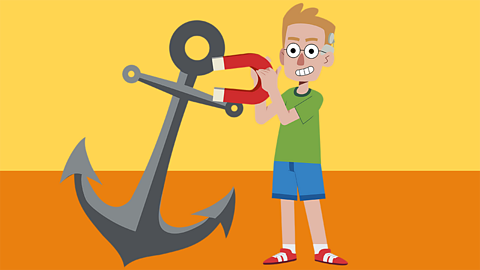
A magnet is a metal that can attract (pull) or repel (push) other types of metals.
Every magnet is a metal, but not all metals are magnets.
The force of magnets is called magnetism.
Magnetism can work over a distance.
This means that a magnet does not have to be touching an object to pull or push it.
Magnets have many practical uses, like keeping doors shut and moving heavy objects, but they can be really fun as well!
Watch: How to use a magnet
Magnets can be really useful but you need to use them in the right way. Watch the clip below to see how magnets are used.
Learn about magnets and their many uses.
Phew, that was close! Lucky these were here really.
They look like magnets, yes look they’ve got two poles. A north and a south.
Even if the magnets aren’t touching, they can exert a force on each other.
Are you stuck? The opposite poles of a magnet attract one another, and poles that are the same – south and south for example – repel one another.
I bet you guys use magnets every day. They’re in handbags, fridges, compasses…
Compasses?
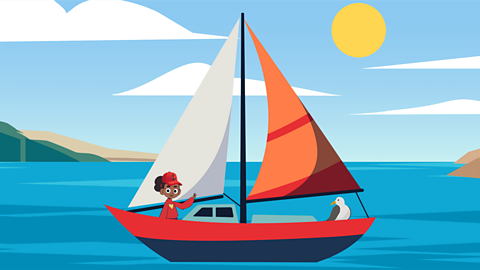
Of course! Sailors have been using magnets in compasses to navigate for hundreds of years.
If the magnets can move freely, it will always show which way is north.
There’s land, you found it. Head north!
Er… maybe we should see what’s south instead!
Magnificent magnet facts
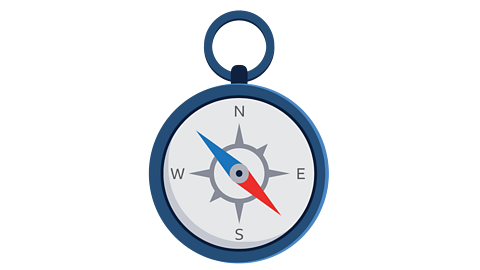
Magnets are used in compasses and many other everyday applications.
One end of a magnet is a called a north pole and the opposite end is a south pole.
If you hold two magnets together at the same pole (north to north, or south to south) their magnetic fields will repel each other and force the magnets apart.
Only three metallic elements are magnetic: iron, cobalt and nickel.
We measure magnetism in units called a tesla, named after the engineer and scientist Nikola Tesla.
The ancient Greeks discovered that some rocks, called lodestones, produce their own magnetic field. Lodestones are made of the mineral magnetite, which contains iron.
The Large Hadron Collider (LHC) in Geneva, Switzerland is made up of around 6,000 superconducting magnets that can conduct science experiments by smashing atoms together at very high speeds.
How do magnets work?
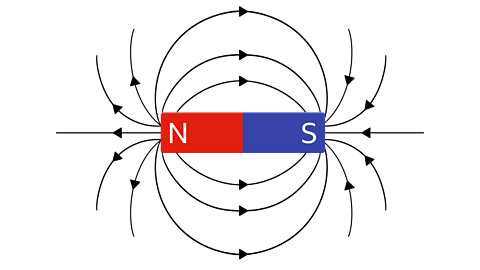
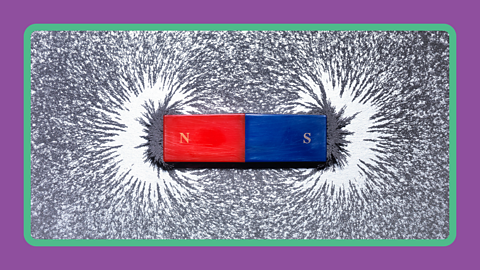
Magnets have two ends. We call these their north pole and south pole.
When two of the same poles are placed close together they repel (push apart) each other. When two different poles are close, they attract (pull together) each other.
Magnets only need to be near each other to attract and repel. They don't need to be touching.
The space around a magnet has attracting and repelling forces. These forces are strongest at the poles of the magnets.
Did you know?
The Earth is a large magnet
The Earth’s core is made up of mostly iron and nickel, which has given the Earth its own magnetic field, with both a north and south-facing pole.
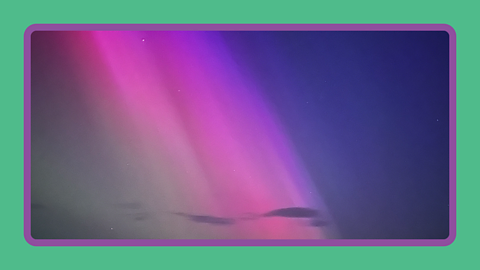
When the Sun's particles collide with the Earth's magnetic field, this can cause the multi-coloured aurora borealis (or northern lights) to be seen in the sky.
Important words
Attract – When something attracts another thing, it pulls them together. Magnets attract metal objects.
Compass - A tool for navigating which has a magnetised needle pointing North, East, South and West.
Magnet – A magnet is a metal that can attract (pull) or repel (push) other types of magnetic metals.
Magnetic field - The area around a magnet in which a magnetic force is active.
Magnetism – The force exerted by magnets when they attract or repel each other.
Pole - In a magnet, one end is attracted to the Earth's magnetic north pole and another is attracted to the Earth's magnetic south pole.
Pull – Using force to move something towards you.
Push – Using force to move something away from you.
Repel – To force or drive something or someone back.
Activities
Activity 1 – Magnetic attraction
Activity 2 – Quiz
Activity 3 – Magnetic maze
Create your own magnetic mazes with this activity in partnership with the Science Museum Group
Click on the banner below to open the instructions.
Magnetic mazes. document
Create your own magnetic mazes in partnership with the Science Museum Group.
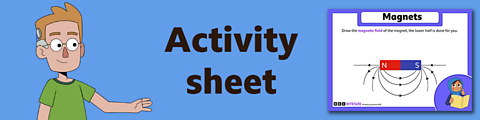
Activity 4 – Draw the magnetic field
New game! Horrible Science: Stinky Space. game
Join Pipette on her epic mission and learn some revolting facts about space along the way.
More on Forces
Find out more by working through a topic
- count2 of 6
- count3 of 6
- count4 of 6
- count5 of 6