What is the Moon?
A moon is a natural satellite which orbits a planet.
Mercury and Venus do not have moons, but all the other planets in our Solar System do. Mars has two moons while Saturn has a whopping 274 moons in its orbit.
Earth only has one moon (the Moon!) which we can see in our night sky a lot of the time. It is a lot smaller and closer to the Earth than the Sun.
It takes the Moon 27 days and 7 hours to orbit the Earth.
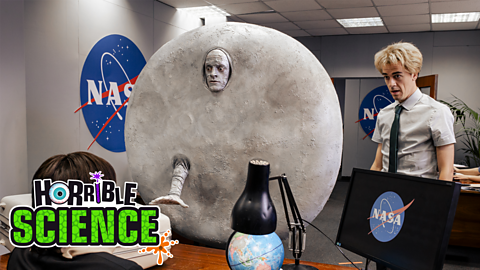
Watch: The Moon Wants A Day Off
Find out what the moon does and decide whether it deserves a day off.
MOON: "Out of my way Lesley."
LESLEY: "General! I’m so sorry, he barged his way in."
MOON: "Sup!"
LESLEY: "Shall I call security?"
MOON: "Shall I call the fashion police? Because you’ve been wearing the same style for a decade."
LESLEY: "It’s called business casual."
GENERAL KELLY: "OK, stop Moon, what is all this about?"
MOON: "I’ve come to book some time off."
GENERAL KELLY: "Wait you want a vacation?"
MOON: "Yeah I’ve been orbiting the Earth for 4.5 billion years, ever since I was formed from bits of debris after something collided with the Earth. I don’t know what – I was a baby!"
MOON: "Anyway bye bye Earth I’m off travelling see ya."
GENERAL KELLY: "You can’t ‘go travelling’, you orbit a planet. That’s what moons do!"
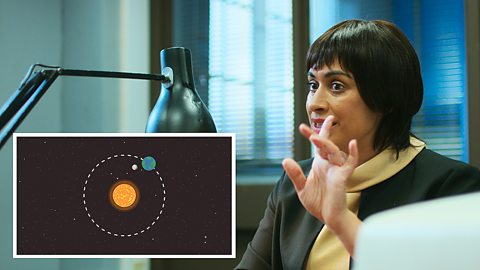
MOON: "OK, hear me out. Normally I take 27 days and about 7 hours to orbit the Earth. Right? Are you watching?’"
GENERAL KELLY: "Yes, and the Earth takes 365 days and 6 hours to orbit the Sun. We’re stuck that way. What’s your point?"
MOON: "What if I was to orbit faster! Faster, yeah faster, faster. See I reckon I could do it in about 21 days, which would give me six spare days, I mean did someone say weekends off. Yeah stop that Lesley."
GENERAL KELLY: "Yes stop that Lesley. Look you can’t have weekends off, you can’t go on vacation, you just can’t leave. You are stuck in the Earth’s gravitational pull and it has been like that for billions of years."
MOON: "It feels like sooo much longer! Did you know that because of the way I rotate as I’m orbiting the Earth it’s always been the same half of me that’s facing you, I mean I've had the same view for billions of years. Which I realise, not a disaster for you guys cause you get to look at all of this."
GENERAL KELLY: "Moon I can’t help you, this meeting is over, Lesley show him the door."
MOON: "I know, I know the way out. Aw you’ve got a picture of me. That’s why you don’t want me to leave, I’ll sign it. Lesley write this down, dear Lesley buy new clothes, bye."
LESLEY: "It’s workwear."
MOON: "Whatever."
LESLEY: "I look good."
How do we see the Moon?
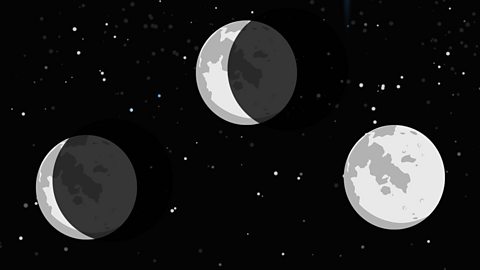
The Moon reflects light from the Sun which is why we can see it.
As it orbits the Earth, light from the Sun reflects on different angles of the moon.
It appears to change shape as we see different parts of the surface lit up.
These shapes are called the phases of the moon.
Did you know?
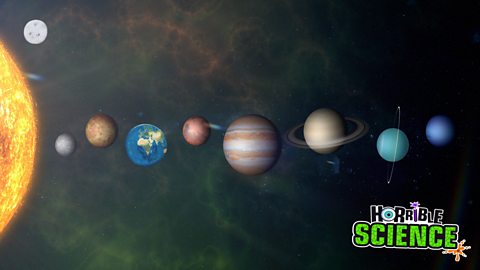
You know all about Earth and the Moon - there are seven other planets to find out about?
You can learn about them here by singing along to the planets song.
Quiz: Does the moon deserve a day off?
How to use Horrible Science in the classroom
If you're looking to bring energy, humour and curriculum-aligned content into your science lessons, Horrible Science might just be your new secret weapon.
More on Horrible Science
Find out more by working through a topic
- count7 of 22
- count9 of 22
- count10 of 22