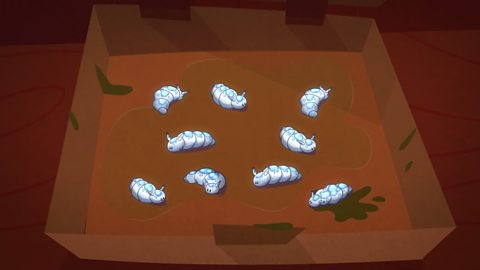
Fin, Snoot and Plimble use multiplication to find out how many meebs they have for chess.
NARRATOR: Hello Snoot. Hello Fin.
Hello cousin Plimble.
PLIMBLE: Plimble!
NARRATOR: What's that game you're playing?
ALL: (ALIEN LANGUAGE)
NARRATOR: Meeb chess…
Interesting.
And what exactly is a meeb?
SNOOT: Meeb!
NARRATOR: I see…
How many meebs have you got?
That’s 1… 2… 3… 4… 5… for Snoot, 6 for Fin and 6 for Plimble.
PLIMBLE: Plimble!
NARRATOR: How many is that altogether?
SNOOT: Erm… Hmm…
NARRATOR: Well, if there are 3 players, and 6 meebs for each player, it’ll be 3 times 6, which equals 18.
FIN: (ALIEN LANGUAGE)
NARRATOR: OK Fin, don’t get excited!
How would you work it out?
There’s 6 meebs per player, and 3 players, so you prefer to multiply 6 times 3, which also equals… 18.
BOTH: Aha!
The fact is, it doesn’t matter which way round you do it when you multiply.
You can do 3 times 6 or 6 times 3, it still makes 18 every time.
So, who’s going first in this exciting game?
PLIMBLE: (SNORING)
NARRATOR: Ah…
Can you play with just two?
Which way round?
It doesn't matter which way round you multiply numbers. The answer is always the same.
2 x 3 is always the same as 3 x 2
Try it out by arranging objects into groups. Start with 2 groups of 3. Then rearrange this into 3 groups.
How many are in each group?
Quiz
Which order should I multiply numbers in? video
Fin and Snoot use multiplication to help them pack for a holiday.
How can I multiply a group of numbers? video
Snoot is shopping for blobs and eyeballs. He uses multiplication to find their total cost.
Find more 1st Level resources from BBC Bitesize
First Level is a stage of Scotland’s Curriculum for Excellence.

More on Numbers and number processes
Find out more by working through a topic
- count18 of 25
- count19 of 25
- count20 of 25
- count21 of 25