TOURIST ONE: I knew she’d be here. I saw a scaly tail.
TOURIST TWO: Turned out to be a part of Nessie.
NARRATOR: A relative clause adds to a sentence by using a pronoun.
You saw a scaly tail, ‘that’ turned out to be a part of Nessie.
Let’s try again.
You found Nessie on that tree.
You found the lake.
So you could say, you found Nessie on that tree ‘which’ is by the lake.
The relative pronoun is ‘which’, because you’re talking about the tree where Nessie is. It’s relative to the tree.
And the relative clause ‘which is by the lake’, is adding to what you know already.
NESSIE: (Sneeze)
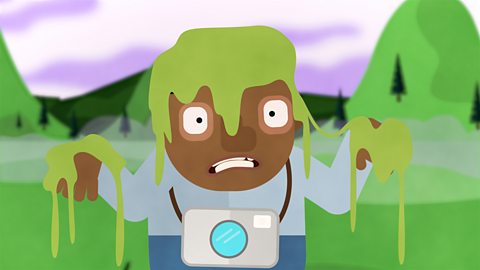
TOURIST ONE: Argh!
Description
A relative clause can be used to give additional information about a noun. They are introduced by a relative pronoun like ‘that’, ‘which’, ‘who’, ‘whose’, ‘where’ and ‘when’.
Now playing video 6 of 8
- 1 of 8
- 2 of 8

- 3 of 8
- 4 of 8