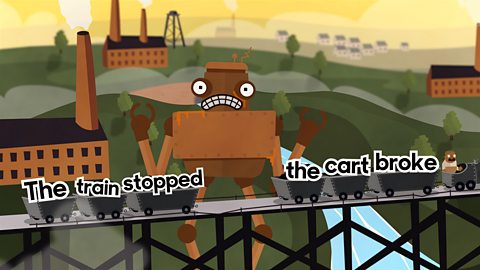
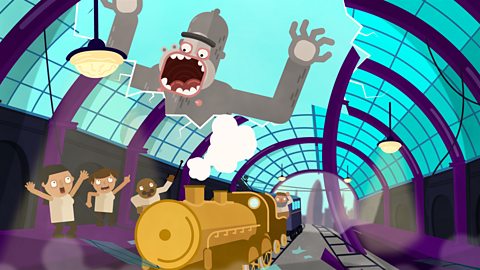
TRAIN DRIVER: Stop, stop! This sentence is broken.
NARRATOR: Ah. Let’s take a look… aah, you need a new subordinating conjunction.
TRAIN DRIVER: Oh, of course… Er, what are they?
NARRATOR: A subordinate conjunction joins two ideas or clauses in a sentence. The two ideas or clauses here are, “The train stopped” and “the cart broke.”
ROBOT: (Fart)
NARRATOR: Good choice, my gassy friend. We could join those ideas or clauses with “because.” The train stopped because the cart broke. Now we have one longer sentence. Err, hang on a minute. You could use any of these here: “as soon as,” “when,” “after” - there are loads. And they work in different ways. They show when something happens, why it happens, or even where. I fixed the train so that I could eat. Now you get it.
ROBOT: (Whistle)
Description
A conjunction is a word, or words, used to connect two clauses together. Words such as ‘although’, ‘because’ or ‘when’ .
A subordinate clause is a part of a sentence that adds additional information to the main clause.
A subordinating conjunction is simply the word/words that is used to join a subordinate clause to another clause or sentence. For example:
He was annoyed, the train had stopped.
By adding ‘because’ we can link the subordinate clause ‘the train had stopped’ with the main clause ‘He was annoyed’.
He was annoyed because the train had stopped.
Now playing video 5 of 8
- 1 of 8
- 2 of 8
- 3 of 8
- 4 of 8