Key points about food and drink choices in French
Use Means ‘a’ or ‘an’. Indefinite articles change depending on whether the nouns they go with are masculine or feminine., Means 'the'. Definite articles change depending on whether the noun it goes with is masculine, feminine, singular or plural. or partitive articles ('some' or 'any') when talking about food and drink.
Verbs such as commencer (to start) and continuer (to continue) are followed by à.
Verbs such as arrêter (to stop) and éviter (to avoid) are followed by de.
This guide contains listening activity and a Higher Tier reading.
Vocabulary – Talking about mealtimes and food

Did you know?
An after-school snack is often called un quatre-heures because it’s eaten around 4 pm.
Click or tap on Show more to see useful vocabulary for describing what you eat and drink for different meals.
There are some words provided below that are not on the set vocabulary list but which are easy to remember in French (eg, cereal, biscuits, pizza, salad).
Breakfast
| French | English |
|---|---|
| Je prends le petit déjeuner à sept heures. | I have breakfast at 7 am. |
| Au petit déjeuner, je mange des céréales avec du lait. | For breakfast, I eat cereal with milk. |
| Aujourd’hui, mon père a mangé du pain et un fruit. | Today, my dad had bread and a piece of fruit. |
| Ma mère boit du thé mais moi, je bois du café. | My mother drinks tea but I drink coffee. |
| Ma sœur mange des œufs chaque matin et elle boit du chocolat chaud. | My sister eats eggs every morning and she drinks hot chocolate. |
Lunch
| French | English |
|---|---|
| Je déjeune à une heure. | I have lunch at 1 pm. |
| Je vais prendre une baguette. | I'm going to have a baguette. |
| Je bois toujours de l’eau. | I always drink water. |
| Le weekend, on achète des frites. | At the weekend, we buy chips. |
| Mon frère n’aime pas le fromage | My brother doesn’t like cheese. |
| Tous les jours, je prends des fruits. | Every day I have some fruit. |
Snack
| French | English |
|---|---|
| Je prends un quatre-heures après l’école. | I have a snack after school. |
| Quand nous étions petits, nous mangions beaucoup de gâteaux. | When we were little, we used to eat lots of cakes. |
| Je voudrais trois biscuits car j’ai très faim. | I’d like three biscuits because I’m very hungry. |
Evening meal
| French | English |
|---|---|
| Je prends le dîner à six heures et demie. | I have dinner at 6.30 pm. |
| J’aime manger les pâtes ou le riz. | I like eating pasta or rice. |
| Nous mangeons des repas végétariens plusieurs fois par semaine. | We eat vegetarian meals several times a week. |
| Si ma mère travaille, on prépare une pizza avec de la salade. | If my mum is working, we prepare pizza with salad. |
| Pour terminer, nous prenons souvent de la glace. | To finish, we often have ice cream. |
Remember that the verb prendre (to take) is used with mealtimes and food to say what you are having.
Grammar – Using articles with food and drink

When talking about food, you might need to use one of the following types of article:
the indefinite article - un or une (a or an)
the definite article - le, la, l’, les (the)
the partitive article - du, de la, des, de l’ (some, any)
Using indefinite articles
Use indefinite articles (un, une) to talk about an individual item of food or one drink.
For example:
Je mange un fruit. - I’m eating a piece of fruit.
Elle va acheter une glace. - She is going to buy an ice cream.
Using definite articles
Use definite articles (le, la, l’, les) to talk about food and drink in general and after verbs of preference.
For example:
J’aime les glaces. - I like ice-cream.
Je déteste la viande – je préfère le poisson. - I hate meat – I prefer fish.
Using partitive articles
Partitive articles are the words ‘some’ and ‘any’. Use these to refer to an unknown quantity of something.
In French, the partitive article is formed with de (‘of’) and the definite article (‘the’).
The partitive article changes depending on whether the noun it goes with is masculine, feminine, starts with a vowel or a silent h, or plural.
| masculine | feminine | before a vowel or silent h | plural |
|---|---|---|---|
| de + le → du | de la | de l' | de + les → des |
Partitive articles are often used to talk about food and drink with verbs including:
| Verb in the infinitive | Example |
|---|---|
| manger - to eat | Je mange du riz. - I eat (some) rice. |
| boire – to drink | Elle a bu de l’eau. - She drank (some) water. |
| prendre – to take/have | On va prendre des bananes. - We are going to take (some) bananas. |
| faire – to do | J’ai fait des gâteaux. - I made (some) cakes. |
| avoir – to have | Nous avons de la glace pour ce soir. – We have (some) ice cream for tonight. |
| préparer – to prepare | Ils ont préparé du poisson. – They have prepared (some) fish. |
| acheter – to buy | Je voudrais acheter du sucre. - I would like to buy (some) sugar. |
Negative verbs
When using negative expressions use de without the article (le, la, l’ or les).
Negative expressions include:
ne … pas - not any
ne … plus - no more
ne … jamais - never
For example:
Il n’y a pas de lait. - There isn’t any milk.
Mon ami ne boit jamais d’eau minérale. - My friend never drinks mineral water.
Expressions of quantity
Use expressions of quantity with the article, eg Je manage beaucoup de salade - I eat a lot of salad
With expressions of quantity use de without the article (le, la, l’ or les).
Expressions of quantity include:
beaucoup de - a lot of
trop de - too much / too many
plus de - more
For example:
Il y a beaucoup de légumes au marché. - There are a lot of vegetables in the market.
J’ai bu trop de café aujourd’hui. - I have drunk too much coffee today.
Je voudrais un peu plus de sucre, s’il vous plaît. - I would like a bit more sugar, please.
Mini quiz - Using articles
Translate the following sentences into French.
I would like an ice-cream, please.
Je voudrais une glace, s’il vous plaît.
Use the indefinite article to mean ‘a’ or ‘an’.
I don’t like vegetables.
Je n’aime pas les légumes.
Use the definite article to talk about something in general.
They ate too many cakes.
Ils ont mangé trop de gâteaux.
Use de after expressions of quantity, like ‘too many’.
Find out more about using indefinite and definite and partitive articles in the Gender, nouns and articles guides.
Vocabulary - Talking about making healthy food and drink choices
Useful phrases to describe eating healthily include:
| French | English | French | English |
|---|---|---|---|
| Je suis devenu(e) végan(e). | I became vegan. | J’évite de manger trop de fastfood. | I avoid eating too much fast food. |
| Ma famille est végétarienne. | My family is vegetarian. | Nous avons commencé à manger plus tôt, le soir. | We have starting eating earlier in the evening. |
| On mange de la viande seulement deux fois par semaine. | We eat meat only twice a week. | On doit manger des légumes tous les jours. | You must eat some vegetables every day. |
| En général, je mange assez sainement. | In general, I eat quite healthily. | Ce n’est pas une bonne idée de manger entre les repas. | It’s not a good idea to eat between meals. |
Useful phrases to describe making healthy drink choices include:
| French | English |
|---|---|
| Je bois beaucoup de thé vert. | I drink a lot of green tea. |
| Mon frère a arrêté de boire du café le soir. | My brother has stopped drinking coffee in the evenings. |
| Boire du lait est bon pour la santé. | Drinking milk is good for your health. |
All Foundation Tier vocabulary listed in this guide can be found on the vocabulary sheet below.
Grammar - Verbs followed by ‘à’ or ‘de’ and an infinitive
Some verbs are followed by à and an infinitive or by de and an infinitive.
Verbs followed by à and an infinitive
| French | English | Example |
|---|---|---|
| Check your connection, refresh the page and try again. | to start/ begin to | Nous avons commencé à manger sain. – We’ve started to eat healthily. |
| Check your connection, refresh the page and try again. | to help to | Il aide à faire la cuisine. – He’s helping to do the cooking. |
| Check your connection, refresh the page and try again. | to encourage to | Ils m’encouragent à goûter du formage français. – They encourage me to try French cheese. |
| Check your connection, refresh the page and try again. | to think of | Je pense à commander ce dessert. – I’m thinking of ordering this dessert. |
| Check your connection, refresh the page and try again. | to succeed in / manage to | Je vais réussir à préparer cette salade. – I’m going to succeed in/manage to make this salad. |
Verbs followed by de and an infinitive
| French | English | Example |
|---|---|---|
| Check your connection, refresh the page and try again. | to try to | Ils essaient une nouvelle recette. – They’re trying a new recipe. |
| Check your connection, refresh the page and try again. | to continue to | Elles continuent à faire les courses. – They are continuing to do the food shopping. |
| Check your connection, refresh the page and try again. | to decide | Ils ont décidé de changer. – They decided to change. |
| Check your connection, refresh the page and try again. | to avoid | Elle va éviter de boire du lait. – She is going to avoid drinking milk. |

Remember
Modal verbs and verbs of opinion can be followed directly with an infinitive (and don’t take à or de).
For example:
Je veux boire quelque chose. - I want to drink something.
Verbs followed by ‘à’ or ‘de’ and an infinitive - Mini quiz
Decide if the following sentences should be completed with à, de or nothing.
Nous détestons __________ faire la cuisine.
Nous détestons faire la cuisine.
We hate cooking.
Nothing extra is needed here as verbs of opinion can be followed directly by an infinitive.
Je vais essayer _________ boire beaucoup d’eau.
Je vais essayer de boire beaucoup d’eau
I am going to try to drink a lot of water.
The verb essayer is followed by de before the infinitive.
Ils pensent _____ manger moins de viande.
Ils pensent à manger moins de viande.
They are thinking of eating less meat.
The verb penser is followed by à before the infinitive where it has the meaning ‘to think of doing’ something.
Listening practice
Listen to the podcast extract in which a teenager talks about how they have changed their diet. Choose the three correct statements from the options given.
| A | They have started to improve their diet. |
| B | They sometimes eat chips. |
| C | They have become vegetarian. |
| D | They do not eat fish. |
| E | They would like to learn to cook. |
| F | Their favourite recipe is cheesecake. |
The answer is A, D and F
Click ot tap on Show more to see the full transcript and transation.
Transcript
J’ai commencé à manger plus équilibré récemment et maintenant j’évite de manger entre les repas. Je ne mange plus de frites !
Ma famille est végétarienne mais j’ai décidé de manger de la viande une fois par semaine car je l’aime. Cependant, je refuse de manger du poisson.
Moi et mon frère, nous avons appris à faire la cuisine à l’âge de dix ans. Notre recette préférée est un gâteau au fromage.
Translation
I’ve started to eat a more balanced diet recently and now I avoid eating between meals. I no longer eat chips!
My family is vegetarian but I’ve decided to eat meat once a week because I like it. However, I refuse to eat fish.
My brother and I, we learnt to cook at the age of 10. Our favourite recipe is a cheesecake.
Vocabulary sheet
Click or tap on the image below for a list of useful vocabulary to use when talking about food and drink choices.

Higher Tier - Vocabulary - Food and drink choices
Useful phrases include:
| French | English |
|---|---|
| Je ne prend plus de sucre dans les boissons chaudes. | I don’t take sugar any more in hot drinks. |
| Je pense que huit verres d’eau par jour est suffisant. | I think that eight glasses of water a day is sufficient. |
All Higher Tier vocabulary listed in this guide can be found on the vocabulary sheet below.
Higher Tier – Grammar - Uncountable nouns
Countable nouns are objects that can be counted, such as ‘brother’. You can say ‘I have one brother’ or ‘I have two brothers’.
Uncountable nouns are nouns that cannot be counted, such as ‘water’, and they are usually in the singular form with the partitive articles ‘some’ and ‘any’. This is the same in French. Use de, de la or de l’ with uncountable nouns to mean ‘some’ or ‘any’.
For example:
Je vais manger du chocolat. – I am going to eat some chocolate.
Tu as de l’eau? – Do you have any water?
Find out more about using partitive articles with uncountable nouns in the Partitive articles in French guide.
Higher Tier – Grammar – Infinitives
Verbs followed by de and an infinitive include:
| Infinitive | English | Example |
|---|---|---|
| refuser de | to refuse to | Je refuse de manger de la viande. – I refuse to eat meat. |
Higher Tier - Reading practice
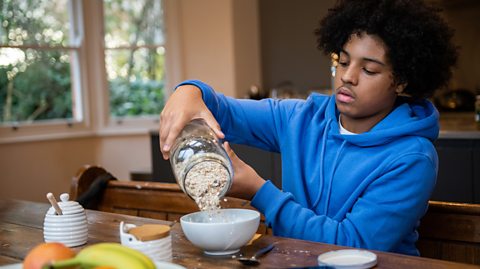
Read the following blog post about the pros and cons of meal planning. Write one advantage and one disadvantage mentioned for each of the following:
Eating breakfast
Taking a packed lunch
Eating together as a family
Pour manger sain, on doit simplement s’organiser. Ce n’est pas difficile !
D’abord, il faut commencer la journée avec un bon petit-déjeuner. C’est vrai qu’on doit se lever un peu plus tôt et parfois, on n’a pas trop envie de manger le matin. Cependant, les études montrent que ce premier repas du jour nous aide à nous concentrer et à mieux travailler.
Ensuite, apportez votre propre déjeuner au collège ou au travail. Même s’il faut du temps pour le préparer, c’est beaucoup moins cher qu’acheter un repas et souvent plus sain aussi. Si vous trouvez ça ennuyeux, essayer d’ajouter des choses différentes – vous trouverez beaucoup d’idées sur Internet.
Finalement, le repas du soir, c’est une occasion pour s’asseoir ensemble autour de la table avec sa famille. On peut partager la préparation de la nourriture et parler de sa journée. Le seul inconvénient, c’est quand quelqu’un dans la famille refuse d’essayer de nouvelles recettes ou de goûter un plat inconnu.
- Eating breakfast
Advantage
One of:
- helps you concentrate
- helps you work better.
Disadvantage
One of:
- have to get up earlier
- don’t feel like eating in the morning.
- Taking a packed lunch
Advantage
One of:
- cheaper than buying a meal
- often healthier
Disadvantage
One of:
- takes time to prepare
- can be boring
- Eating together as a family
Advantage
One of:
- share the meal preparation
- talk about one’s day
Disadvantage
One of:
- someone in the family refusing to try new recipes
- refusing to taste unknown dishes
Click or tap on Show more to read a translation.
To eat healthily you have to get organised. It is not difficult!
First, you must start the day with a good breakfast. It’s true that you must get up a little earlier and sometimes you don’t want to eat in the morning. However, studies show that this first meal of the day helps us to concentrate and to work better.
Next, take your own lunch to school or work. Even if you need time to prepare it, it is a lot cheaper than buying a meal and often healthier too. If you find that boring, try adding different things – you will find a lot of ideas on the internet.
Finally, the evening meal is an opportunity to sit down round the table with the family. You can share the meal preparation and talk about your day. The only inconvenience is when when someone in the family refuses to try new recipes or to try an unknown dish.
Higher Tier - Vocabulary sheet
Click or tap on the image below for a list of useful vocabulary to use when talking about food and drink choices.
Now you have revised the important vocabulary and key grammar points for describing food and drink choices, why not have a look at the Describing tourist attractions in French guide?
More on Lifestyle and wellbeing
Find out more by working through a topic
- count5 of 5
- count3 of 5