What political parties are there in Northern Ireland?
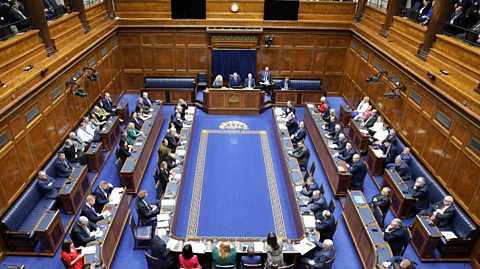
The seats in the Northern Ireland Assembly are held by a number of different parties. Political parties in Northern Ireland include:
- Alliance Party
- Democratic Unionist Party (DUP)
- Green Party
- People Before Profit Alliance (PBP)
- Sinn Féin (SF)
- Social Democratic Labour Party (SDLP)
- Ulster Unionist Party (UUP)
- TUV
What is the role of the NI Executive?
Below are some of the roles of the NI Executive.
- Agree a Programme for Government for Northern Ireland.
- Set out government priorities and commitments to improve the economy and society.
- Agree on the draft budget for Northern Ireland, prescribing how finances are allocated and spent by the different government departments.
- Draft legislation to be passed before the Northern Ireland Assembly members. The Executive have to reach a consensus on how to resolve significant or controversial issues.
What are the departments within the Northern Ireland Executive?
The Northern Ireland Executive consists of 9 government departments, each responsible for specific areas of policy and public services.
Each department is headed by a Minister who is part of the Executive. The key departments of the Northern Ireland Executive are:
| Department | Responsibilities |
|---|---|
| The Executive Office | • supports ministers and institutions of government • manages a programme of government • promotes better community relations • wquality • diversity • social inclusion and rights |
| Agriculture, Environment and Rural Affairs | • food • farming • environmental policy • development of NI's rural sector |
| Communities | • housing • urban regeneration • pensions • sport • arts and culture • languages • maintains museums, libraries, the Public Record Office |
| Economy | • coordinating economic development • enterprise • social economy • innovation • energy • telecommunications • tourism |
| Finance | • Northern Ireland's budget • department spending • Land and property services |
| Education | • education to post primary • the curriculum • schools and their infrastructure. • support on issues such as child protection and safeguarding • teachers • non-teaching staff |
| Health | • dentistry • nursing, midwifery and allied health professionals • mental health and learning disabilities • public health policy and advice • pharmacy • medical and environmental health advice |
| Infrastructure | • road improvement schemes • rivers and flooding • public transport • waterways • ports • road users • sustainable transport |
| Justice | • justice and the law • prisons • forensic science • legal aid • youth justice • policing and community safety • courts and tribunals |
More on Democratic institutions
Find out more by working through a topic
- count4 of 5
- count5 of 5