How did the Good Friday Agreement shape NI's democratic institutions?
The Good Friday Agreement and NI's democratic institutions
Narrator:
The Good Friday. Agreement, also known as the Belfast Agreement. Is a landmark peace agreement to resolve the Troubles in Northern Ireland.
It was signed by political leaders on the 10th April 1998, after three decades of conflict.
Ending violence is difficult. So the Good Friday Agreement has a lot of parts to it, but all parts aim to build political stability and nurture trust in democratic institutions.
As part of the agreement, Northern Ireland is recognised as part of the United Kingdom but with the right to self-determination.
If a majority in Northern Ireland votes to unite with the Republic of Ireland the UK government will honour this.
Northern Ireland is overseen by a devolved power sharing government - devolved because certain law making powers are transferred from the UK Government to allow Northern Ireland to make decisions on local issues, such as on health, education and transport.
Power sharing because it ensures these decisions are shared between all communities, those who want a united Ireland, Nationalist, and those who want to remain part of the UK - Unionist. But how does this power sharing work?
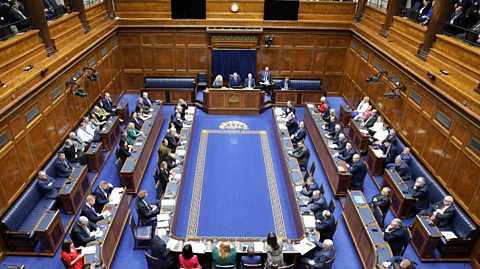
The Northern Ireland government is made-up of the Northern Ireland Assembly and the Northern Ireland Executive.
The Assembly sets the local laws within Northern Ireland, whereas the Executive implements the laws and overseas the day-to-day running of government.
The Assembly is made-up of members of the Legislative Assembly MLA's elected by the people of Northern Ireland to represent their views.
There are 90 MLA's elected through proportional representation. This means the assembly is made-up of MLA's from the different communities.
Each MLA must agree to a ministerial code and pledge of office, and each MLA is contactable by the public.
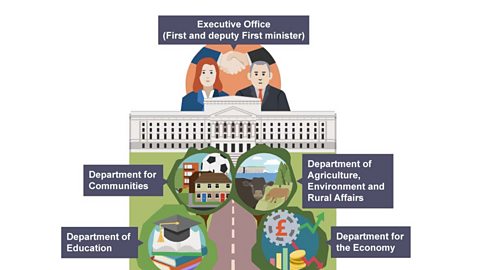
The Assembly then nominates ministers to the Northern Ireland Executive with the Minister to oversee each of the 9 government departments.
Part of the power sharing agreement means there will be ministers from different parties and communities in the Executive.
The First Minister is chosen from the largest party, the Deputy First Minister is chosen from the next largest party of the other community.
This ensures that different parties and communities have a seat at the Executive table.
The Assembly holds the Executive to account and has the power to approve the Northern Ireland budget.
This ensures key decisions have cross community support.
What is the Good Friday Agreement?
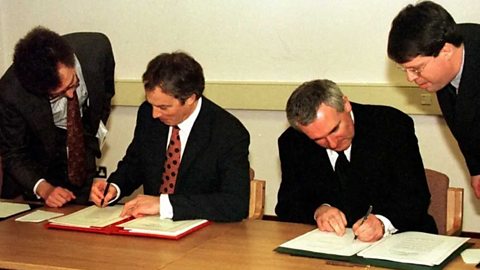
The Good Friday Agreement (also known as the Belfast Agreement) is a landmark peace agreement the main aim of which, was to resolve the conflict known as "The Troubles" in Northern Ireland.
Signed on April 10, 1998, and ratified in May 1998 after a Referendum in Northern Ireland and the Republic of Ireland, this agreement was a pivotal moment in the peace process and has had a profound impact on almost every aspect of life in Northern Ireland - from the political institutions, such as the power-sharing government, to Brexit and how it operates in this part of the UK.
The Good Friday Agreement has two connected documents:
- An agreement between most of Northern Ireland’s political parties.
- An international agreement between the British and Irish governments.
What are the key provisions of the Good Friday Agreement?
| Political institutions | Devolved Government | Establishment of a devolved Northern Ireland Assembly with power-sharing arrangements between nationalist/republican and unionist/loyalist parties. |
| Executive | Formation of an Executive Committee consisting of representatives from different political parties to govern Northern Ireland. | |
| Constitutional status | Northern Ireland | Recognized as part of the United Kingdom, but with provisions for democratic change if a majority in Northern Ireland wishes to unite with the Republic of Ireland. |
| North-South cooperation | North-South Ministerial Council | Created to promote cooperation between Northern Ireland and the Republic of Ireland on various issues, such as agriculture, transportation and health. |
| East-West cooperation | British-Irish Council | Established to foster cooperation between the governments of the UK and Ireland, as well as the devolved administrations in Scotland and Wales. |
| Human rights and equality | Northern Ireland Human Rights Commission (NIHRC) | Commitment to human rights and equality, including the establishment of the Northern Ireland Human Rights Commission (NIHRC) and the Equality Commission for Northern Ireland. |
| Decommissioning | Decommissioning Scheme | Agreement on the decommissioning of paramilitary weapons and the cessation of violence by all paramilitary groups. |
| Policing and justice | Reformed policing | Establishment of a reformed police service, known as the Police Service of Northern Ireland (PSNI), to replace the Royal Ulster Constabulary (RUC), and to address concerns about policing in Northern Ireland. |
| Release of political prisoners | Early prison release | As part of the agreement, many prisoners linked to paramilitary groups were released early, as long as their organisations were committed to peace. |
| Principle of consent | Self-determination | The Agreement confirmed that Northern Ireland will remain part of the United Kingdom unless a majority of people in Northern Ireland vote to join a united Ireland. |
| Dual nationality | Dual citizenship | People born in Northern Ireland have the right to identify and be accepted as British, Irish, or both, and can hold both British and Irish citizenship. |
What are some of the major outcomes of the Good Friday Agreement?
Some of the major outcomes of the Good Friday Agreement are:
- Political stability: The Agreement laid the foundation for a more stable and inclusive political framework in Northern Ireland, helping to reduce violence and improve relations between communities.
- Power-sharing: The power-sharing arrangements aimed to ensure that all major political communities were represented in the governance of Northern Ireland.
- Economic and social development: The peace process enabled economic development and improvements in social conditions in Northern Ireland.
- Peace process: The Good Friday Agreement is widely regarded as a major achievement in conflict resolution, demonstrating the potential for negotiation and compromise to resolve long-standing conflicts.
More on Democratic institutions
Find out more by working through a topic
- count4 of 5
- count5 of 5