How are MSPs elected to the Scottish Parliament?
Quick version
Every four or five years MSPs are elected to the Scottish Parliament using an electoral system called the Additional Member System or AMS.
Scotland is divided into 73 constituencies. Each constituency elects one MSP but there are also an additional 56 regional or list MSPs making 129 MSPs in total.
Scotland is also represented at the UK Parliament in Westminster through 59 Scottish MPs.
All bills passed by the Scottish Parliament have to receive the Royal Assent before they can become law.
The Scottish Parliament has a powerful committee system which can propose as well as scrutinise bills.
Video - How does additional member system work?
Watch this video to learn how MSPs are elected using an electoral system called the Additional Member System or AMS.
What is the Additional Member System?
The Scottish Parliament is made up of 129 members or MSPs, who representeveryone in Scotland.
The country is divided into eight electoral regions and 73 constituencies.
Each voter in Scotland is represented by eight MSPs.
One constituency MSP and seven regional MSPs.
They are elected using the Additional Member System or AMS.
At an election voters are given two ballot papers, one for their constituencyand one for their region.
On the constituency ballot paper voters mark one cross next to the name of theindividual person they wish to vote for.
The candidate who wins the most votes is elected as that constituencies MSP.On the regional ballot paper, voters place a cross next to their preferred politicalparty or independent candidate.
The total number of regional votes is counted and used to work out the numberof MSPs each party or independent candidate should have to fairly represent theproportion of votes they received in the region.
The number of constituency MSPs each party has already had elected issubtracted from each party's total.
The party's regional list of candidates is then used to top this up until theproportional number of MSPs is reached.
This makes the additional member system a form of proportional representation, where the number of seats a party gains relates to the number of votes it receives.
Learn more in depth
Additional Member System
MSPs are elected to the Scottish Parliament every four or five years (this varies to avoid a clash with Westminster elections). The electoral system used to choose MSPs is known as the Additional Member System (AMS).
For the purposes of this election, Scotland is divided into 73 constituencies. Each constituency elects one MSP but there are also an additional 56 regional or list MSPs making 129 MSPs in total.
The last election to the Scottish Parliament was in 2021. The outcome of this election was that the SNP were the largest party and formed a minority government. The next Scottish Parliament election is due to take place on 7th May 2026.
How is Scotland represented at Westminster?
As well as appointing 129 MSPs to the Scottish Parliament, Scotland is also represented at the UK Parliament in Westminster through 57 Scottish MPs. The table below shows how many of these represent different political parties.
| Political party | Number of MPs |
|---|---|
| SNP | 9 |
| Conservative | 5 |
| Liberal Democrat | 6 |
| Labour | 37 |
How does the Scottish Parliament works
Watch this video to find out what happens at the Scottish Parliament and what MSPs do.
What happens at the Scottish Parliament?
Every four or five years, voters in Scotland elect the 129 MSPs who representthem in the Scottish Parliament.
73 represent constituencies and 56 represent larger regions.
All MSPs vote on who will be the First Minister.
This is most likely the leader of the biggest party in Parliament.
The First Minister then chooses ministers to form the Scottish Government.
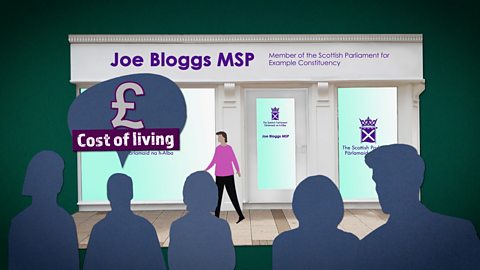
It is the job of MSPs to represent people in their constituency or region.
MSPs spend time in their community holding surgeries and looking into localissues as representing their area in parliament.
Some MSPs represent the electorate through being part of the government.
All MSPs attend the debating chamber where they debate issues and propose,amend and vote on bills.
Bills voted for by majority become new laws called Acts of the ScottishParliament.
On Thursdays at Holyrood, MSPs have the opportunity to question Scotland'sFirst Minister during First Minister's questions.
The Scottish Parliament has a powerful committee system.
Committees are made up of MSPs from all political parties and are responsiblefor proposing and amending legislation, scrutinising bills, taking evidence fromwitnesses and conducting inquiries.
In this way, they can effectively hold the government to account
The The Act of Parliament that outlined the setting up of the Scottish Parliament and Administration and other changes to how Scotland is governed created the Scottish Parliament. As with the UK Parliament, all A proposal for a new law or a change to existing law. passed by the Scottish Parliament have to receive the The formal agreement by the monarch that a bill can become an Act of Parliament or Act of the Scottish Parliament, making it law. before they can become law.
The Scottish Parliament works in a similar way to most other parliaments around the world. MSPs can hold debates and make new laws in the areas for which the Scottish Parliament has powers to do so. The parliament and the MSPs within it, have responsibility for spending the parliament's A plan for expected income and spending over a specified time period..
The Scottish Parliament does not have a second chamber like the House of Lords. Instead, it has a powerful committee system which can propose as well as To examine or inspect closely. bills. In committees, small numbers of MSPs discuss A particular law, or a group of related laws. in detail and work closely together.
What are meetings of the Scottish Parliament for?
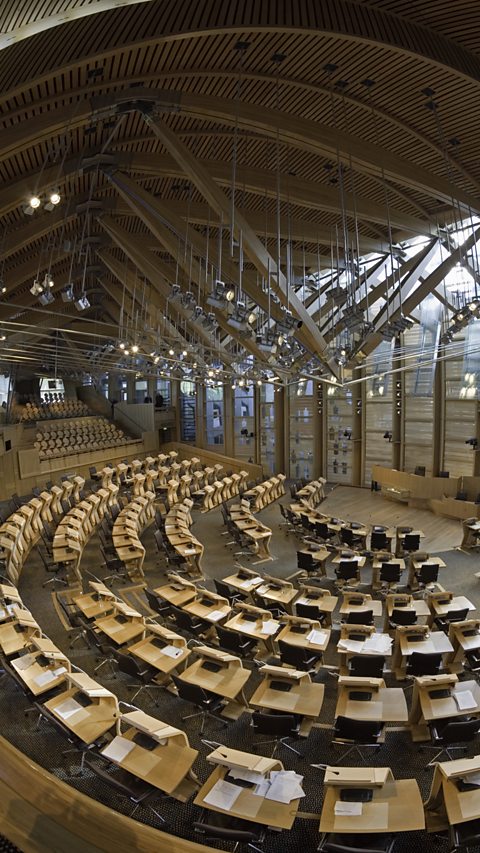
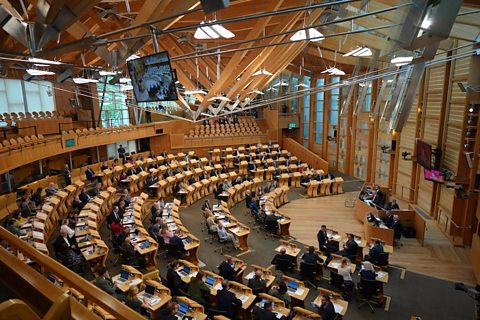
The Debating Chamber is the focal point for the Scottish Parliament's business.
MSPs can participate in the Chamber in a number of ways:
- debate issues and bills (proposed laws)
- suggest amendments (changes) to a bill
- vote on bills
- question members of the Scottish Government during question time
- question the First Minister during First Minister's Questions
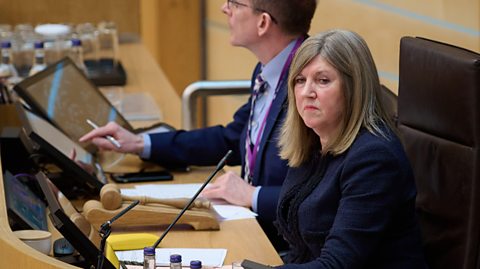
The procedures of the Scottish Parliament are overseen by the Presiding Officer.
The Presiding Officer decides who will speak in a debate. They also ensure that:
- the rules of the parliament are followed
- MSPs conduct themselves appropriately
- the business of parliament is carried out efficiently and fairly
All debates and other proceedings are shown live on television and online.
When does the Scottish Parliament meet?
MSPs meet in the Chamber on Tuesday and Wednesday afternoons and from 11.30am on Thursday. The Parliament only sits for 35 weeks a year. MSPs represent the people of their area by:
- speaking in a debate or voting for or against a motion (proposal)
- suggesting an amendment to a motion or introducing a new law (a bill)
On a Thursday, at noon, MSPs have the opportunity to question the First Minister during First Minister's Questions (FMQs).
What are Scottish Parliament committees?
The Scottish Parliament does not have a second chamber like the House of Lords. Instead, it has a powerful committee system. They can propose bills as well as scrutinise them. These committees have five to fifteen members, and they will discussA particular law, or a group of related laws. in detail and work closely together.
The Scottish Parliament's Public Petitions Committee considers any issues raised by members of the public brought to the Scottish Parliament in the form of a A formal written request to an authority requesting that action is taken on a particular matter., providing they meet certain A rule or condition that must be met. The plural is criteria..
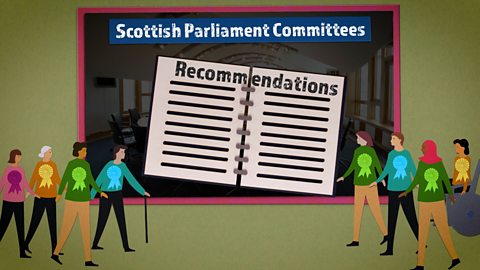
Most MSPs sit on at least one committee (smaller groups of MSPs) of the Scottish Parliament.
In these committees MSPs discuss legislation in detail and work closely together.
The committees have the power to require anyone to give evidence before them. They will also produce reports about their work.
Unlike Westminster, Scottish Parliament committees can propose as well as scrutinise legislation.
Some committees eg the Health Committee are permanent and meet weekly to review the work of the Scottish Government.
Other committees are only temporary and are set up to investigate issues or make recommendations. For example, a committee was formed to scrutinise the Scottish Government response to the Covid-19 pandemic and make recommendations. This was the ‘Covid 19 Recovery Committee’.
Types of committee in the Scottish Parliament
There are two types of committee in the Scottish Parliament
- mandatory committees – these must exist.
- subject committees. These are ones which the government chooses to set up.
Examples of mandatory committees are the Equal Opportunities Committee and the Finance Committee.
Examples of 'subject' committees are the Education and Skills Committee and the Health and Sport Committee.
There are two types of committee in the Scottish Parliament
- mandatory committees – these must exist.
- subject committees. These are ones which the government chooses to set up.
Examples of mandatory committees are the Equal Opportunities Committee and the Finance Committee.
Examples of 'subject' committees are the Education and Skills Committee and the Health and Sport Committee.
How do committees work?
All committees are made up of between three and eleven MSPs. Their make-up is based on the proportion of seats each party has overall. MSPs are more likely to consider issues based on their merits rather than oppose them on a party political basis.
Any MSP has the right to attend a committee meeting and to ask questions.
When sitting on a committee MSPs represent the people of their area by:
- asking questions eg of Ministers or expert witnesses
- using a committee to change an existing law
- voting on whether or not a new law should be passed
When and where do committees meet?
Committees meet weekly or fortnightly usually on Tuesdays, Wednesdays or Thursday mornings. Meetings take place in one of the Scottish Parliament's committee rooms.
Most are open to the public. In summer, many committees will move around and sit at various locations across Scotland.
Quiz
Recap what you have learned
MSPs are elected to the Scottish Parliament using an electoral system called the Additional Member System or AMS.
Scotland is divided into 73 constituencies. Each constituency elects one MSP but there are also an additional 56 regional or list MSPs making 129 MSPs in total.
The last election to the Scottish Parliament was in 2021, where the SNP were the largest party and formed a minority government. The next Scottish Parliament election is due to take place on 7th May 2026.
Scotland is represented at the UK Parliament in Westminster through 59 Scottish MPs.
MSPs can hold debates and make new laws using their devolved powers.
The Scottish Parliament has a powerful committee system where small numbers of MSPs can propose as well as scrutinise bills.
The Debating Chamber in the Scottish Parliament is where MSPs have debates, suggest amendments, vote on bills, question members of the Scottish Government and conduct First Minister’s Questions.
The procedures of the Scottish Parliament are overseen by the Presiding Officer.
MSPs meet in the Chamber on Tuesday and Wednesday afternoons and from 11.30am on Thursday.
On a Thursday, at noon, MSPs have the opportunity to question the First Minister during First Minister's Questions.
The Scottish Parliament has a powerful committee system. They can propose bills as well as scrutinise them.
There are two types of committee in the Scottish Parliament, mandatory committees and subject committees.
More on Democracy in Scotland
Find out more by working through a topic
- count10 of 19
- count11 of 19