How are voters in Scotland represented in the Scottish Parliament?
Quick version
Everyone in Scotland is represented by eight MSPs
- one constituency MSP
- seven regional MSPs
MSPs can represent people in their constituency or region by:
- responding to letters and emails from local people and organisations who want their support
- attending local meetings and events where they meet and discuss important issues with groups of constituents
- holding surgeries where constituents can bring their problems and questions, which the MSPs will try to address
MSPs can represent their constituency or region in the Scottish Parliament by:
- taking part in debates
- asking questions at Question Time
- introduce a members bill
- lobbying members of the government
- working on committees
Video - Work of MSPs and the Scottish Parliament
Watch this video to find out what happens at the Scottish Parliament and what MSPs do.
What happens at the Scottish Parliament?
Every four or five years, voters in Scotland elect the 129 MSPs who representthem in the Scottish Parliament.
73 represent constituencies and 56 represent larger regions.
All MSPs vote on who will be the First Minister.
This is most likely the leader of the biggest party in Parliament.
The First Minister then chooses ministers to form the Scottish Government.
It is the job of MSPs to represent people in their constituency or region.
MSPs spend time in their community holding surgeries and looking into localissues as representing their area in parliament.
Some MSPs represent the electorate through being part of the government.
All MSPs attend the debating chamber where they debate issues and propose,amend and vote on bills.
Bills voted for by majority become new laws called Acts of the ScottishParliament.
On Thursdays at Holyrood, MSPs have the opportunity to question Scotland'sFirst Minister during First Minister's questions.
The Scottish Parliament has a powerful committee system.
Committees are made up of MSPs from all political parties and are responsiblefor proposing and amending legislation, scrutinising bills, taking evidence fromwitnesses and conducting inquiries.
In this way, they can effectively hold the government to account
Learn in more depth
What are constituency MSPs and regional MSPs?
There are two types of MSP:
Constituency MSPs - Scotland is divided into 73 areas called constituencies. Each constituency is represented by one MSP.
Regional MSPs - Scotland is divided into eight regions. Each region is represented by seven MSPs.
What work do MSPs do in their constituency or region?
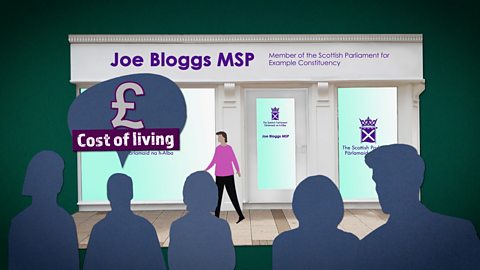
On Friday, MSPs will generally work in their constituencies and regions, often meeting the people they represent.
Most MSPs have an office in in their constituency or region.
MSPs work in their constituency in a number of ways:
- MSPs respond to letters and emails from local people and organisations who want their support
- MSPs hold surgeries where constituents can bring their problems and questions, which the MSPs will try to address
- MSPs attend local meetings and events where they meet and discuss important issues with groups of constituents
- MSPs meet with other local representatives (for example councillors), business leaders, or members of the community, to discuss priorities in the area
All these activities allow MSPs to get to grips with the local issues facing their electorate and to ensure they represent them fairly.
MSPs can take on a constituent's problem in one of a number of ways:
- by contacting a government minister
- by starting a debate or asking a Parliamentary question
- by introducing a Members' Bill or proposing an amendment to a bill
How does the Scottish Parliament works
The Scottish Parliament does not have a second chamber like the House of Lords. Instead, it has a powerful committee system which can propose as well as To examine or inspect closely. bills. In committees, small numbers of MSPs discuss A particular law, or a group of related laws. in detail and work closely together.
What are meetings of the Scottish Parliament for?
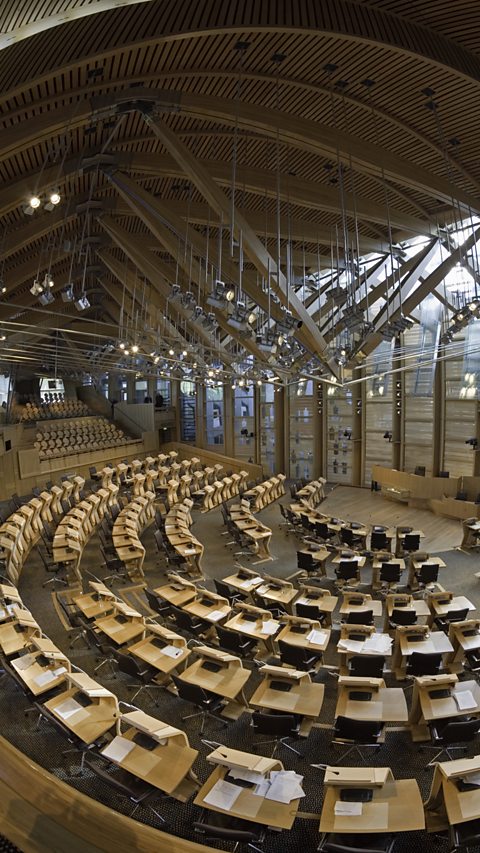
The Debating Chamber is the focal point for the Scottish Parliament's business.
MSPs can participate in the Chamber in a number of ways:
- debate issues and bills (proposed laws)
- suggest amendments (changes) to a bill
- vote on bills
- question members of the Scottish Government during question time
- question the First Minister during First Minister's Questions
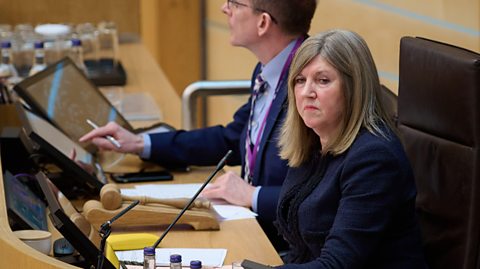
The procedures of the Scottish Parliament are overseen by the Presiding Officer.
The Presiding Officer decides who will speak in a debate. They also ensure that:
- the rules of the parliament are followed
- MSPs conduct themselves appropriately
- the business of parliament is carried out efficiently and fairly
All debates and other proceedings are shown live on television and online.
When does the Scottish Parliament meet?
MSPs meet in the Chamber on Tuesday and Wednesday afternoons and from 11.30am on Thursday. The Parliament only sits for 35 weeks a year. MSPs represent the people of their area by:
- speaking in a debate or voting for or against a motion (proposal)
- suggesting an amendment to a motion or introducing a new law (a bill)
On a Thursday, at noon, MSPs have the opportunity to question the First Minister during First Minister's Questions (FMQs).
What work do MSPs do in the Scottish Parliament?
Member's Bills
There are different ways laws and decisions are made in the Scottish Parliament.
Alongside bills introduced by the government and committees, individual MSPs can also propose bills for parliamentary debate. Each MSP can introduce two Member's Bills during a single parliament.
In order for the bill to be debated, the MSP introducing the bill first needs to secure support from all political parties.
An example of a successful Member's Bill is the Children (Equal Protection from Assault) (Scotland) Bill. The Bill was introduced by the Green Party MSP John Finnie to "help stop the use of physical punishment of children". The Bill was passed and became an Act on 7 November 2019.
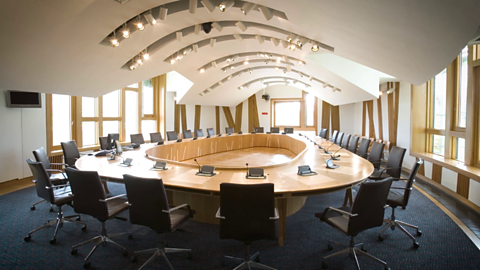
Committees
MSPs can represent people in their area by serving on a committee.
Committees are groups of MSP that look into specific topics or issues by:
- holding an inquiry
- looking at legislation
- vote on amendments to legislation
- looking at the work of the Scottish Government
MSPs on a committee can propose new legislation through Committee Bills.
Other methods of representation
MSPs can also represent people in their area by:
- meeting with constituents at the Scottish Parliament
- raising issues with members of the Scottish Government
- speaking to lobbying groups about issues that affect the area they serve
- serving as a minister in the Scottish Government
Quiz
Recap what you have learned
Everyone in Scotland is represented by eight MSPs
- one constituency MSPs representing one of the 73 constituencies that Scotland is divider into
- seven regional MSPs representing each of the eight regions that Scotland is divided into
MSPs work in their constituency or region between Fridays and Mondays by:
- holding surgeries where constituents can bring their problems and questions
- responding to letters and emails from local people and organisations who want their support
- attending local meetings and events where they meet and discuss important issues with groups of constituents
- meeting other representatives such as councillors, as well as business and community leaders
MSPs represent their constituency or region in the Scottish Parliament between Tuesdays and Thursdays by:
- taking part in debates in the Debating Chamber
- asking questions at Question Time
- asking a question at **First Minister's Questions on a Thursday at noon
- introduce up to two Member's Bills in each parliament
- lobbying members of the government
- working on committees
More on Democracy in Scotland
Find out more by working through a topic
- count14 of 19
- count15 of 19