Key points
Rounded values
When rounding decimals apply the same mathematical rules used when rounding whole numbers.
It is not always possible to give an exact value. When it’s not possible, numbers can be rounded. For example, when Usain Bolt broke the 100 m World Record in August 2009, his time was recorded as an incredible 9.58 seconds. Time is an example of Continuous data can take any value within a range. It is data which has been measured rather than counted, eg time, length, mass. data, meaning that his time of 9.58 seconds has been measured as accurately as possible, but ultimately has been rounded to the nearest one hundredth of a second.
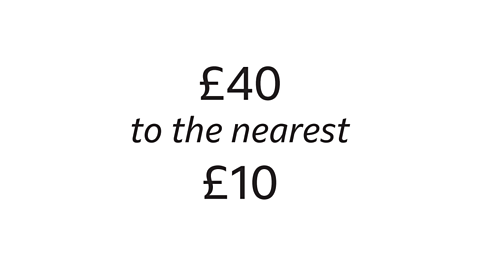
Depending on the context, and the need for Accuracy is how close a measured value is to the actual (true) value., values can be rounded. They can be rounded, for example, to the nearest:
tenth
hundredth
thousandth
Decimal places
Rounding to a desired degree of accuracy means making a number simpler but keeping its value very close to what it was. The result is not exact, but is easier to manage and use.
There are steps which can be followed to decide whether a number should be rounded up or rounded down to a set degree of accuracy.
- Identify the position of the decimal place One of the symbols of a number system, most commonly the symbols 0, 1, 2, 3, 4, 5, 6, 7, 8 and 9 you are rounding to.
- Leave it the same if the next digit is less than 5 (this is called rounding down)
- But increase it by 1 if the next digit is 5 or more (this is called rounding up)
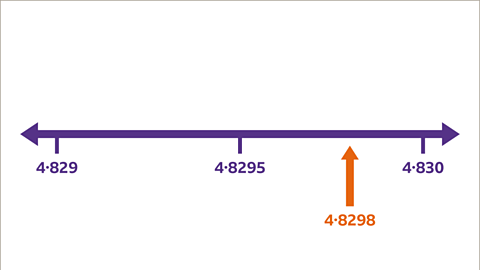
- Using a A straight line on which numbers are marked at equal intervals. as a representation is a helpful way of visualising whether a number is closer to one value or another.
Examples
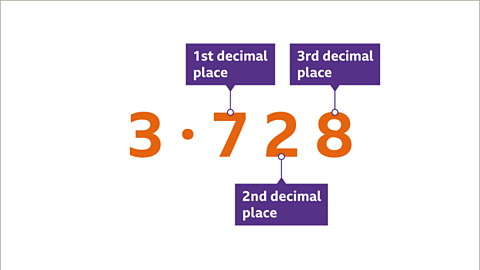
Image caption, Decimal places are counted from the decimal point. The number 3 ∙728 is written to three decimal places.
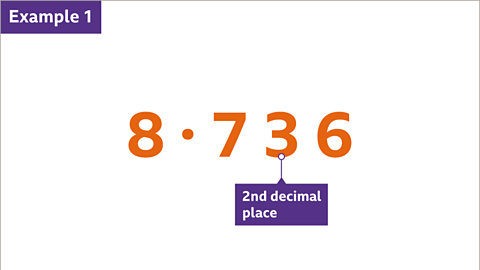
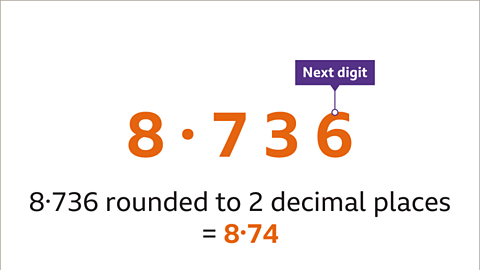
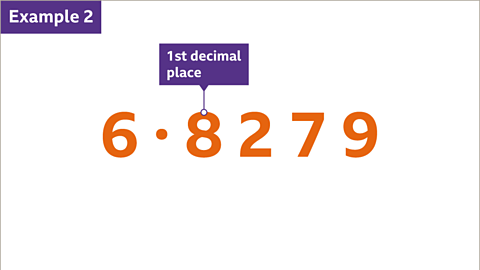
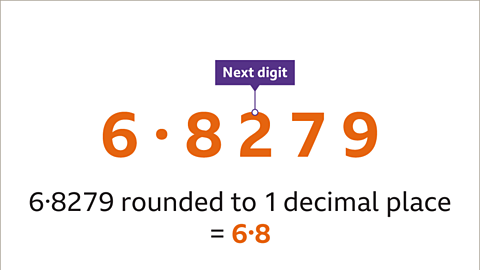
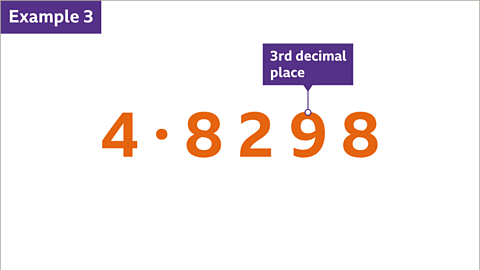
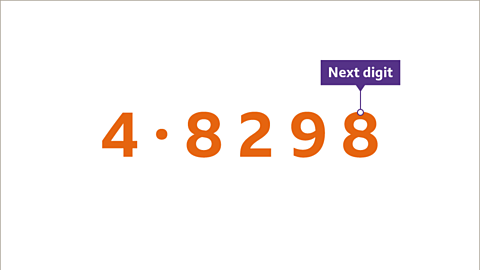
1 of 8
Question
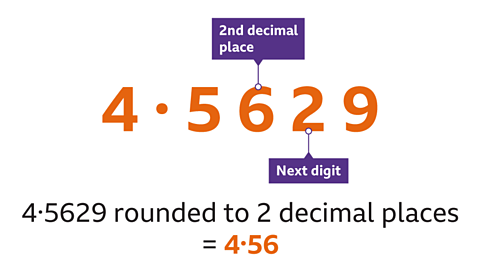
Round 4∙5629 to 2 decimal places.
Count the digits from the decimal point. The digit 6 is in the second decimal place.The next digit is 2. Because 2 is less than 5, the digit 6 remains unchanged.4∙5629 to 2 decimal places is rounded down to 4∙56.
Practise rounding numbers
Practise rounding decimal numbers in this quiz.
Quiz
Real-world maths
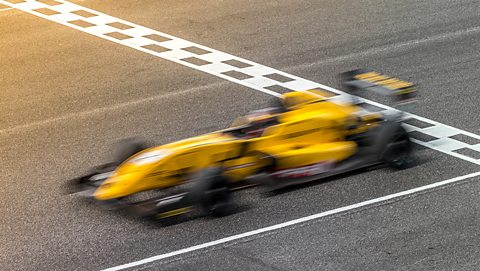
Rounding decimal values is used regularly in everyday life.An exact figure or value is not always appropriate to use or becomes difficult to manage effectively, particularly when dealing with continuous data as our ability to measure precisely is limited.
- Converting between imperial and metric measurements usually results in values with several decimal places. It is common to round these to deal with more manageable values.
- Measuring the time taken to complete a task can only be measured to a certain degree of accuracy so these are usually rounded to 2 or 3 decimal places (or the nearest one hundredth or one thousandth of a second). For example, in a sports events and motor racing.
Revise for your exams with BBC Bitesize
Get ready for the GCSEs with quizzes, past papers, flashcards, podcasts and more resources!

More on Rounding and estimating
Find out more by working through a topic
- count4 of 6
- count5 of 6
- count6 of 6
- count1 of 6