Key points
To multiply decimals, the numbers are multiplied as Integers are numbers with no fraction or decimal part. They can be positive, negative or zero. 42, 8, and 10000 are examples of integers.. Choose your preferred method of multiplication, then divide by the appropriate The second power of 10 for example is 100. Powers of 10 are 10, 100, 1000 and so on. to get the correct answer.
The following multiplication methods may be helpful: short multiplication, the area method, partition method or Napier’s method.
To be successful in multiplying decimals, you need to be able to understand place value.
How to multiply decimals by 10, 100 and 1000
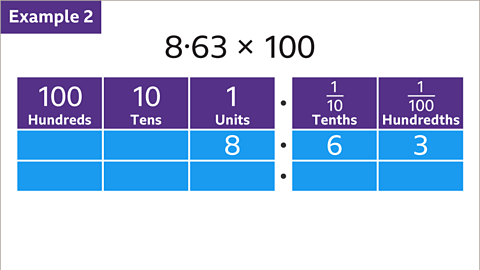
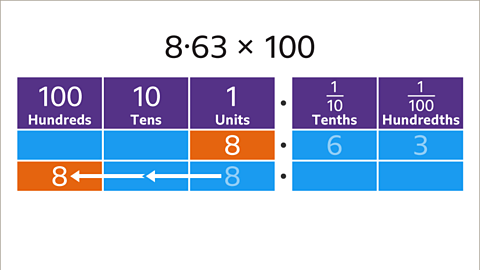
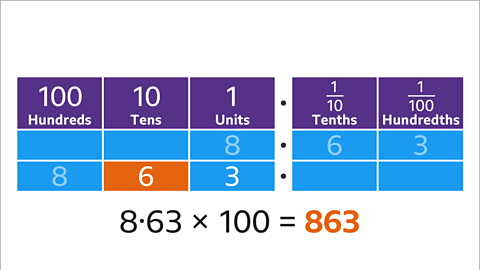
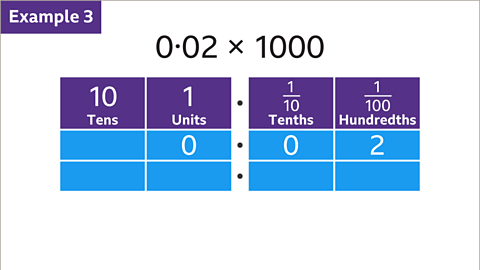
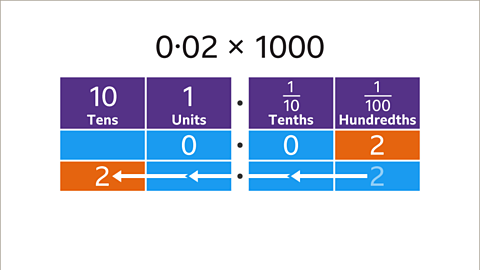
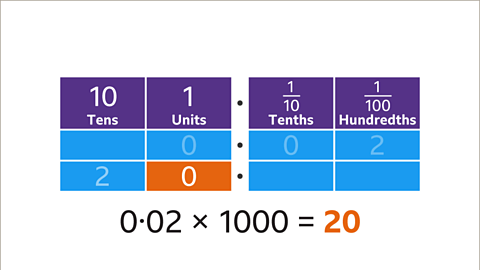
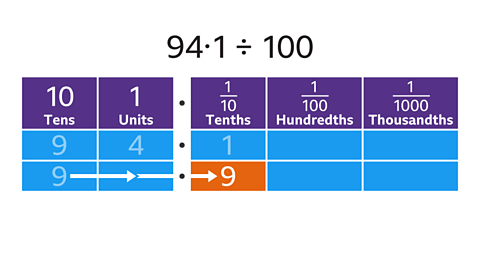
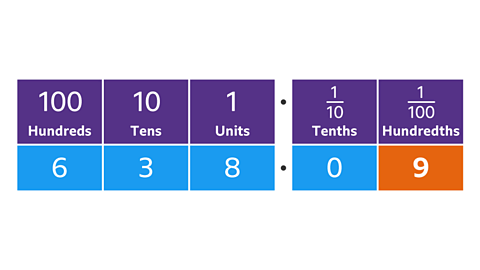
To multiply decimals by 10, 100, and 1000, use place value labels.
Write the digits of the decimal using place value labels.
Start with the first non-zero digit.
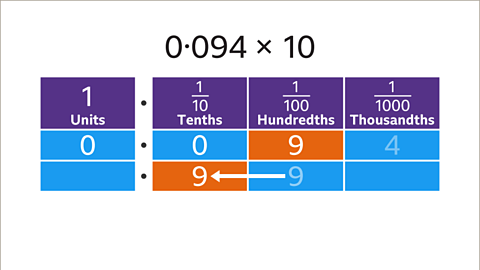
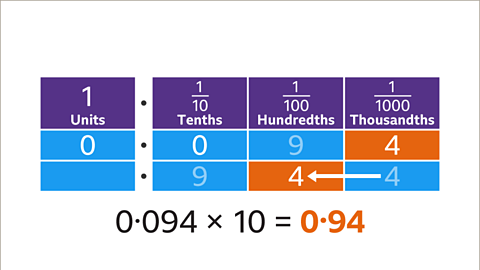
To multiply by 10 move each digit one place to the left.
To multiply by 100 move each digit two places to the left.
To multiply by 1000 move each digit three places to the left.
Fill any gaps created to the left of the decimal point with zeros to ensure the number has the correct value.
This process can also be completed without The value of a digit that relates to its position or place in a number. Eg, in 1482 the digits represent 1 thousand, 4 hundreds, 8 tens and 2 units. labels.
Examples
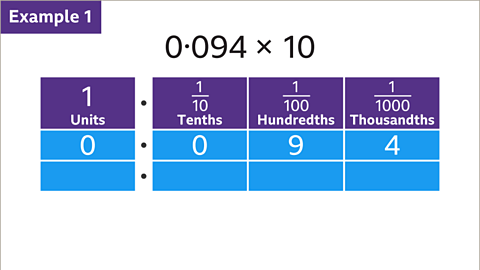
Image caption, Multiply 0∙094 by 10. Write 0∙094 using place value labels.
1 of 9
Question
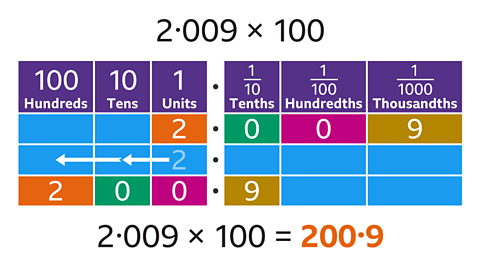
What is 2∙009 × 100?
Each digit moves two places to the left to become 100 times larger.
2 units become 2 hundreds, zero tenths become zero tens, zero hundredths become zero units and 9 thousandths become 9 tenths.
2∙009 × 100 = 200∙9
How to multiply a decimal by a whole number
To multiply a decimal by a whole number:
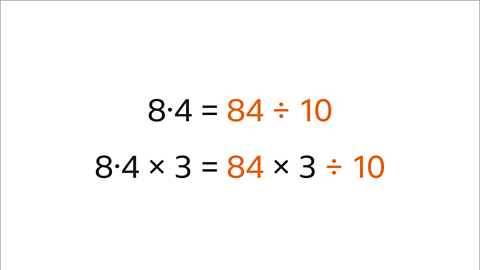
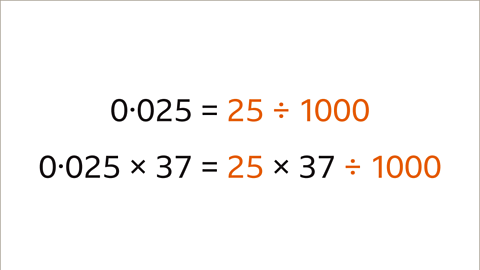
Change the decimal to a whole number divided by a power of ten.
Rewrite the question as a whole number multiplication divided by the The second power of 10 for example is 100. Powers of 10 are 10, 100, 1000 and so on. .
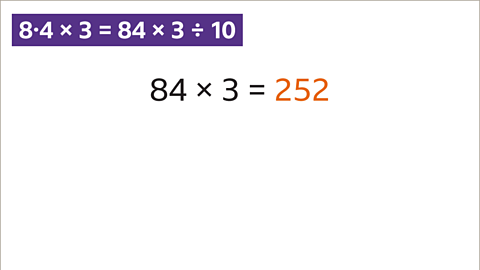
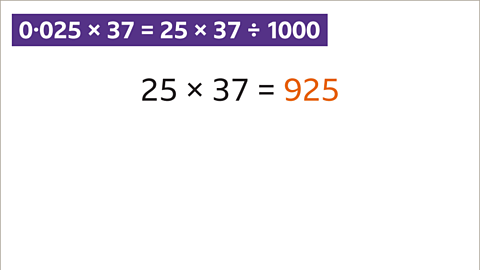
Multiply the whole numbers using your preferred method:
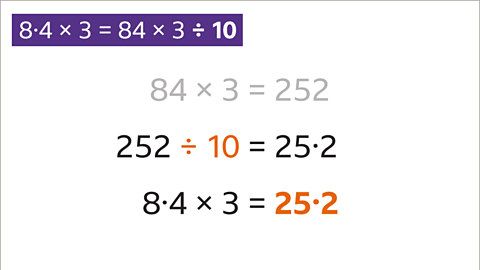
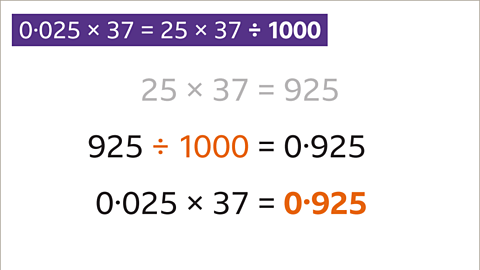
- Divide the The result of multiplying one number by another, eg the product of 4 and 5 is 20 since 4 × 5 = 20by the power of ten to complete the calculation.
Examples
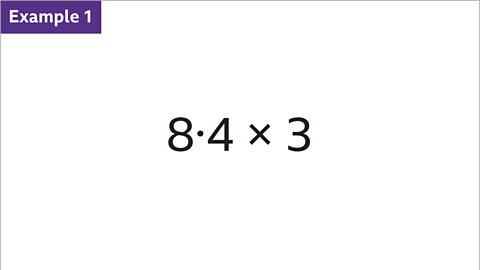
Image caption, Multiply 8∙4 by 3
1 of 8
How to multiply two decimals
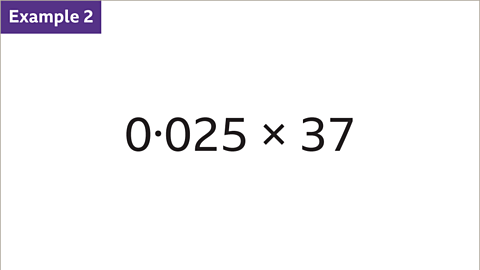
To multiply a decimal by a decimal:
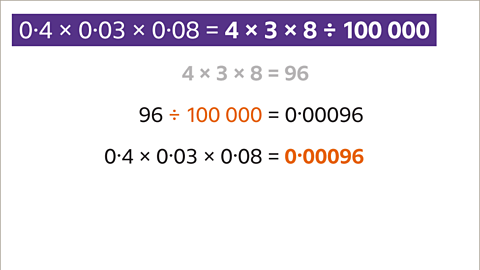
Rewrite each decimal as a whole number divided by a The second power of 10 for example is 100. Powers of 10 are 10, 100, 1000 and so on. .
Rewrite the question as a whole number multiplication divided by a single power of ten. A single division by a power of ten can replace two or more separate divisions by powers of ten.
Multiply the whole numbers using your preferred method:
The area method
Long multiplication
Partition method
Napier’s method
Divide the The result of multiplying one number by another, eg the product of 4 and 5 is 20 since 4 × 5 = 20 by the power of ten to complete the calculation.
Examples
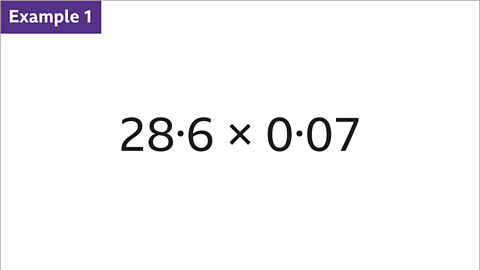
Image caption, Multiply 28∙6 by 0∙07
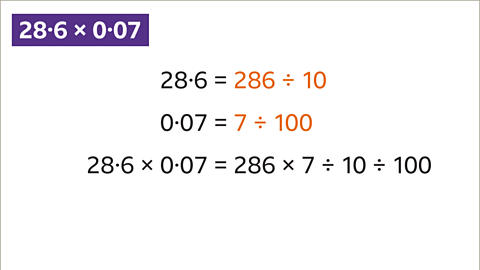
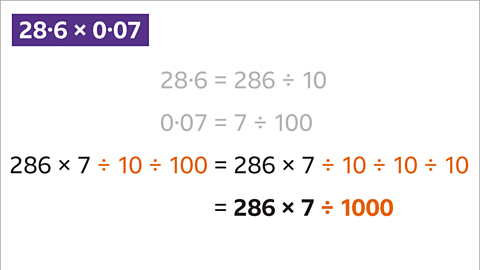
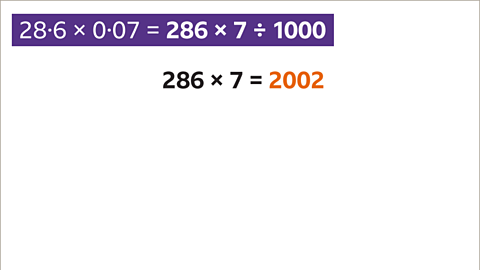
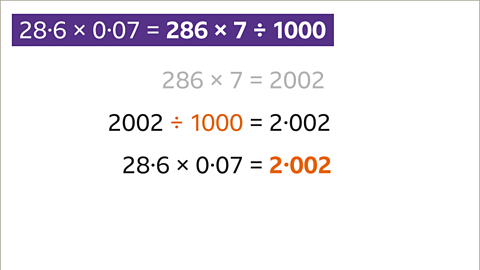
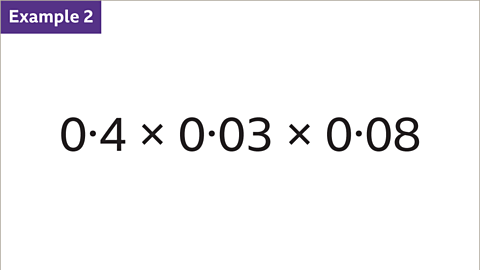
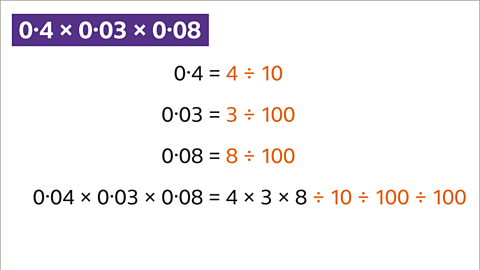
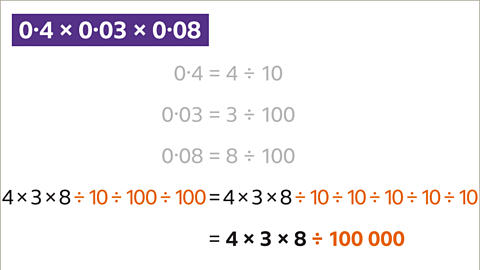
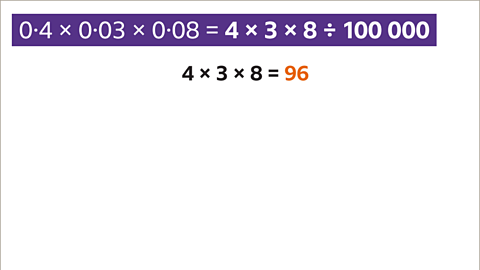
1 of 10
Question
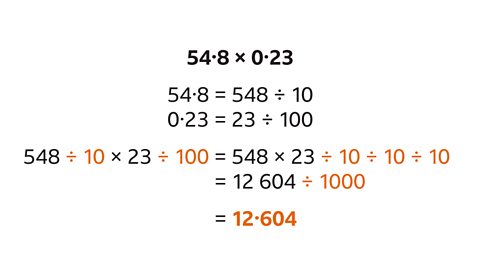
Given that 548 × 23 = 12 604, what is 54∙8 × 0∙23?
548 has been divided by 10 to give 54∙8
23 has been divided by 100 to give 0∙23
54∙8 × 0∙23 = 548 × 23 ÷ 1000=12 604 ÷1000
The product of 548 and 23 (12 604) should be divided by 1000
12 604 ÷ 1000 is 12∙604
Practise multiplying decimals
Practise multiplying decimals with this quiz. You might need a pen and paper to work out the answers.
Quiz
Real-world maths

Lengths are often measured in decimals. A carpenter may multiply lengths by powers of ten, for example when converting centimetres to millimetres.
Working out the cost of buying multiple snacks for a party buffet will involve multiplying the price (expressed as a decimal) by the number of packs (a whole number).
Revise for your exams with BBC Bitesize
Get ready for the GCSEs with quizzes, past papers, flashcards, podcasts and more resources!

More on Decimals
Find out more by working through a topic
- count4 of 4
- count1 of 4
- count2 of 4