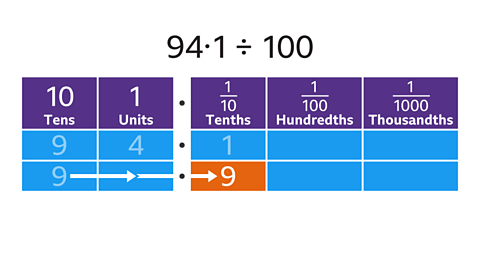
Key points
Each digit of a number has a The value of a digit that relates to its position or place in a number. Eg, in 1482 the digits represent 1 thousand, 4 hundreds, 8 tens and 2 units..
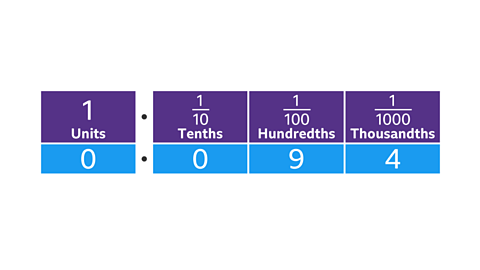
In the decimal system, the place values are all The second power of 10 for example is 100. Powers of 10 are 10, 100, 1000 and so on. , including hundreds, tens, units, tenths, hundredths, and thousandths.
In every number, each place to the left is 10 times greater and each place to the right is 10 times smaller.
The decimal point separates the whole numbers from the parts (or fractions) of a number. An understanding of place value is essential for ordering decimals.
Understanding place value
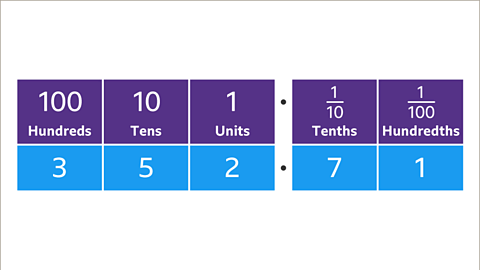
A place value table can help to clearly show the value of each digit. To find the place value of a digit:
Write the number in a place value table, using the decimal point to get each digit in the correct column.
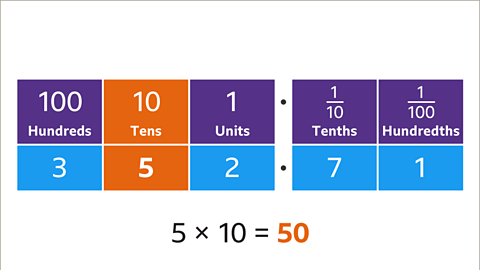
Read the column for the place value of the digit.
The value of the digit is the digit multiplied by the column heading.
Two decimal numbers can be compared in size using The symbol > is used when a value is greater than another, eg 23 > 5. The symbol < is used when a value is less than another, eg 11< 40 symbols (< or >). Decimal numbers can be arranged in Arranged from least value to greatest value. or Arranged from greatest value to least value..
Examples
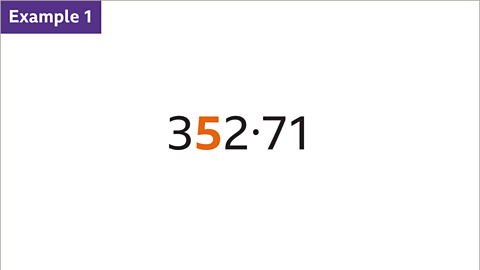
Image caption, What is the place value of the digit 5 in 352∙71?
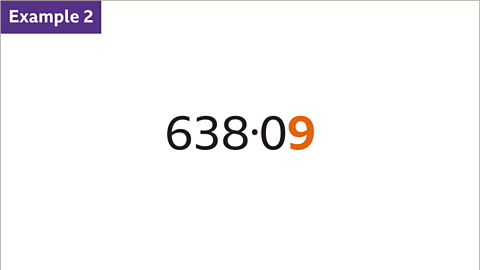
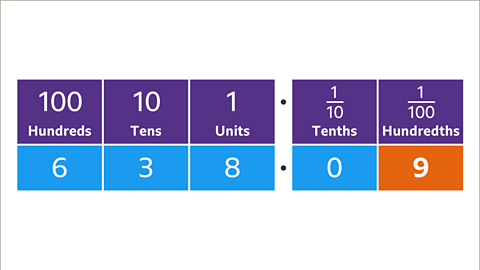
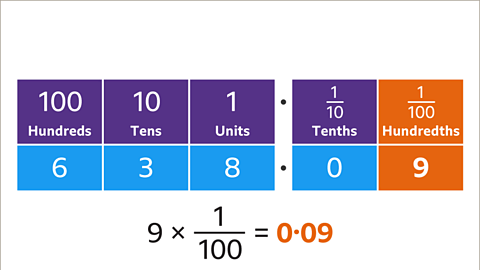
1 of 6
Ordering decimals
To compare a list of decimal numbers:
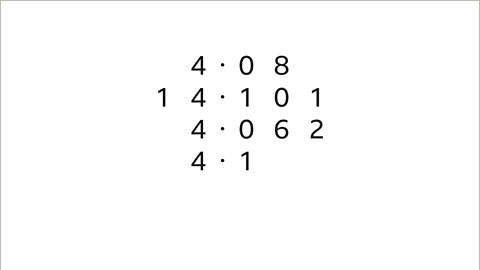
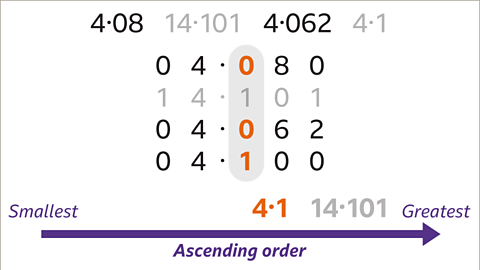
Write the numbers in a place value table, lining up the decimal points to get each digit in the correct column.
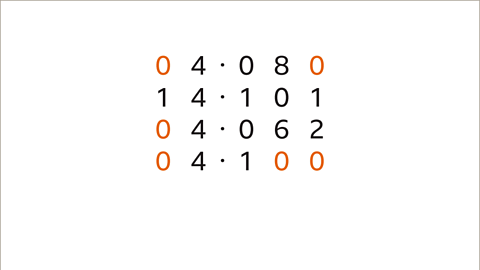
If the numbers have a different amount of digits, there may be some gaps in the columns. Fill any gaps with a zero.
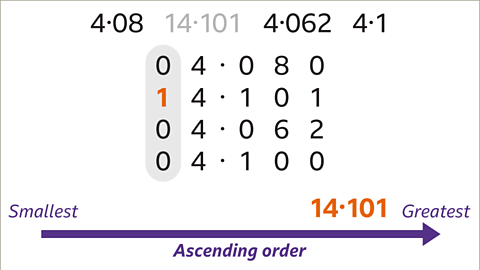
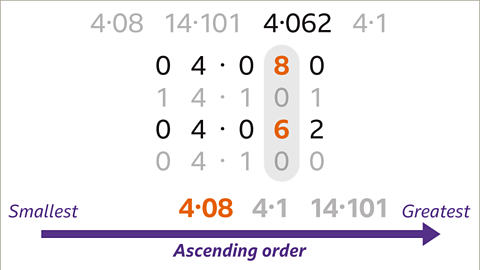
Compare the digits in the columns, starting at the left with the greatest place value.
A greater digit means that the number is greater.
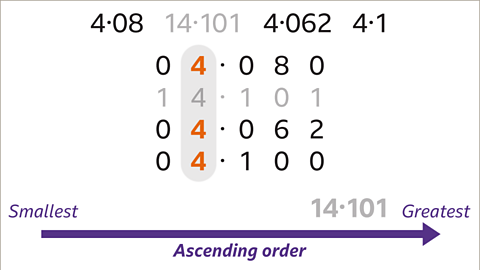
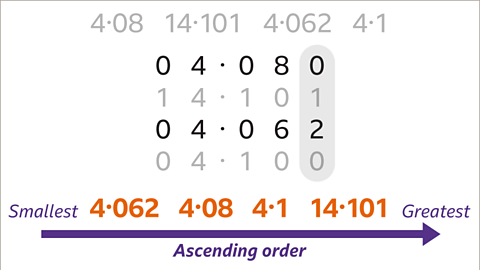
When digits are equal in a column, move to the next column to the right and compare those digits.
With practise this can be done without the place value table, by writing the numbers lined up with their decimal points. The decimal point of a whole number comes after the last digit. Once each number is compared, they can be put in to Arranged from least value to greatest value. or Arranged from greatest value to least value. order.
Examples
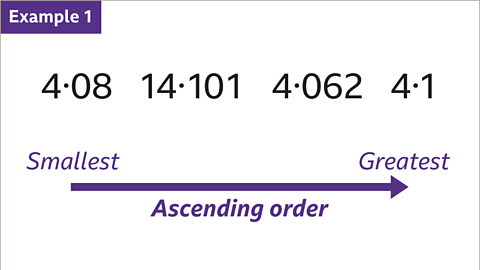
Image caption, Write the following numbers in ascending order: 4∙08, 14∙101, 4∙062, 4∙1
1 of 8
Question
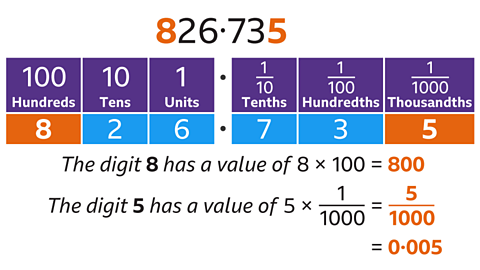
What are the values of the digits 8 and 5 in the number 826∙735?
Write the digits into the place value table. Line up the decimal points to get the numbers in their correct columns.
The digit 8 is in the hundreds column. 8 × 100 = 800
The digit 5 is in the thousandths column. 5 × \( \frac{1}{1000} \) = \( \frac{5}{1000} \) or 0∙005
The value of the digit 8 is 800The value of the digit 5 is \( \frac{5}{1000} \) or 0∙005
Practise place value and ordering decimals
Practise ordering decimals and place value with these activities. You might need a pen and paper to help with your workings out.
Ordering activity
Quiz
Real-world maths

Understanding place value and how to order decimals is useful when comparing decimals.
Height, length and mass often include decimal numbers. A child with a height of 1∙3 metres is taller than another with a height of 1∙09 metres.
In a race, athletes are ranked in descending order from first place to last place. When comparing the speeds of athletes, their times are recorded to the nearest thousandth of a second and placed or ranked in ascending order (fastest time first).
Revise for your exams with BBC Bitesize
Get ready for the GCSEs with quizzes, past papers, flashcards, podcasts and more resources!

More on Decimals
Find out more by working through a topic
- count2 of 4
- count3 of 4
- count4 of 4