Characters
There are many characters in Shakespeare’s play Much Ado About Nothing. Take an in-depth look at the main ones identifying their key attributes and relationships and analysing their part in the play.
Character overview
The characters in this play mostly belong to Leonato’s family and household. In addition, there are Leonato’s guests: Don Pedro - the Prince of Aragon - and his soldiers. Extra laughs are provided by Dogberry and the night-watchmen.
The four main characters in the play are:
- Beatrice
- Benedick
- Claudio
- Don John
Beatrice
Beatrice is Leonato’s niece and Hero’s cousin. She is clever, funny, and very sharp. She likes to play with words. She doesn’t have a boyfriend and says she doesn’t want one either. Men seem to find her a bit scary. Benedick is her sparring partner. They may have had a romantic link in the past that turned sour. The rest of the characters set Beatrice up with Benedick and she willingly falls for him. She is strong-willed, passionate and defends her cousin’s honour when everyone else abandons Hero.
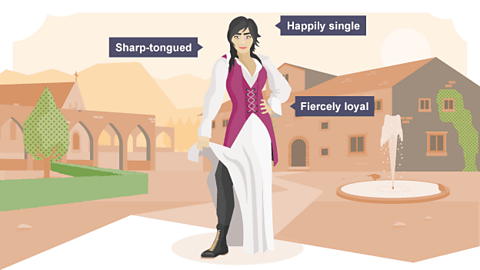
Image caption, Character attributes
1 of 3
Character attributes
- Sharp-tongued – she verbally battles with Benedick, insulting him with her clever use of words.
- Happily single – she rejects love and rejects all offers of love, including Don Pedro’s casual suggestion that they should get married. She can’t get Benedick out of her heart or head, however.
- Fiercely loyal – she is the only character that really stands up for Hero, and wishes that she were a man so that she could do more to defend her cousin’s honour.
Friends and enemies
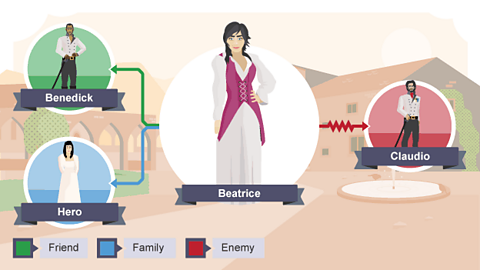
Beatrice’s friends are:
- Hero - her cousin, to whom she is like an older sister
- Benedick – eventually
Her enemy is:
- Claudio - towards the end she wants him killed for injuring Hero
Changes in character
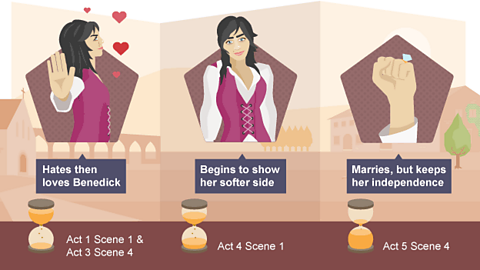
- Beatrice appears to hate Benedick, but falls rapidly in love with him when she thinks he loves her.
- She is quick-tongued and argumentative throughout. At the beginning of the play her arguments seem bitter, but at the end they become playful banter instead.
- Beatrice spends most of the play being more independent than a woman should be in the Elizabethan era – she refuses to marry, is cheeky to her uncle and wishes she was a man to challenge Claudio. At the end of the play she agrees to marry – but she keeps up her independent streak, still pretending not to be madly in love with Benedick.
Character analysis
Question
How does Beatrice use language to hurt Benedick?
Beatrice has a sharp tongue. Benedick tells Don Pedro:
BENEDICK
she speaks poniards, and every word stabs
Act 2 Scene 1
Beatrice is clever and likes to play with language. With Benedick, she uses words as weapons. This quotation proves that her word play is having the desired effect. Poor Benedick complains that her insults hurt him, like daggers leaving a wound.
Question
How does Beatrice show she is easily persuaded?
Beatrice initially claims that she would rather remain single. She vividly informs Benedick and anyone else that cares to listen:
BEATRICE
I had rather hear my dog bark at a crow than a man swear he loves me.
Act 1 Scene 1
But does she mean it? On the one hand, she even turns down the prince’s proposal. But she only wants to remain single until she is led to believe that Benedick is in love with her. It doesn’t take much for her to change her mind and fall in love. She doesn’t repeat her preferences for dog barks when he actually tells her he loves her.
Question
What causes Beatrice’s frustrations when Claudio hurts Hero?
Beatrice is fiercely loyal to her cousin, Hero. She tells Benedick that she would fight Claudio for her cousin’s honour if she could:
BEATRICE
Oh God that I were a man! I would eat his heart in the market place.
Act 4 Scene 1
Beatrice has a fiery temper. As a woman, the other characters are a little afraid of her, or at least think she’s odd – women were supposed to be mild-mannered and quiet, like Hero. Beatrice is frustrated that she can’t take her place in the world as an equal to any man. She is cleverer than all of the other characters in the play. She feels injustice, but can’t do anything about it because she is a woman.
Listening task
In Act 1 Scene 1, Beatrice and Benedick are having a "merry war of words". It is the first time they have seen each other for a while, but Beatrice comments to herself, "I know you of old", suggesting that they may have had a romantic link in the past.
BEATRICE
I wonder that you will still be talking, Signior Benedick, nobody marks you.
BENEDICK
What, my dear Lady Disdain! Are you yet living?
BEATRICE
Is it possible Disdain should die, while she hath such meet food to feed it, as Signior
Benedick? Courtesy itself must convert to Disdain, if you come in her presence.
BENEDICK
Then is courtesy a turn-coat: but it is certain I am loved of all ladies, only you excepted:
and I would I could find in my heart that I had not a hard heart, for truly I love none.
BEATRICE
A dear happiness to women, they would else have been troubled with a pernicious suitor. I
thank God and my cold blood, I am of your humour for that: I had rather hear my dog bark
at a crow than a man swear he loves me.
BENEDICK
God keep your ladyship still in that mind, so some gentleman or other shall scape a
predestinate (fatal) scratched face.
BEATRICE
Scratching could not make it worse, an 'twere such a face as yours were.
BENEDICK
Well, you are a rare parrot-teacher.
BEATRICE
A bird of my tongue is better than a beast of yours.
BENEDICK
I would my horse had the speed of your tongue, and so good a continuer but keep your
way a God's name. I have done.
BEATRICE
You always end with a jade's trick: I know you of old.
Question
Do you find their argument funny or uncomfortable to listen to?
It’s possible to find this argument funny and feel a little uncomfortable as you listen. The director would advise his actors as to whether to play it strongly for comedy, or to allow the audience to become aware of hidden tensions between the two. The exchanges are quick-witted. Perhaps the couple enjoy sparring. Perhaps there’s real resentment on Beatrice’s part, and irritation ON Benedick’s. Perhaps Benedick feels uncomfortable that Beatrice is so obviously upset with him.
Question
Do you think Benedick ends the argument because he:
- knows he can’t win?
- has run out of things to say
- he secretly likes her and she is hurting his feelings by being so horrible to him?
All of the above are possible.
It depends what particular aspects of Benedick’s character the actor or director wishes to bring out.
Benedick
Benedick is an experienced soldier, a man’s man who has no time for romance. He prefers the company of men and claims that he will never get married. It doesn’t take much to make him fall in love with Beatrice when the other characters trick him into thinking that Beatrice is pining away with love for him. He is the only male character, apart from the priest, who believes in Hero when she is wrongly accused of being unfaithful. He is sincere in his love for Beatrice and proves that he will do anything to make her happy.
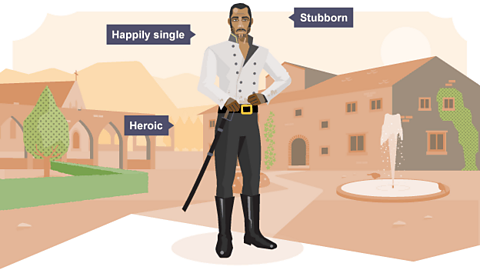
Image caption, Character attributes
1 of 3
Character attributes
- Stubborn – he refuses to talk sensibly to Claudio about Hero, and no matter what Don Pedro and Claudio say, Benedick refuses to see himself as a married man… until the end.
- A sworn bachelor – confusingly, he is the perfect match for Beatrice who also sees herself as a lifelong singleton.
- Heroic – Benedick defends Hero’s honour. He pledges his love to Beatrice in a moving and heroic way. He even promises to kill his friend to please her.
Friends and enemies
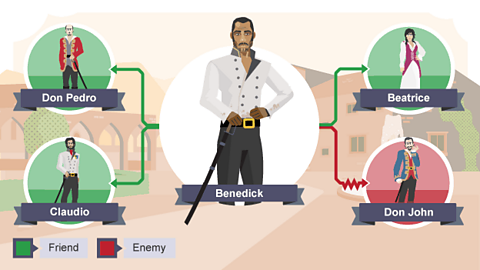
Benedick’s friends are:
- Don Pedro – his brother-in-arms
- Claudio - his brother-in-arms
- Beatrice – eventually
Benedick’s enemies are:
- Don John – Don Pedro’s nasty brother
Changes in character
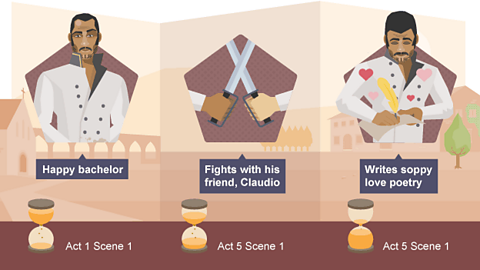
- Benedick begins as a determined bachelor but ends up happily married to a woman he loves.
- He starts off as being Claudio’s best friend, but when Claudio accuses Hero, Benedick believes her, not him. When Beatrice asks, he even challenges Claudio to a duel.
- Benedick’s changes can be quite funny: he starts out complaining about music being too soppy, and ends up writing terrible love poetry to Beatrice.
Character analysis
Question
Benedick can be very stubborn at times. How does this affect Claudio?
Like Beatrice, Benedick likes to play with words. When Claudio asks him what he thinks about Hero he says:He says:
BENEDICK
I noted her not, but I looked on her.
Act 1 Scene 1
He is suggesting here that he saw Hero but she wasn’t worth noticing (noting). He knows that he is infuriating Claudio who wants a man-to-man chat about whether he should ask Hero to marry him, but he doesn’t want to talk about love and marriage, and he doesn’t want to lose his friend to a woman.
Question
Benedick is stubborn but is he easily persuaded?
Yes. Benedick claims that he will never get married, but is easily persuaded to give up his single life when he is tricked into thinking that Beatrice is in love with him.
He says to himself:
BENEDICK
When I said I would die a bachelor, I did not think I should live till I were married.
Act 2 Scene 3
Benedick is still playing with words even when he realises the others will mock him for changing his mind. Are Benedick and Beatrice tricked into falling in love with each other, or have they been in love with each other all along? They are a perfect match. They are both stubborn and couldn’t admit they had feelings for each other.
Question
How does love transform Benedick?
Benedick becomes a romantic hero. He is transformed from an irritating or laughable character into a much more likeable and noble character.
He says to Beatrice:
BENEDICK
I will live in thy heart, die in thy lap, and be buried in thy eyes.
Act 5 Scene 2
He is honest and sincere in his love for Beatrice, seen in this touching quotation. He offers her his life. Listing three phrases together gives the quotation a powerful rhythm and energy.
Did you know? When the play was written, “nothing” may have sometimes been pronounced "noting", so there is a play on words in the title. The story is a fuss about nothing, but also about the chaos caused by what people "note", ie notice and make assumptions about.
Listening task
In Act 2 Scene 3, the other characters have tricked Benedick into believing that Beatrice is in love with him.
Much Ado About Nothing characters - Benedick
BENEDICK
This can be no trick, the conference was sadly borne,
they have the truth of this from Hero, they seem to pity the lady:
it seems her affections have their full bent: love me?
Why, it must be requited: I hear how I am censured,
they say I will bear myself proudly, if I perceive the love come from her:
they say too, that she will rather die than give any sign of affection.
I did never think to marry, I must not seem proud,
happy are they that hear their detractions, and can put them to mending:
They say the lady is fair, 'tis a truth, I can bear them witness:
and virtuous, 'tis so, I cannot reprove it: and wise, but for loving
me: by my troth, it is no addition to her wit, nor
no great argument of her folly,
for I will be horribly in love with her:
I may chance have some odd quirks and remnants of wit broken on me,
because I have railed so long against marriage:
but doth not the appetite alter? A man loves the
meat in his youth that he cannot endure in his age.
Shall quips and sentences, and these paper
bullets of the brain awe a man from the career of his
humour? No, the world must be peopled.
When I said I would die a bachelor, I did not think I should live till
I were married - here comes Beatrice: by this day,
she's a fair lady, I do spy some marks of love in her.
Question
What does Benedick say that suggests he really likes Beatrice?
He says she is “fair”, “virtuous” and “wise”. He repeats the fact that she is “fair” – this means beautiful.
Question
Is Benedick worried about what his friends will think if he changes his mind about marriage?
Benedick realises that his friends will tease him because he was always so anti-marriage. He likes Beatrice so much though, that he finds excuses for why he has changed his mind.
Claudio
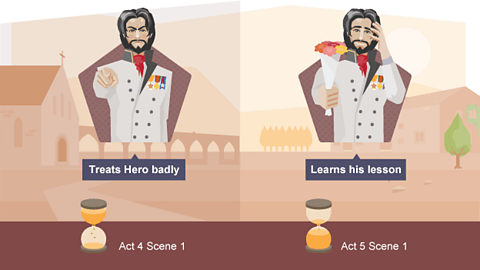
Claudio comes back from battle with medals and the prince’s favour. This annoys Don John who sets out to wreck his life. Claudio decides that he will marry Hero. He thinks she is pretty, but he doesn’t really know her. He is young and inexperienced with women. When Don John begins to cause trouble for him, we see a different side to his character. He can be petty, jealous and easily deceived. Claudio is easily led, but also keen to save his own face at the cost of everyone else. At the end, he thinks that he is marrying Hero’s cousin, but to his surprise and delight, he is given a second chance with Hero.
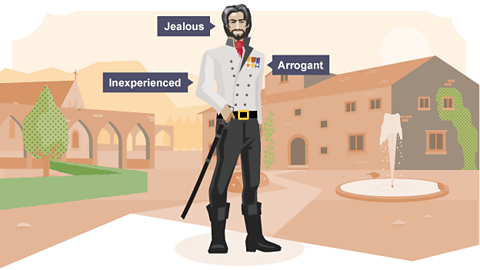
Image caption, Character attributes
1 of 3
Character attributes
- Inexperienced – Claudio asks Benedick for his opinion on Hero. Don Pedro chats Hero up for him.
- Jealous – Don John finds it easy to wind Claudio up. First of all, Claudio thinks that Don Pedro has taken Hero off him. Later, he mistakes Margaret for Hero, with Borachio.
- Impulsive – Claudio ruins Hero’s reputation publicly when he believes that she has been unfaithful.
Friends and enemies
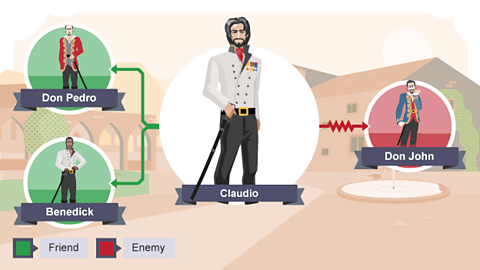
Claudio’s friends are:
- Don Pedro – his prince, who is also deceived by Don John
- Benedick – his best friend, who he almost loses
He is enemies with:
- Don John – his biggest enemy
Changes in character
Claudio initially appears to be a romantic hero, a brave soldier who falls in love with the beautiful girl. But the way he treats Hero when he is deceived by Don John makes him lose this romantic status. He just about recovers our sympathy in his sorrow when Hero ‘dies’ and is proved innocent. Claudio is best friends with Benedick, and loyal to Don Pedro, his prince. But he is easily tricked into sulking with Don Pedro when he thinks he’s stolen his girl. Benedick stops being friends with Claudio when he accuses Hero.
Claudio is easily deceived because he is very jealous about Hero. Towards the end he realises she is completely innocent.
Character analysis
Question
How does Claudio show his inexperience with women?
Claudio is made jealous very easily. Beatrice notes:
BEATRICE
The count is neither sad, nor sick, nor merry, nor well: but civil, count, A pun on Seville oranges which are bitter., and something of that The colour yellow was linked with jealous when the play was written..
Act 1 Scene 1
It shouldn’t matter whether Benedick likes her or not, but Claudio seems very young when he asks Benedick this question. Later, he even agrees when Don Pedro says he will approach Hero for him.
Question
How does Shakespeare show Claudio’s gullibility?
Claudio is made jealous very easily. Beatrice notes:
BEATRICE
The count is neither sad, nor sick, nor merry, nor well: but civil, count, A pun on Seville oranges which are bitter., and something of that The colour yellow was linked with jealous when the play was written..
Act 1 Scene 1
It shouldn’t matter whether Benedick likes her or not, but Claudio seems very young when he asks Benedick this question. Later, he even agrees when Don Pedro says he will approach Hero for him.
Question
Claudio is an arrogant character. How does this trait affect other characters?
Claudio behaves arrogantly towards Hero and her family. When Hero’s father and uncle confront him, he has no time for them and tells Benedick:
CLAUDIO
We had like to have had our two noses snapped off with two old men without teeth.
Act 5 Scene 1
Listening task
In Act 4 Scene 1, the wedding of Claudio and Hero is about to begin. Hero and her family are blissfully unaware that Claudio and Don Pedro have come to publicly shame her (they think they saw Hero kissing Borachio in her bedroom window, but in reality it was Borachio and Margaret).
Much Ado About Nothing characters - Claudio
FRIAR FRANCISYou come hither, my lord, to marry this lady?
CLAUDIO
No.
LEONATO
To be married to her: friar, you come to marry her.
FRIAR FRANCIS
Lady, you come hither to be married to this count?
HERO
I do.
FRIAR FRANCIS
If either of you know any inward impediment why you
should not be conjoined, I charge you on your souls to utter it.
Claudio Know you any, Hero?
HERO
None, my lord.
FRIAR FRANCIS
Know you any, count?
LEONATO
I dare make his answer, none.
CLAUDIO
Oh, what men dare do! What men may do! What men daily
do, not knowing what they do!
BENEDICK
How now! Interjections? Why, then, some be of laughing, as, ah,ha, he.
CLAUDIO
Stand thee by, friar: father, by your leave,
Will you with free and unconstrainèd soul
Give me this maid, your daughter?
LEONATO
As freely, son, as God did give her me.
CLAUDIO
And what have I to give you back, whose worth
May counterpoise this rich and precious gift?
DON PEDRO
Nothing, unless you render her again.
CLAUDIO
Sweet prince, you learn me noble thankfulness:
There, Leonato, take her back again,
Give not this rotten orange to your friend,
She's but the sign and semblance of her honour:
Behold how like a maid she blushes here!
Oh what authority and show of truth
Can cunning sin cover itself withal!
Comes not that blood, as modest evidence,
To witness simple virtue? Would you not swear,
All you that see her, that she were a maid,
By these exterior shows? But she is none:
She knows the heat of a luxurious bed:
Her blush is guiltiness, not modesty.
LEONATO
What do you mean, my lord?
CLAUDIO
Not to be married,
Not to knit my soul to an approvèd wanton…
Question
Imagine how angry Claudio is at this point. On stage, do you think he would act violently towards Hero?
It is possible that Claudio might act violently towards Hero. It would make powerful and disturbing viewing. Perhaps his anger is more restrained. Perhaps he can’t bear to touch her now. What do you think?
Question
At what point does the rest of the wedding party realise that Claudio is not going to marry Hero?
From the text, Claudio’s intentions aren’t obvious until Claudio calls Hero a 'rotten orange'. The audience knows from the beginning what is going to happen, but the rest of the wedding party are blissfully unaware, which is what creates the tension and suspense in this scene.
Don John
Don John is Don Pedro’s half-brother; they share a father. His mum and dad weren’t married when he was born. They are both princes – that’s what ‘Don’ means – but because Don John is not the legitimate son, he can never inherit his father’s land, and his brother will always rule over him. This probably is what makes him so grumpy. He dislikes Claudio because his brother likes him so much. He tries to ruin things for Claudio for fun, and Claudio’s jealous personality makes it easy for him.
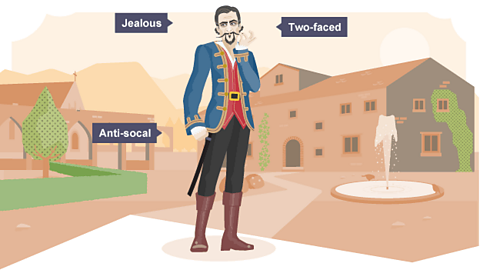
Image caption, Character attributes
1 of 3
Did you know? Don John is a character type called a malcontent. Dissatisfied with life and everyone around him, he delights in making the world a rotten place for all of the other characters, too. Other malcontents in Shakespeare’s plays include Iago in Othello, Hamlet and Richard III.
Character attributes
- Jealous – Don John hates Claudio because everything seems to be going right for him. He also holds a grudge against him for the part he played in Don John’s recent downfall.
- Anti-social – The other characters in the play find his company uncomfortable.
- Two-faced – Incredibly, Don Pedro and Claudio fall for Don John’s lies. He must be a convincing liar, because the audience know what a villain he is.
Friends, family and enemies
Friends, family and enemies
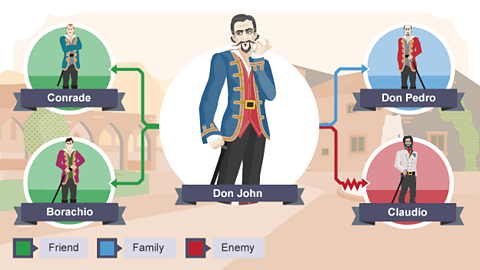
Don John is friends with:
- Conrade
- Borachio
His relatives include:
- Don Pedro – his brother
He is enemies with:
- Claudio
Changes in character
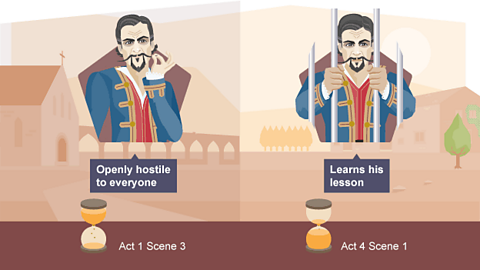
- Don John does not change in reality through the play – but what the other characters think he is, does change. In the beginning Don John is openly hostile. His friend Conrade advises him to try and hide his feelings. He takes the advice and seems quite helpful to Claudio and Don Pedro. Don John delights in ruining the wedding and watching the groom publicly destroy the bride’s reputation. But he hides it, and almost manages to escape.
Character analysis
Question
Don John is a nasty character. Why causes him to hold a grudge against Claudio?
Don John is jealous of Claudio. Don John says about Claudio:
DON JOHN
That young start-up hath all the glory of my overthrow.
Act 1 Scene 3
Whilst Don John is tolerated, Claudio’s bravery is celebrated. Everything seems to be going right for Claudio, and it seems to Don John that this is all at his expense – it was him that they have just beaten in the war. He holds a grudge against Claudio and sets out to ruin him just for entertainment.
Listening Task
In Act 1 Scene 3, Don John is in a very bad mood. His friend Conrade tells him to try and hide his hostility, but Don John explains that he can’t help himself. It’s just the way he is and no one should try to change him.
Much Ado About Nothing characters - Don John
DON JOHN
I cannot hide what I am: I must be sad
when I have cause, and smile at no man's jests: eat
when I have stomach and wait for no man's leisure: sleep
when I am drowsy, and tend on no man's business: laugh
when I am merry, and claw no man in his humour.
CONRADE
Yea, but you must not make the full show of this
till you may do it without controlment. You have of
late stood out against your brother, and he hath
ta'en you newly into his grace, where it is
impossible you should take true root but by the
fair weather that you make yourself: it is needful
that you frame the season for your own harvest.
DON JOHN
I had rather be a canker in a hedge,
than a rose in his grace, and it better fits my blood to be
disdained of all, than to fashion a carriage to rob
love from any. In this (though I cannot be said to
be a flattering honest man) it must not be denied
but I am a plain-dealing villain. I am trusted with
a muzzle and enfranchised with a clog, therefore I have decreed not
to sing in my cage. If I had my mouth, I would bite: if I had my
liberty, I would do my liking. In the meantime let me be that I am
and seek not to alter me.
Question
Why is he so angry?
Don John feels that he is like a prisoner. He is angry because he is forever under his brother’s rule.
Question
Why is he so angry?
Don John feels that he is like a prisoner. He is angry because he is forever under his brother’s rule.
Additional characters
Don Pedro
Don Pedro is the Prince of Aragon. He is a guest at Leonato’s house having recently returned from battle. He has had some trouble with his half-brother, Don John. Don Pedro proposes to Beatrice, but she doesn’t take him seriously. He challenges the other characters to set Beatrice and Benedick up before the week is over.
At the very end of the play, Benedick advises the prince to:
BENEDICK
Get thee a wife, get thee a wife
Act 5 Scene 4
Character attributes
- Charming
- Single
Borachio
Borachio’s name means drunkard. He is Don John’s henchman and enjoys playing a mean trick on Claudio, but is sorry when he is arrested and learns how devastating the results are for Hero. He seems to do well with the ladies, Margaret in particular.
Just before he is arrested, Borachio gleefully tells Conrade:
BORACHIO
I will, like a true drunkard, utter all to thee.
Act 3 Scene 3
Character attributes
-Dishonest-Boastful
Conrade
Conrade is Don John’s henchman. He advises Don John not to show his true feelings so clearly. Later, he gets arrested when Borachio is boasting about his part in Hero’s downfall.
In Act 1 Scene 3, Don John tells him not to give out advice when he’s as miserable as Conrade is:
DON JOHN
I wonder that thou (being as thou sayest thou art, born under Saturn) goest about to apply a moral medicine to a mortifying mischief.
Act 1 Scene 3
Character attributes
- Miserable
- Dishonest
Did you know? In Elizabethan times, people born under the influence of the planet Saturn were thought to be moody and miserable.
Leonato
Leonato is the Governor of Messina. He is Hero’s dad. Leonato welcomes Don Pedro and his followers to his house. He also takes care of Beatrice, his niece. He is friendly and full of fun when things are going his way. He’s very quick to believe the prince and Claudio over his own daughter, though. He pretends to the world that his daughter is dead, rather than publicly sticking up for her. He is very forgiving of Claudio though, as he still allows him to marry his daughter at the end.
At the very beginning of the play in Act 1 Scene 1, Leonato sums up the moral of the story and gives insight into his good nature with this philosophy:
LEONATO
How much better is it to weep at joy, than to joy at weeping!
Act 1 Scene 1
Character attributes
- Kind hearted
- Hot-tempered
Hero
Hero is Leonato’s daughter. Claudio asks for her hand in marriage. Hero doesn’t have much say in the matter; it’s for her father to decide. Hero’s cousin, Beatrice is also her close friend. Hero is quiet and mild mannered, but she is confidently in charge when they trick Beatrice. She does not stand up for herself when she is accused of being unfaithful. She has to pretend to die, before being married to Claudio for a second time.
In Act 1 Scene 1, Claudio says that Hero is:
CLAUDIO
…the sweetest lady that ever I looked on.
Act 1 Scene 1
Character attributes
- Quiet
- Innocent
Antonio
Antonio is Leonato’s brother. He is an old man, but he wants to defend his niece’s honour and stands up to Don Pedro and Claudio to support his brother. He threatens Claudio in Act 5 scene 1:
ANTONIO
Sir Boy, I’ll whip you from your
Act 5 Scene 1
Character attributes
- Loyal
- Hot-tempered
Margaret
Margaret is Hero’s lady-in-waiting. She likes boys a lot and even flirts with Benedick. She also likes telling dirty jokes. Her night with Borachio gets Hero into deep trouble. Borachio says that she knew nothing about the nasty trick that is played on Claudio, but it’s difficult to tell.
Borachio defends Margaret’s character, but can he be trusted? He says in Act 5 Scene 1 that she:
BORACHIO
…always hath been just and virtuous.
Act 5 Scene 1
Character attributes
- Tactless
- A flirt
Ursula
Ursula is Hero’s lady in waiting. She is much more sensible than Margaret, but in Act 3 Scene 1, she heartily joins in with the trick that is played on Beatrice:
URSULA
Fear you not my part of the dialogue.
Act 3 Scene 1
Character attributes
- Sensible
- Loyal
Friar Francis
Friar Francis is shocked by the events at the wedding. He doesn’t know Hero very well, but he can tell that the outrageous things they say about her are lies. He comes up with the plan to pretend that Hero is dead to make Claudio feel sorry. You might think a holy man shouldn’t tell lies. Everybody else in the play does it, though!
The Friar defends Hero in Act 5 Scene 4:
FRIAR
Did I not tell you she was innocent?
Act 5 Scene 4
Character attributes
- Kind
- Wise
Dogberry
Dogberry is the constable in charge of the watch. He unintentionally saves the day. He roots out the villains and clears Hero’s name. He is completely serious, and very honest. The way he speaks is funny because he tries to use big words and gets them wrong all the time.
In Act 4 Scene 2, he is taking down Conrade and Borachio’s statements and Conrade calls him an ass. He wants this written down. He says:
DOGBERRY
…though it be not written down, yet forget not that I am an ass
Act 4 Scene 2
Character attributes
- Proud
- Well meaning
Verges and the Watchmen
These are the 'policemen' that work with Dogberry. They are comic figures, but if you look beyond this, they are the only truly honest characters in the play.
When they arrest Borachio, the second watchman says:
DOGBERRY
…we have here recovered the most dangerous piece of lechery, that ever was known in the commonwealth.
Act 4 Scene 2
Character attributes
- Honest
- Fools
Other characters include:
- The Sexton, who helps Dogberry to examine the suspects.
- Balthasar, who is Don Pedro’s personal musician.
- A boy, Benedick’s servant.
- Attendants, messengers and musicians.
Test yourself
More on Much Ado About Nothing
Find out more by working through a topic
- count4 of 5
- count5 of 5
- count1 of 5

- count2 of 5

