Themes
There are many themes in Much Ado About Nothing. Explore the main themes of love, conflict and appearance and reality looking at how they affect characters and influence the story.
Key themes
For a play with a title that claims that it’s not about very much, it explores some quite big themes. Themes are the main ideas that keep appearing in a play, story or poetry. The themes covered in Much Ado About Nothing are serious and complex even though the play is a comedy.
Some of the important themes in Much Ado About Nothing are:
- love
- conflict
- appearance and reality
Love
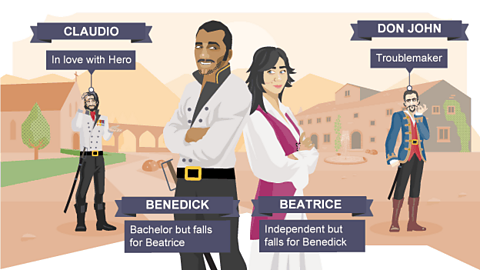
The play suggests that love is a tricky business, and that marriage should not be entered into lightly. Shakespeare shows us that young love can be passionate, jealous and fragile. The fine line between love and hate is explored for us to laugh at. There is the love and easy laughter that is shared between friends and the complex and often troubled love that exists between a father and his daughter. In the end, it is love, rather than hate that wins the day. Four hundred years ago, an audience loved a happy ending just as much as we do today.
Exploring love as a theme in Shakespeare's comedy, 'Much Ado About Nothing'.
VOICEOVER
In Much Ado About Nothing, love seems a bit like a game.
It’s a game that’s both fun, funny and entertaining to watch.
And deadly serious.
I wonder if this is why he’s called Shakey?
Oh dear. For example, Beatrice and Benedick’s friends
play a trick on them to get them together.
Love wins through in the end, as Beatrice and Benedick
really do love one another.
But what about the cruel game played by Don John?
Don John makes Claudio think that his bride-to-be,
Hero, is unfaithful. What happens to love then?
Claudio publicly shames Hero. He doesn’t believe her at all. Ouch.
And Hero’s dad Leonato. He doesn’t believe his own daughter.
His love is hardly unconditional.
Shakespeare’s telling us that love can win
where we expect it to fail,
and fail where we expect it to win.
But don’t worry.
It’s a happy ending despite the twists and turns.
Love wins in the end.
Question
Does Claudio really love Hero?
Claudio thinks that he is in love with Hero, but he doesn’t even know her. He tells Don Pedro and Benedick:
Claudio
That I love her, I feel.
Act 1 Scene 1
If Claudio had got to know Hero, and really loved her, he would have believed her over Don John. Their situation contrasts strongly with Benedick’s promise to go to any lengths to prove his true love to Beatrice. Claudio isn’t even very sure what love is. He has to rely on Don Pedro to do his wooing and when he is accusing Hero of being unfaithful, it becomes apparent that his ideas of love come from Greek stories that he has read. Furthermore, does Hero love Claudio? She has to agree to marry whomever her father chooses. She does seem quite pleased with him though – giggling with Ursula about how handsome he is.
Question
How does love affect Benedick and Beatrice’s relationship?
Benedick and Beatrice have had some sort of romance in the past. Regarding Benedick’s heart, Beatrice tells Don Pedro:
BEATRICE
…he lent it me a while, and I gave him use for it, a double heart for his single one.
Act 2 Scene 1
We have our suspicions from the beginning that Beatrice and Benedick have a history together. Later Beatrice tells Don Pedro that when she gave her heart to Benedick, he treated her badly. The couple have so much in common, it’s a relief when they get together. Their relationship might be fiery, but it will always be exciting.
Question
How does Shakespeare broach the subject of unconditional love?
Leonato withdraws his love from Hero when Claudio accuses her of being 'a common stale'. This is a very nasty way of saying that she is not a virgin. He wishes her dead and shouts at her:
LEONATO
Why ever wast thou lovely in my eyes?
Act 4 Scene 1
From Leonato’s speech, he has obviously doted on Hero, but he believes the apparently honourable Claudio and Don Pedro about her. She has disappointed him and rather than live with the shame, he wishes her dead. His love is not unconditional.
Did you know? In Shakespeare's day, couples rarely married for love. Girls certainly had no choice in the matter. It was the norm in Shakespeare’s day that they were seen as their father’s property until they got married and became their husband’s property.
You can find the theme of love in lots of Shakespeare’s plays:
- look at Romeo and Juliet for the ultimate story of young love
- look at Othello for jealous love
- look at The Taming of the Shrew for a pair of lovers who love to hate each other
- look at The Merchant of Venice for loving friendships
- look at The Tempest, Romeo and Juliet and The Merchant of Venice for fathers whose love for their daughters is tested
Conflict
The theme of conflict certainly adds spice to the story. Some characters feed off their conflict. Some characters need to experience conflict to learn what it is to be happy. The trouble in the play is brought about by unresolved conflict.
Exploring conflict as a theme in Shakespeare's comedy Much Ado About Nothing.
[CAPTION-CONFLICT]
VOICEOVER
There’s conflict in every drama. That’s what makes it dramatic.
Don’t believe me? Think of anything.
What about a nature documentary about penguins?
Well the conflict is between the penguin and the harsh environment.
[SFX WHISTLING WIND TO SHOW EXTREME COLD] Ok. Point made.
In this play Shakespeare shows us how unresolved
conflict can affect us all. Now -
First there is the unresolved conflict between…
Listen can we not lose the penguin?
[UNCERTAIN] Ok. So there’s unresolved conflict between
Don Pedro and Don John.
Don John is the cause of all the nasty conflict in the play.
Whereas the conflict between Benedick and Beatrice
is highly entertaining.
In both cases, there is a conflict within the characters
about how they feel and how they should act.
And they resolve this conflict in the play in much the same way
as the penguin resolves its conflict with the icy cold.
What?!? Penguins don’t have knitwear.
Or flamethrowers. I don’t think this is right.
Can we not get rid of this misleading penguin?
What’s that?
Shakespeare loves the penguin?
He wants to rename the play,
‘Much Ado About Penguins’?
Are you sure?
Analysis of conflict in the play
Question
How does conflict play a part in Don John and Don Pedro’s relationship?
Don Pedro and Don John have supposedly resolved their conflict when the play begins. But Don John complains to Conrade:
DON JOHN
I am trusted with a muzzle, and enfranchised with a clog, therefore I have decreed not to sing in my cage.
Act 1 Scene 3
Don John obviously will not be put in his place and will always resent his position as the half-brother of the prince. He complains that although he is supposedly trusted, he’s actually being restricted like an animal; he says he won’t 'sing' in his cage, that is, act nicely and be friendly. He uses his situation in life as an excuse to cause distress in the lives of others.
Question
Can conflict be entertaining to an audience?
Yes, the conflict between Benedick and Beatrice is highly entertaining. Leonato says:
LEONATO
there is a kind of merry war betwixt Signor Benedick and her
Act 1 Scene 1
Each character plays on words in an effort to outwit one another. The irony is that in their conflict, they display such common characteristics that their relationship can only ever end in harmony and mutual respect.
Question
How does conflict affect Leonato and Hero’s relationship?
The conflict between Leonato and Hero is distressing. Leonato says:
LEONATO
If they speak but truth of her,These hands shall tear her
Act 4 Scene 1
Hero never speaks directly to her father in this scene, not even to defend herself. Leonato talks of his overwhelming love for Hero, and how devastated he is at her betrayal. We know that she deserves his love, and that he should be proud of her. Beatrice and the priest speak up for Hero, but Leonato won’t listen.
Question
How does Dogberry indirectly resolve the conflict between Claudio, Don Pedro and Leonato?
Dogberry’s watchmen capture Borachio. Dogberry arrests him. The constable and his watchmen are comic characters but they are the only truly honest characters of the play. By delivering Borachio and Conrade to Leonato in the presence of Don Pedro and Claudio, Dogberry reveals Hero’s innocence and makes Don Pedro and Claudio ashamed of their previous behaviour.
Dogberry says to Leonato:
DOGBERRY
I leave an arrant knave with your worship, which I beseech your worship to correct yourself, for the example of others
Act 5 Scene 2
You can find the theme of conflict in lots of Shakespeare’s plays:
- look at Romeo and Julietfor conflict in the streets
- look at A Midsummer Night’s Dream for marital conflict in the woods
- look at Julius Caesar for political conflict
- look at Othello, Romeo and Juliet and The Merchant of Venice for fathers whose love for their daughters is tested
Appearance and Reality
Sometimes things are not quite what they seem. Sometimes we fail to see situations as they really are. People often pretend to be something that they’re not, hiding their true selves for one reason or another. Shakespeare was really interested in this idea and explored it in many of his plays. This theme is usually referred to as Appearance and Reality.
Exploring appearance and reality as a theme in Shakespeare's Much Ado About Nothing.
[CAPTION- APPEARANCE AND REALITY]
VOICEOVER
Sometimes we think we know people.
But do we really?
And sometimes we think we know what’s happening around us.
But we misread the situation entirely.
See? That was just a power cut during the
filming of a banana commercial.
And he’s a highly paid monkey.
In Much Ado about Nothing, Shakes–hang on.
That monkey doesn’t have a girlfriend, does he? Blimey!
In Much Ado about Nothing, Shakespeare shows us that
hiding our true image can be fun!
Who doesn’t like a masked ball?!
But there’s also nasty trickery.
Remember Don John’s evil scheme?
And trickery for goodness’ sake,
like when Hero pretends to be dead!
And trickery for fun! Like the trick played on
Beatrice and Benedick. Well, it starts off as fun.
But ends up with them getting married!
That’s because underneath the appearance of being horrible
to each other, the reality is they love one another.
You can stop pretending to hate each other now.
Wow. The lengths that some people go to keeping up appearances.
Question
Why were masked balls so popular in Shakespeare's day?
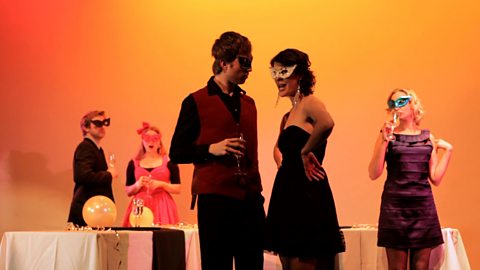
At a masked ball, everyone has fun pretending to be someone else. In the play Ursula says:
URSULA
Come, come, do you think I do not know you by your excellent wit?
Act 2 Scene 1
Masked balls were fun. People could behave in unexpected ways, comfortably hidden behind a mask. But in this scene, the fun backfires for some characters. Benedick’s feelings are hurt by Beatrice. Claudio is fooled by Don John. In both these cases the masks fail to do a proper job of disguise.
Question
How does Borachio use the theme of appearance and reality to fool Claudio and Don Pedro?
Borachio gets Margaret to pretend that she is Hero whilst he embraces her in Hero’s window. Borachio outlines his plan to Don John:
BORACHIO
hear me call Margaret Hero, hear Margaret term me Claudio
Act 2 Scene 2
It’s a bit of a mystery why Margaret agrees to do this – she is full of naughty fun and perhaps really doesn’t know that Don Pedro and Claudio are standing at the foot of the window watching. Claudio and Don Pedro are convinced that they are watching Hero. It’s baffling that they believe this. It’s so far from reality. But they do, and the play takes a dramatic turn.
Question
What impression of Hero is Claudio giving when he describes her as a 'rotten orange'?
This is the ultimate appearance and reality metaphor. Claudio is saying that Hero looks sweet, like an orange on the outside, but when you peel away the outer layer, she, like a rotten fruit, is foul and spoilt. Ironically, he is completely wrong. She is as sweet in reality as she appears.
He tells Leonato:
CLAUDIO
Give not this rotten orange to your friend
Act 4 Scene 1
Question
Why does the Friar tell Leonato to pretend that Hero is dead?
The Friar’s logic is that if Claudio thinks that he has lost Hero forever, he will learn to treasure her.
The Friar says to Hero:
FRIAR
Come, lady, die to live
Act 4 Scene 1
Leonato comments that she might as well be dead, because her reputation is ruined. Poor Hero. Claudio goes on to marry a woman he thinks he doesn’t know. To his joy and surprise, the girl at his side is Hero in disguise. Luckily, he is given a second chance at happiness.
You can find the theme of Appearance and Reality in lots of Shakespeare’s plays:
- look at Romeo and Juliet for another masked ball
- look at Twelfth Night and The Merchant of Venice for girls in disguise (as boys)
- look again at Romeo and Juliet for girls pretending to be dead, but this play has a much unhappier ending
- look for villains that temporarily get away with pretending to be the good guy in plays such as Macbeth, Richard II, Othello
Test yourself
More on Much Ado About Nothing
Find out more by working through a topic
- count3 of 5
- count4 of 5
- count5 of 5
- count1 of 5