What are enzymes?
NARRATOR
Food provides our bodies with energy. Digestion starts in the mouth, continues to the stomach and is completed in the small intestine. Digestion is essentially the breaking down of large insoluble food molecules into small soluble ones that can then be absorbed into the bloodstream.
Enzymes are proteins and they speed up this process without being used up.
Carbohydrase’s are enzymes that break down carbohydrates into simple sugars like glucose.
Protease’s break down proteins into amino acids.
Lipase’s break down fats into fatty acids and glycerol.
The digested food molecules then move down to the ileum, the final part of the small intestine which is adapted for absorption.The ileum is long and has a large surface area with plenty of folds. It is covered in tiny finger-like structures called villi to help with the absorption. The villi are one single cell thick so it’s easier for nutrients to pass through.
Each villus has a good blood capillary network that absorbs nutrients like glucose and amino acids into the bloodstream to transport to cells around the body. And they also have one central lacteal, a small vessel that absorbs fatty acids and glycerol from the digested fats.
Every time we eat, this process kicks into action to ensure food is efficiently broken down and absorbed to make the bodies energy and nutrient needs.
Enzymes are proteins that act as biological catalysts.
They speed up the rate of reactions without being used up.
Enzyme action
Each enzyme has an active site, which is where the reaction takes place.
The lock and key model explains how enzymes work:
The enzyme is like a "lock".
The substrate (the molecule it reacts with) is like a "key" that fits into the lock.
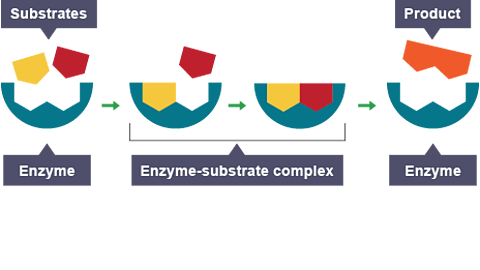
Key facts about enzymes:
an enzyme’s active site and its substrate are complementary in shape
enzymes and substrates collide to form enzyme-substrate complexes
the substrates are broken down or built up quickly
the products are released
the enzyme can be used over again
Enzyme specifity
Each enzyme is specific and acts on only one substrate to catalyse one reaction.
The active site has a specific shape that is complementary to the shape of its substrate, allowing them to fit together like a lock and key, meaning each enzyme works with only one specific substrate.
Inhibitors
Inhibitors are molecules that fit into an enzyme’s active site but are not broken down.
They stop the substrate from fitting into the action and prevent enzyme-substrate complexes forming so reduce the rate of reaction.
How does temperature affect enzyme activity?
As temperature increases the rate of enzyme activity increases, up to the The temperature, pH or enzyme concentration that allows the enzyme to work at its best. temperature, as more Energy which an object possesses by being in motion. causes more collisions between the enzyme and A substance on which enzymes act. forming more enzyme-substrate complexes.
Above the optimum temperature the enzyme’s active site becomes When an enzyme’s active site loses its shape meaning it can no longer work..
This means the Region of an enzyme where the substrate attaches. changes shape and can no longer form enzyme-substrate complexes, leading to a decrease in enzyme activity.
Denaturation is a permanent change.
How does pH affect enzyme activity?
pH
Deviating from the optimum Scale of acidity or alkalinity. A pH (power of hydrogen) value below 7 is acidic, a pH value above 7 is alkaline. (too high or too low) causes the enzyme’s active site to become denatured and the active site changes shape.
It can no longer form enzyme-substrate complexes, leading to a decrease in enzyme activity.
Watch: A BBC Teach clip investigating the effect of pH on enzyme activity
NARRATOR
This investigation tests how well the enzyme amylase performs at different pH values.
Amylase is a carbohydrase enzyme made by the pancreas and by glands in and around the mouth and throat.
It helps the body to break down carbohydrates and starches into sugar.
pH varies in different parts of the digestive system, and enzymes are developed to work in specific conditions.
You’ll need a variety of equipment.
To mimic what happens in the body, the carbohydrate solutions should be close to body temperature, approximately 35°C.
An electric water bath is the easiest way to control this temperature.
Using a pipette with a spotting tile allows you to take tiny continuous samples from your test tubes rather than using multiple test tubes.
Before you begin, check that your water bath temperature has reached 35°C.
Using a syringe, add amylase solution and buffer solution to a test tube.
Immediately sit the test tube in the water bath, and set the stopclock for five minutes.
Buffer solution resists changes in pH, helping to keep the pH constant throughout the investigation.
The syringe will give a more accurate measurement than a measuring cylinder — this is important when dealing with small volumes.The boiling tube needs to stay in the bath for five minutes to allow the solution inside to adjust to the 35°C temperature.
Put a drop of iodine into each well of your spotting tray.
Iodine is used to test for the presence of starch — if starch is still present, this will show that the enzyme has not broken it down into sugar.
Once the timer reaches five minutes, add starch solution to the boiling tube and immediately begin sampling using your pipette.
You should sample every 30 seconds — use your stopwatch to time this accurately.
You’ll know that the enzyme is working at the point that the iodine does not change colour to blue-black — indicating that there is no more starch present.
Variables in this investigation:
- Independent variable: pH
- Dependent variable: Time taken for starch to break down
- Control variables: Temperature, concentration and volumes of solutions, and incubation time
To calculate the rate of the reaction, use:
- Rate = 1000 ÷ time taken
- Units: s⁻¹
To improve accuracy, repeat the experiment at the same pH using smaller time intervals, focusing in and around the time when starch was no longer detected.
Enzyme concentration
As the enzyme concentration increases, the rate of enzyme activity increases because there are more enzymes to form enzyme-substrate complexes.
This happens up to a certain point. Enzyme activity then levels off (plateaus) as there are not enough substrate molecules to react with the extra enzymes.
Optimum
The The temperature, pH or enzyme concentration that allows the enzyme to work at its best. value is the level at which the reaction rate is at its maximum, ie, fastest.
Practical 1.4 - Effect of temperature on the action of an enzyme
Procedure:
Add 20ml of hydrogen peroxide (H₂O₂) to each test tube
Place each test tube in a water bath set at different temperatures (eg 10°C, 20°C, 30°C, 40°C, 50°C)
Add 2g of raw potato (which contains catalase enzyme) to each test tube
Measure the volume of oxygen gas produced using a gas syringe for 1 minute
Record results
Results
| Temperature / °C | Volume of oxygen gas produced / ml |
|---|---|
| 10 | 5 |
| 20 | 10 |
| 30 | 25 |
| 40 | 35 |
| 50 | 0 |
Conclusion
As the temperature increases, the rate of enzyme activity increases, up to 40°C, which is the optimum temperature for the enzyme.
Beyond 40°C, the enzyme becomes denatured.
Independent variable: temperature / °C
Dependent variable: volume of oxygen gas produced / ml
Control variables:
- same volume and concentration of hydrogen peroxide
- same mass of potato (enzyme)
- collect gas for same time
What role do enzymes play in the digestive system?
Enzymes are used in the Organ system involved in breaking food down so that it can be absorbed into the bloodstream. to break large, complex, insoluble food molecules into small, simple, soluble molecules so they can be absorbed into the bloodstream.
| Enzyme | Substrate | Product |
|---|---|---|
| Carbohydrase or Amylase | Starch | Simple sugar, glucose |
| Protease | Protein | Amino acid |
| Lipase | Fat (lipid) | Glycerol and fatty acids |
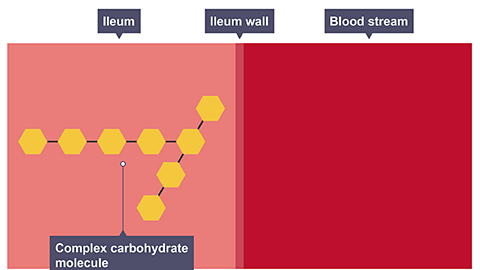
Image caption, Molecular breakdown
A large, insoluble food molecule enters the ileum.
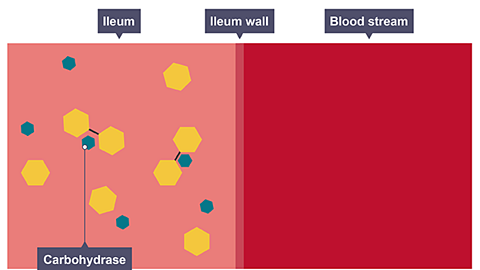
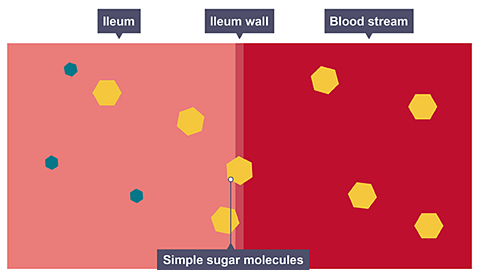
1 of 3
The small intestine (ileum)
Most food is digested in the ileum by enzymes. Its main function is to absorb digested food into the bloodstream for transport to body cells.
Adaptation of the ileum for absorption:
- large surface area – due to being long and folded
- thin – digested food doesn’t have to travel far to reach the blood
- permeable – digested food can pass through easily
- good blood supply – to maintain the The difference in concentration between two solutions, between different cells or between cells and a surrounding solution. for The random movement of a substance from a region of high concentration to a region of low concentration. between the ileum and bloodstream
- villi – finger like projections that further increase surface area
Features of the villi that aid absorption:
- good blood supply – a villus has a large network of Small, permeable blood vessels present in the organs of the body that allow the diffusion of substances like oxygen and glucose.. Once blood becomes high in digested food products it is transported away and replaced with blood that is low in digested food products. This maintains the concentration gradient necessary for diffusion between the ileum and bloodstream.
- lacteal – a tube that absorbs the products of fat digestion before returning them to the blood
- single layer of surface Type of tissue that lines or covers surfaces of an organism. It is made up of epithelial cells. cells – this reduces the diffusion distance that digested food products have to travel in order to enter the bloodstream
- permeable – digested food can pass through easily
What are the commercial and economic uses of enzymes?
Enzymes are used in biological washing powders to break down stains.
- Protease breaks down proteins (eg blood, egg stains).
- Lipase breaks down fats and oils (eg grease stains).
- Amylase breaks down starches (eg food stains).
Advantages:
- work quickly at lower temperatures, saving energy and money
Disadvantages:
- enzymes are denatured at temperatures above 40°C
- some people may be allergic to enzymes, leading to skin irritation
How much do you know about enzymes?
Digestive system activity
Play this game to explore how food is processed by the human body.
More on Living processes
Find out more by working through a topic
- count5 of 6
- count6 of 6
- count1 of 6