What are hormones?
Hormones are chemical messengers.
They are:
- released by glands
- travel in the blood
- carried to target organ or organs
Compared to the nervous system, hormones are much slower and act over a longer period – sex hormones such as testosterone and oestrogen act over years.
Hormones play an important role in maintaining a constant state within the internal environment of the body in response to changes both inside and out.
This is known as homeostasis and is necessary for the proper functioning of cells and enzymes.
Two examples of hormones in the homeostatic role:
- Insulin – controlling blood glucose concentrations
- ADH – controlling the water content of the body, referred to as osmoregulation
How does insulin work?
After eating a meal, blood glucose levels increase.
Pancreas monitors blood glucose concentration.
Pancreas produces insulin in response to increasing blood glucose concentration.
Insulin causes the liver to reduce blood glucose concentration by:
- increasing glucose absorption from the blood by the liver and muscles
- respiring the absorbed glucose
- converting excess glucose to glycogen which is stored in the liver and muscles
Negative feedback (Higher tier)
This is a mechanism to ensure the concentration of a substance does not deviate too far from normal.
These mechanisms usually involve a hormone and the continual monitoring of the substance being controlled, eg the pancreas adjusting the amount of insulin it makes depending on the blood glucose concentration.
It’s known as negative feedback because an increase in hormone decreases the substance being controlled, eg an increase in insulin decreases blood glucose concentration.
Diabetes
Diabetes is a disorder where the body can't control its glucose concentration.
Glucose is the main energy source for all the cells of the body, so it's kind of important to keep its concentration right.
It's produced from the digestion of carbohydrates, so every time you eat something, it's absorbed into the bloodstream.
The blood is always carrying glucose, so it's available for cells as and when they need it.
The amount of glucose going into your body, and the amount you’re using changes through the day.
So the concentration of glucose -or blood sugar - changes all the time.
But if the concentration gets too high the glucose becomes dangerous and starts damaging cells, tissues and organs.
And if it gets too low your cells can't function properly.
So there has to be a glucose control system, and that's where insulin comes in.
Insulin is a protein hormone made in the pancreas and carried around the body in the blood.
The pancreas cells are sensitive to the blood sugar concentration, so as soon as it starts rising they release more insulin into the blood.
That Insulin acts like a switch, allowing cells to absorb more glucose.
The Insulin also affects your liver cells.
Liver cells convert excess soluble glucose to an insoluble carbohydrate called glycogen which is stored in the liver and the muscles.
That’s what happens when the blood glucose concentration rises, so what about when it drops?
Well, your pancreas releases less insulin, and your liver and muscle cells remove less glucose from the blood.
Glycogen may be converted back into glucose within the liver cells, and released into your blood.
Or Glycogen can also be converted back into glucose in your muscle cells they use it themselves.
So, the body's always maintaining a delicate balance, keeping glucose levels in a safe range and if that balance goes wrong, that's diabetes.
There are two types of diabetes, and they're called…'type 1'… and… 'type 2'. It's really original, right?
The symptoms are similar, but the causes are different.
Type 1 diabetes is when the body's immune system attacks the pancreas, destroying the cells which produce insulin.
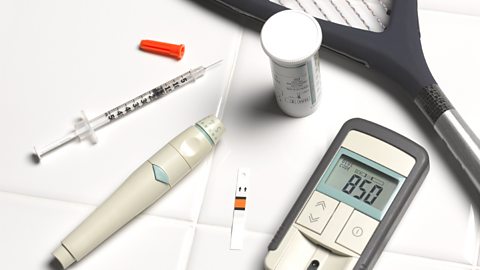
If someone has type 1 diabetes they have to inject themselves with insulin, to replace the insulin that their body can't make.
And if it is untreated, the blood glucose levels just keep rising.
They have to monitor their blood glucose concentration regularly be aware of what and how much they've eaten, and how much exercise they've done.
Type 1 affects a relatively small percentage of the population, often young people and researchers don't yet fully understand the causes.
Type 2 diabetes is much more common.
It's caused by the effects of cells in the body becoming resistant to insulin so much so that the pancreas can't compensate, however much insulin it takes.
Someone is more likely to develop type 2 if other members of their family have it.
Other factors increase the risk too though such as age, and there's also weight: 80 to 85% of people with type 2 are obese.
A lack of exercise and an unhealthy diet are therefore major risk factors.
The good news on that is that by losing weight, eating carefully and exercising, many people can completely reverse the problem.
In the most severe cases Insulin injections are needed.
Understanding diabetes really is important, because the numbers of people affected by it are rising at an alarming rate.
But hopefully if we encourage people to eat well and exercise more, we can get it under control.
Diabetes occurs when someone cannot control their blood glucose levels.
This happens because they either don’t produce enough insulin or none at all.
Symptoms:
glucose in the urine – blood glucose concentration is so high that some is filtered out by the kidneys and passed into the urine
high blood glucose levels
being thirsty
the need to go to the toilet a lot
lethargy – feeling tired / having low energy
What are the differences between Type 1 and Type 2 diabetes?
| Type 1 diabetes | Type 2 diabetes | |
|---|---|---|
| Develops | develops usually early in life | in people over 40 (a progressive disease linked to poor diet/lack of exercise/obesity) |
| Effect | pancreas stops producing insulin | pancreas gradually produces less insulin |
| Treatment | insulin injections / diet - reduce carbohydrate intake | diet - reduce carbohydrate intake / increase exercise to lose weight / insulin injections |
| Future | developing nasal insulin | rising Type 2 diabetes cases due to obesity - becoming more common in young people |
What are the long term effects of diabetes?
eye damage/blindness
heart disease
stroke
kidney damage
These complications are due to high blood glucose concentrations damaging the capillaries that supply that part of the body.
Why is the number of people with Type 2 diabetes increasing?
- Obesity: poor diet and less exercise lead to weight gain, which raises the risk of Type 2 diabetes.
- Aging population: older people are more likely to develop Type 2 diabetes.
- Less activity: modern, less active lifestyles contribute to the problem.
- Better diagnosis: better awareness and improved medical testing so more people being diagnosed.
- Genetics predisposition: family history makes some people more likely to get Type 2 diabetes.
Osmoregulation
Watch: Explaining the role and function of the kidneys and the process of osmoregulation
Osmoregulation controls water levels in the body. Poor control can damage cells.
The kidneys are essential for maintaining this water balance.
Water is gained and lost from the body in the following ways:
| Gain water | Lose water |
|---|---|
| drinking | evaporation in lungs |
| eating | evaporation of sweat by skin |
| respiration | production of urine by kidneys |
In normal conditions, the amount of water gained balances with the amount lost.
If conditions change, osmoregulation brings the volumes back into balance.
| Change in conditions | Body water levels | Osmoregulation | Effect |
|---|---|---|---|
| hot weather or exercise | lose more water as sweat | kidneys produce small volume of concentrated urine. Develop thirst and so will drink more | less water is lost / water levels increase |
| drink more than normal | gain more water | kidney produces large volume of dilute urine | more water is lost / water levels decrease |
Hormones and the excretory system
The function of the kidneys:
remove waste from the body
osmoregulation (water balance)
How the kidney works:
Blood enters kidney via the renal artery
The kidneys filter waste from the blood and removes excess water forming urine
Urine passes into the ureter
Urine is stored in the bladder
Urine is passed out the body via the urethra.
Anatomy and physiology of the kidneys
ADH – anti-diuretic hormone (Higher tier)
When the brain detects lower than normal water levels in the blood, antidiuretic hormone (ADH) is produced. It travels in the blood to its target organ – the kidneys.
It causes the kidney to reabsorb more water.
This produces a lower volume of more concentrated urine and returns blood water levels to normal.
When the brain detects higher than normal water levels in the blood (eg from drinking more than normal), less or no ADH is produced.
Less water is reabsorbed back into the blood by the kidneys.
This produces a larger volume of dilute urine and returns blood water levels to normal.
Plant hormones
Plants need to respond to the world around them just like we do, and for them, two of the most important things are gravity and light.
They need to figure out which way is up and which is down, and they need to know where the light is so they can photosynthesise. So how do they do that?
Well, mainly they use hormones. In particular, a group of plant hormones called auxins.
Auxin controls growth in the meristems near the tips of the shoots and roots causing shoot cells to grow more and root cells to grow less.
So… the pattern of auxin distribution around the plant is really going to change the way it grows.
If a plant tip had loads of auxin on the left side and hardly any on the right, the left side would grow way more than the right and we'd end up with a very lopsided plant.
It looks weird but it does happen, and it's a really important process.
Plants need to respond differently to light depending on where it’s coming from to help them maximise photosynthesis.
When light falls evenly on the shoot, the auxin spreads evenly through the shoot tip – and it grows steadily up.
But when a shoot tip is exposed to light from just one side auxin diffuses away from the light to the shady side.
So the cells on the shady side elongate and grow faster, and the shoot grows towards the light.
This response is called positive phototropism.
You get the opposite, negative phototropism too - think of the roots, they're negatively phototropic because they grow away from light.
The other major factor that determines how plants organise their growth is, of course, gravity…
When a root starts to grow out of a seed it needs to turn down WHICHEVER way the seed’s been planted…
How does it do it? Yep you bet, auxin.
The auxin sinks to the lower side of the root in response to gravity
But remember, auxin in roots slows down the rate of growth – so the cells on the lower side grow more slowly and this creates a downward bend, which, if you're a root, is just the sort of bend you want.
If a shoot starts growing sideways, gravity again causes an unequal distribution of auxin with more on the lower side of the tip.
This has the opposite effect to the roots, making the cells grow faster and bending the shoot upward.
The way plants respond to gravity is called 'gravitropism'.
Roots are positively gravitropic so they grow downwards, and shoots are the opposite - negatively gravitropic.
Auxin is really important in another way too it affects the overall shape of the plant.
See, it's essential that the central shoot grows more quickly, and stays stronger, than the side branches that grow out of it.
And that's all down to good old auxin.
Plant growth and development is controlled by plant hormones.
Auxin is a plant hormone that cause shoots to grow towards light. This is known as phototropism.
Phototropism
Plant responds to unidirectional light (eg plant on a windowsill)
Plant shoot bends towards light
Advantage of this response: - more light – more photosynthesis - more growth
How does a shoot bend towards unidirectional light?
(Higher tier):
Auxin is produced at the tip of the shoot and moves down the shoot.
Light coming from one side causes the uneven distribution of auxin – more on the shaded side.
Auxin causes cells on shaded side to elongate faster – this is known as differential growth.
This causes the stem to bend towards light.
How much do you know about hormones?
More on Living processes
Find out more by working through a topic
- count1 of 6

- count2 of 6

- count3 of 6