What is a skeleton?
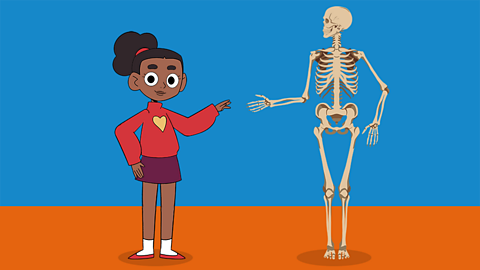
Many animals have skeletons to support and protect their body and to help it move.
The human skeleton is made of bones which grow as we grow.
Your bones come in all shapes and sizes.
Some of the largest are in your legs, and the smallest are in your ears.
Watch: Why is the skeleton important?
This video will show you why the skeleton is incredibly important for us humans!
Watch Mr No-Skeleton show us the importance of our bones.
Narrator: What is a skeleton? To answer that question here’s a very special person… Mr No-Skeleton!.
Now, Mr No-Skeleton, I believe you’ve got very strong muscles. Let’s see how strong you are.
Very good. Actually ladies and gentleman, Mr No-Skeleton just had his bones removed to make this programme.
Can we put them back now?
Ah I must say, now you look in somewhat better shape.
And of course your name isn’t really Mr No-Skeleton, is it?
Man: No. It’s Barry.
Narrator: So the question is, why didn’t Barry’s muscles work so well when he didn’t have his skeleton?
Well you see, our skeleton is the framework that all our muscles are built around.
As humans and animals grow, so does our skeleton!
It allows us to move, and it protects us too. Your skull is just like a helmet.
Fascinating facts
Fascinating facts about our skeleton!
Bones are filled with a spongy tissue called bone marrow. Bone marrow contains cells that produce blood cells.
There are 206bones in a adults body, and 106 of them are in your hands and feet.
Bones naturally heal themselves. If you break one it starts healing and creating cells right away, though sometimes we need plaster casts or operations to fix them in place.
There is only one bone in our skeleton not connected to another, the hyoid, which keeps our tongue in place.
Bones are made up of the chemical element calcium.
Functions of the skeleton

All your bones have specific functions:
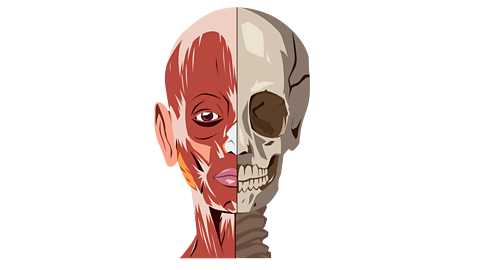
Protection – Your skull protects your brain, and your ribs protect your heart, lungs and other vital organs.
Support – The bones in your legs, back and neck keep you upright.
Movement – Your muscles pull on your bones so that you can move. Joints between bones, like your elbows and knees, make this easier.
It is important to eat a healthy diet with enough calcium to help your bones grow properly. We find calcium in dairy products like milk and cheese.
What does your skeleton do?
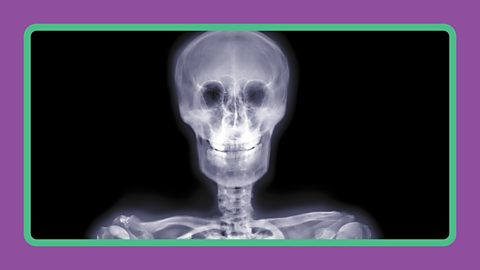
Image caption, A human skeleton
Our skeleton gives our body its shape and supports our weight. It provides protection for our internal organs, like our heart and lungs, and helps us to move around.
1 of 3
Did you know?
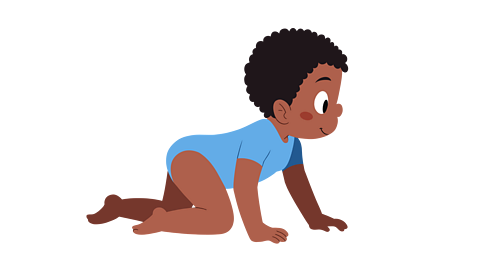
Babies have around 300bones, but as they grow, some bones fuse together, which is why, by the time they are a fully grown adult, they only have 206bones!
The smallest bone in the human body is the stapesbone in the ear, while the femur (thigh bone) is the longest and strongest bone.
Your body continuously breaks down old bone and rebuilds new bone, a process known as remodelling.
Important words
Bones – A skeleton is made out of bones. They act as a support for our bodies and help form our shape.
Calcium – To keep our bones strong and healthy, we need to have enough calcium in our bodies. Milk, leafy green vegetables and nuts are all good sources of calcium.
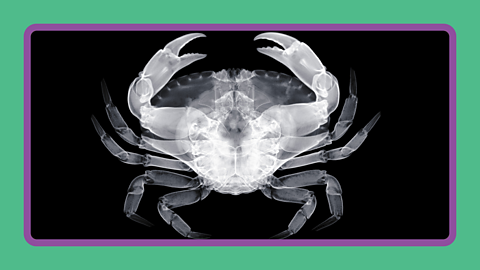
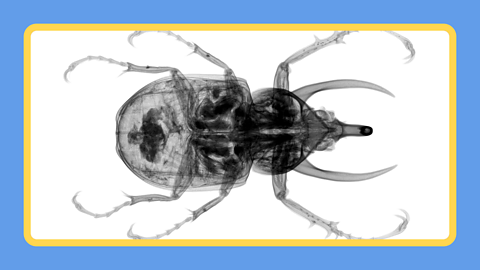
Exoskeletons – An exoskeleton is a hard outer layer that invertebrates have to protect themselves, instead of an internal skeleton.
Joints – Joints are the parts that connect different bones together and allow for movement.
Muscles – Muscles are like rubber bands that can stretch and contract. They help to keep our bodies upright and support us when we move.
Organs – The heart, lungs and the stomach are all examples of organs. They are protected by skeletons.
Skeleton – The human skeleton is made of bones which grow as we grow.
Activities
Activity 1 – Skeleton selection
Try to identify the different parts of the skeleton.
Activity 2 – Skeleton quiz
How much have you learnt about the skeleton? Try this quiz to find out!
Activity 3 – Label the joints
Let's try to identify our joints.
- Find a picture of yourself or print one out.
- Draw arrows to each part of your body where you think there is a joint.
- Explain why this part of the body has a joint.
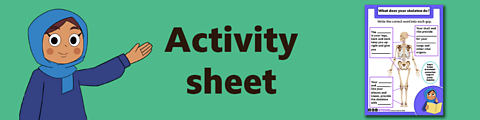
Activity 4 – Fill in the gaps
New game! Horrible Science: Stinky Space. game
Join Pipette on her epic mission and learn some revolting facts about space along the way.
More on Animals including humans
Find out more by working through a topic
- count8 of 11
- count9 of 11
- count10 of 11
- count11 of 11