Overview of Aunt Julia by Norman MacCaig
Norman MacCaig's poem Aunt Julia reflects on his relationship with his Gaelic-speaking aunt on the small island of Scalpay.
- MacCaig felt a strong attachment to his Aunt Julia despite the language barrier between them.
- This is one of the most memorable of his studies of Highland characters.
- Julia is depicted in a series of striking metaphors that show how the young narrator connects her with three elements of nature - earth, water and air.
The poem deals with themes of communication, nature and heritage.
You can read Aunt Julia by Norman MacCaig on the Scottish Poetry Library website.
Context
 Image source, Milk Wood Photography / Alamy
Norman MacCaig's Aunt Julia lived on Scalpay, a small island off the coast of Harris in the Outer Hebrides. She lived a traditional, hardworking life on a croft and she spoke only her native Gaelic language.
MacCaig sometimes described himself as three quarters Gaelic - three of his grandparents were Gaels and his mother came from the same small island. He was born and brought up in Edinburgh, however, and knew Scalpay only from visits.
He developed a deep affinity with the people, landscape and culture of Gaelic North West Scotland from his visits there.
The last stanza of the poem introduces a tone of regret before ending with a picture of the larger than life character calling to him still:
getting angry, getting angry/with so many questions unanswered.
The reason for this regret is that only after Julia's death did the poet learn enough Gaelic to be able to communicate with her. Hence, all the questions that he would have asked to her must now remain unanswered, just as her questions to him as a child had been.
Image source, Milk Wood Photography / AlamyForm and structure of Aunt Julia
Aunt Julia is an A description of a person’s life written by that person. poem so Norman MacCaig employs a A first-person narrative is when the story is told from the point of view of one person using the pronoun 'I'. stance.
A hallmark of MacCaig’s poetry is his skilful and effective use of accessible language.
Writing in Poetry that doesn't have an intentional rhythm or rhyme, but instead can sound more like speech helps to create a conversational style and tone, while the use of The use of run on sentences with no punctuation at the end of lines or across stanzas. and repetition allow him to emphasise key aspects of the poem.
Aunt Julia is divided into five stanzas, each with a specific focus:
- The first introduces the subject of the poem - Aunt Julia.
- The second describes her physical appearance and the objects MacCaig most strongly associates with her.
- In the third stanza, the perspective moves to the way the poet felt when he visited her.
- In the fourth, he uses metaphor to create a sense of her character.
- The opening lines of the poem are repeated, giving a sense of parallel structure, with Aunt Julia’s death. The final stanza reflects the speaker’s frustration that he could not communicate effectively with her while she was alive. It also expresses his enduring affection and admiration for her.
Stanza one
Aunt Julia begins with a series of warmly drawn, affectionate childhood memories:
Aunt Julia spoke Gaelic / very loud and very fast.
The speaker states:
- "I could not answer her"
- "I could not understand her"
This immediately establishes one of the main themes - communication. The repetition of "I could not" reinforces the idea of the barrier in communication.
Despite this language barrier he goes on to draw a picture of a strong, capable and passionate woman who created a haven of safety and security for the young boy in her house, and the tone is affectionate. This emphasises that, even without a common language, strong bonds can be created.
Clarity and lucidity were qualities MacCaig constantly worked for in his poetry. They are evident in this opening stanza with its series of straightforward statements, and in the theme of clear communication, or the lack of it.
The poem has freshness and charm. This stems from the fact it is with the eyes and ears of a child that he remembers Aunt Julia. Already in this short, vivid description we have the impression of Julia as a dynamic, vigorous and forceful character.
Stanza two
Norman MacCaig begins to create a picture of a woman who lives a life close to the soil in this rural landscape.
Her work is physically demanding, both out of doors and within her house. She is often barefoot but if shod, wears practical "men's boots" and the poet clearly admires her completing these tasks with capability.
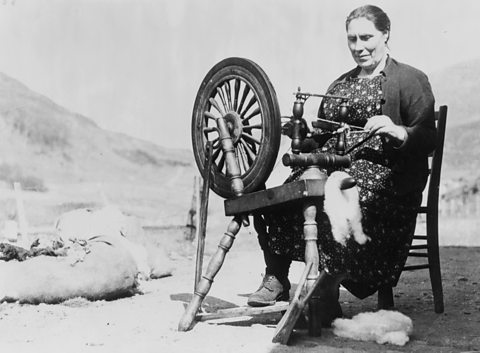
We see her engaged in one of the duties of her domestic life, spinning yarn. This is a skill heavily associated with island life – Harris especially is famous for producing tweed. "Spinning a yarn" is also a metaphor for storytelling, and this brings us back to the essential divide between the speaker and the main character – they can’t share stories. And while he remembers her spinning yarn on her wheel, he is now the one who tells her story.
The long line "paddling with the treadle of the spinningwheel" accentuates the lengthiness of the spinning process. It also creates a sense of movement and activity which MacCaig associates with his aunt.
In almost every description of her in the poem she is either in motion or speaking. This creates stark contrast with the shocking, silent finality of her death in the final stanza.
He continues to recall the spinning process:
her right hand drew yarn / marvellously out of the air
This conveys the air of magic or illusion about the task. It is almost entrancing for the young boy watching.
The long vowels in "her hand drew yarn" elongate the line. This helps to convey the impression of the wool being stretched out and made taut. The use of the present tense throughout this stanza creates a sense of immediacy and shows how vividly and readily he can still access these memories and describe her.
Stanza three and four
In stanza three we see that the language barrier was surmounted by an instinctive bond between the speaker and his aunt. As a result, the young boy feels safe and secure in the dark island of the box bed in Aunt Julia’s home.
It is enclosed and comforting. He vividly remembers lying in "the absolute darkness" listening to crickets "being friendly". Again the affection he feels for her is evident in the decision to open this stanza with the pronoun "Hers", emphasising her significance to him.
In stanza four, MacCaig uses a metaphor, specifically The technique of comparing a person to an inanimate object., to compare his aunt with the elements he associates with the landscape - the wind and water - and with the objects and garments that most strongly evoke her.
She appears to him to be vivid, larger than life. She is so connected with the landscape that she becomes part of it. The observations are those of a child, fascinated by both the curious and the ordinary.
In the poet's memory Julia becomes intertwined with the natural forces of wind and rain, in the description of:
winds pouring wetly / round house-ends.
At the same time he remembers her through a series of mundane domestic objects.
She was "buckets/and water flouncing into them" and also "brown eggs, black skirts/and a keeper of threepennybits".
Again the impression conveyed is of a woman in constant motion. The When an adjective usually used to describe one thing is transferred to another. used in the "flouncing" water gives a description of the deliberate, vigorous way she moved.
These metaphors extend beyond merely describing Julia as an individual. She is also a symbol associated with, or representative of, the particular landscape, lifestyle and culture of this geographical area.
Aunt Julia epitomises the specific way of life of the crofting islanders who worked the land in a harsh, unforgiving climate.
Despite the arduousness of this lifestyle, there is a pride and honesty to this life that the speaker obviously admires.
Julia could even be taken to symbolise the land and elements themselves in this part of the world – difficult at times, yet ultimately providing an honest, noble self-sufficient existence.
Video - What is transferred epithet?
The transferred epithet used in "flouncing water" describes the way Aunt Julia moved. Learn more about what transferred epithet is with this short revision video for Higher English.
Revise transferred epithet and why writers use it.
Transferred epithet
An epithet is a word or phrase which describes the main quality of someone or something.
For example: a happy person.
Epithets are usually adjectives, like “happy”, that describe a noun, like “person”.
Transferred epithet is when this adjective is transferred to a different noun.
For example, happy birthday.
The builders were working at a dizzy height.
Heights can’t literally be dizzy - they have no feelings! The transferred epithet intensifies the idea of the height.
How high up would you need to be to feel dizzy?
'Dizzy heights', even 'sleepless nights’ are examples of transferred epithet used in everyday life.
But transferred epithet can be more complex too.
In ‘Dulce et Decorum Est’, Wilfred Owen explores the horrors of World War One.
“An ecstasy of fumbling,
Fitting the clumsy helmets just on time”
The transferred epithet here is the word ‘clumsy’.
‘Clumsy helmets’ suggests the helmets themselves are struggling to stay calm during a gas attack.
This gives the reader the idea that both the soldiers, and the environment itself, are in a state of panic and chaos.
Why don’t you try using transferred epithet in your writing?
You can leave your readers in wide-eyed amazement.
Stanza five
The final stanza opens by repeating the opening lines of the poem Aunt Julia:
Aunt Julia spoke Gaelic / very loud and very fast.
However, a darker tone enters the poem at this point.
By the time MacCaig had learned "a little" Gaelic, his aunt was dead, lying "silenced" in her grave.
The contrast between the loud, talkative, vibrant Aunt Julia in life and the utter, absolute quiet of death is emphasised using enjambment to position "silenced" at the opening of line five.
The tone seems almost accusatory, as if blaming death for suffocating and stopping her voice.
This sinister, unsettling tone continues in describing the "absolute black" of her grave.
Unlike the comforting security of the "absolute darkness" of the box bed in the third stanza, the subtle shift from "darkness" to "black" conveys the frighteningly bleak void of death.
Instead of sustaining this melancholic, maudlin tone though, the speaker seems to challenge the finality of death -
But I hear her still, welcoming me / with a seagull’s voice
She has left such a strong impression on him he can still vividly imagine her calling to him in welcome.
Her voice is loud, carrying across a "hundred yards". It is shrill like a seagull’s piercing cry. Again, the metaphor used connects her to the natural world which played such a huge part in her life.
The poem ends with the poet imagining her
getting angry, getting angry / with so many questions / unanswered.
The final word is left on a line of its own. This reinforces the speaker's enduring sense of frustration. The ending of the poem is somewhat ambiguous and could be interpreted in a number of ways.
The questions he alludes to could represent, literally, her questions to the boy, which he was unable to answer as he had no Gaelic. Or they could represent all the questions he would have loved to ask but was unable to until it was too late.
Moving beyond the literal, the questions could represent the more universal queries we all have about the meaning and mysteries of life itself.
The repetition of the word "angry" in these final three lines suggests MacCaig is warning us to hold onto and cherish the culture and heritage of the island way of life.
He is afraid if we allow it to die, like Aunt Julia, then it too will be lost forever.
Learn more about how to analyse tone for Higher English:Analysing tone in Critical Reading
What are the themes in Aunt Julia?
Communication
The communication barrier between the speaker and Aunt Julia is a major theme throughout the poem. Aunt Julia “spoke Gaelic / very loud and very fast” and the speaker only learns "a little" Gaelic once she is dead) There is a sense of isolation felt by the speaker, who is frustrated by his inability to communicate effectively with this much-loved relative. In death, he refers to her as “silenced”, so her voice acts as a A figure of speech in which a part is made to represent the whole or vice versa. for her whole being.
Despite this barrier though, he shows us that emotions can often transcend language through the obvious, almost spiritual connection and affection between the two. After her death, the speaker still hears her voice, which he describes as “a seagull’s voice”, again representing how much he associates her with the natural world. Perhaps again he is suggesting his disconnection from Aunt Julia and the island, the seagull's voice making sound but not words that can be understood.
Nature
Aunt Julia is a character rooted to the place where she lives, in its traditions and culture but also in the natural landscape. She is seen cutting peat and working the land. Her feet are "stained with peat", as if the land has become part of her.
She is objectified in the middle section of the poem:
she was buckets… She was winds pouring wetly
The metaphors tell us she is these things. And the similarity of her work (involving buckets and water) with the weather (wind that pours) links her life to the world around her.
This is not straightforwardly dehumanising, rather, it connects both to the fact that her nephew could not communicate with her and that she was so entrenched in the land and work that in his mind, she became these elements.
Heritage
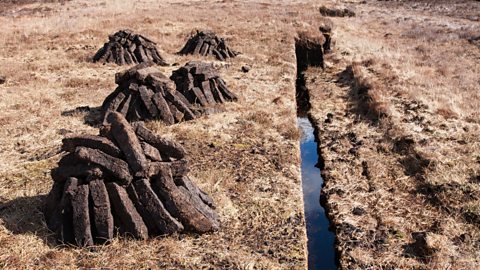
On a wider level, Julia comes to symbolise elements of a distinct Gaelic heritage, language and culture that are at risk of disappearing forever in the modern world.
MacCaig references “peatscapes”, "lazybeds" and the “spinningwheel”, traditional practices that Julia performed in her everyday life. Although his learning “a little” Gaelic comes too late for their relationship, his movement towards this feels like a note of hope at the end of the poem that these important things can be learned, and shared.
Comparing Aunt Julia to other Norman MacCaig poems
The rural landscape and traditions in Aunt Julia are found in much of MacCaig’s poetry. His writing shows a love of nature and how we connect to it. In Aunt Julia, she is completely part of nature:
She was winds pouring wetly / Round house ends
Later in the poem, it is through the “seagull’s voice” that he hears as hers, after she has died, as if she inhabits the wildlife of the island. In Old Lachie’s croft, the speaker similarly becomes almost one with the cockerel he describes:
I poke at/ my rumpled feathers
And in Basking shark, the speaker realises that he is related to the shark:
Shook on a wrong branch of his family tree.
In each of these examples MacCaig is considering the human place in the natural world and the connection between the two. In Landscape and I, this connection between the human condition and landscape is explicit right from the opening lines of the poem:
Landscape and I get on together well. / Though I'm the talkative one, still he can tell / His symptoms of being to me, the way a shell / Murmurs of oceans.
Communicating through a barrier is also present in Landscape and I where the speaker builds a relationship with the Schiehallion mountain without the ability to speak a common language. While Aunt Julia address difficulties communicating with another person, Landscape and I explores the challenge of understanding and finding meaning in nature.
There are obvious links too with Old Highland woman, who could almost be Aunt Julia. Julia is described through her relationship with a nephew she cannot speak with, but the Highland woman is at one with her community, gossiping, laughing and singing. The contrast between the nature of communication in these two poems is marked - one poem about a woman who is “getting angry, getting angry/ with so many questions/unanswered” and another, who “laughs a wicked cackle/with love in it”.
There is a clear metaphorical parallel in how the natural world and darkness is treated in Aunt Julia and Hotel room, 12th floor. In that poem, the speaker is lying in bed isolated, with the noises of the city around them, and nightfall is described as a kind of hostile invader, bringing “uncivilised darkness”. This is contrasted to the “absolute darkness” of the box bed where the speaker of Aunt Julia can only hear the “crickets being friendly”. In death, Aunt Julia is “silenced in the absolute black” of the grave – the very final stillness emphasising that she has returned to the dark earth that she worked. Death feels part of life, nature and the land. In contrast, the New York night is filled with the A harsh or jarring mixture of sounds. of the city and midnight is “shot at by a million lit windows”. The atmosphere is violent, unnatural and disconcerting.
Revise Aunt Julia by Norman MacCaig
Revise Aunt Julia and other poems by Norman MacCaig with interactive quizzes and flashcards for Higher English.
Quizzes - Norman MacCaig. quiz
Test your understanding of Norman MacCaig poems with a series of interactive quizzes for Higher English.

More on Norman MacCaig
Find out more by working through a topic
- count2 of 7

- count3 of 7

- count4 of 7

- count5 of 7