Overview of Basking shark by Norman MacCaig
MacCaig's poem Basking shark depicts the startling encounter he had with one of these giant fish while out on a small boat in the Minch (the sea area between the Hebrides and mainland Scotland) near Lochinver.
The poem deals with themes of:
- evolution
- the relationship between humans and nature
- monstrosity
You can read Basking shark by Norman MacCaig on the Scottish Poetry Library website.
Context of Basking shark
What is a basking shark?
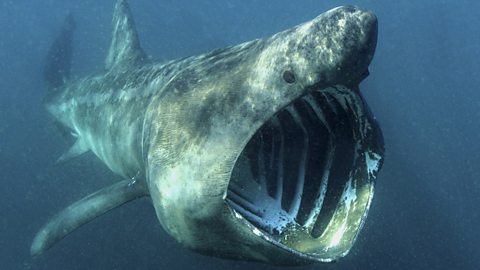
Basking sharks are the second largest species of any fish, reaching sizes in excess of ten metres and weighing several tonnes.
They are still found, though reduced in number, in the seas off the west coast of Scotland. They are harmless filter feeders, having no true teeth, and as such pose no real danger to humans. Still, a surprise close encounter with a creature of that size would be unnerving, particularly if close enough to touch the oars of a small boat, as happened to MacCaig.
About the poet
Norman MacCaig divided his time mainly between:
- Edinburgh, where he lived and worked
- the north-west Highlands, where he had relations and friends
He loved the north-west, particularly the area of Assynt. He would visit it whenever he could during his working life, then for longer spells after retirement.
About the poem
MacCaig's poem Basking shark depicts the startling encounter he had with one of these giant sharks while out on a small boat in the Minch (the sea area between the Hebrides and mainland Scotland) near Lochinver.
This encounter sparked in him a reflection on the comparative paths of evolution such differing species took:
- basking sharks on the one hand, relatively unchanged for millions of years
- humans on the other, vastly changed since the days when marine life first crawled ashore and adapted to a life on land
This train of thought leads to a disturbing question: who is the monster?
- Is it the shark, literally monstrous in size and aspect to the human?
- Is it the poet himself, representative of the human race and all the dark, monstrous deeds of which our race is capable?
The thought remains with the poet, unresolved, as the shark swims off.
Form and structure of Basking shark
Basking shark is set out in five stanzas, each of three lines. Each line is end-rhymed with the others in the stanza.
The The number and type of rhythmic beats in a line of poetry. of the poem is also fairly regular:
- the first two lines of each stanza have five stressed syllables (A line of poetry that has five metric feet or beats in it.)
- the final line has four stressed syllables (A line of poetry that has four metric feet or beats in it.)
You can learn more about metre here: Metre in poetry
The effect of the final shorter stressed line is to create a sense of fitting closure to each stanza.
This tight regularity of form is not always present in Norman MacCaig’s poetry. He is often quite free in stanza length, line length, and metre, and rhyming may or may not be present. MacCaig varied his style according to the internal requirements of a particular poem.
In this poem, the tightness of structure serves to encapsulate the uniqueness of the experience, and the regularity of rhythm and rhyme matches the rhythmic quality of the rise and the fall of the sea itself, and likewise the steady pulling of the oars.
The subject of the poem (the basking shark) is never mentioned in the body of the poem itself, just as MacCaig never sees the full creature itself. Instead we infer from the title what the poet's small boat collided with that day.
Stanza one
Basking shark begins with an unusual sentence structure: two infinitive clauses:
To stub an oar on a rock…To have it rise.
The effect is to create a tension and suspense until the meaning is completed by Norman MacCaig saying this is a thing that happened "once (too often)" to him - a rare encounter, but an unwelcome one.
The opening tension increases too with the mention that there is a rock "where none should be,". This is followed by the startling assertion that this ‘rock’ rises "with a slounge out of the sea."
The use of "rock" suggests the hardness and immovability of the object met, and possibly its large scale. The A new word or phrase."slounge" seems to be an amalgamation of ‘slouch’ and ‘lounge’, and conveys the slow, lazy, ponderous movement of the surfacing creature it describes.
The alarm caused in the poet is neatly shown with the humorous Adding extra information using brackets (), commas , or dashes - -. aside "(too often)" implying this is not an encounter he wishes to repeat. The slow, steady rhythm of these three lines is perfectly suited to the gradual surfacing movement of the huge shark.
Stanza two
The "once (too often)" of the opening stanza is both echoed and refuted with "But not too often" in the opening line of stanza two, which seems to contradict what he has just said.
In doing so he seems to imply that, on reflection, while this was indeed a frightening experience, it was nonetheless one he found ultimately worthwhile and enriching.
I count as gain
Again MacCaig makes clear that he values this event. He concentrates on the specific reasons he feels the encounter was beneficial in the remainder of the poem.
In choosing the word "met" to describe this event, he conveys almost a sense of connection between humans and animals, a hint that they came together as equals. It is typical of MacCaig never to assume human superiority in describing encounters with the world of nature.
The alliterative Describing something by saying it is something else. While a simile compares things using 'like' or 'as', a metaphor creates a direct comparison"a sea tin-tacked with rain" captures with MacCaig’s usual gift of exact observation, the nature of the rain - relatively sparse but hard droplets, piercing the smooth surface with neat round holes. The A sound feature; the repetition of the same sounds (mainly consonants) usually at the beginning of words. of the hard consonant ‘t’ helps to replicate the metallic sound of the rain hitting the boat.
That roomsized monster with a matchbox brain.
Alliteration and metaphor continue in rich vein in the final line with "roomsized monster" and "matchbox brain." The contrast and incongruity of the size of the shark’s enormous body compared with its tiny brain is elegantly portrayed here. The linking alliterative consonant ‘m’ serves to further emphasise the comparison.
There is clever use of long and short vowels in this final line too: the long vowels in "roomsized monster" appropriately extend and elongate the expression to reinforce the size of the shark in contrast to the short, clipped vowels of "matchbox brain".
Video: What is alliteration?
The alliteration and rhyme in this stanza really echo the movement of the boat and the sounds of the rain. You can learn more about alliteration in this short video.
What is alliteration? How and why would you use it? Bitesize explains with examples from 'My Rival's House' by Liz Lochhead.
Alliteration
A series of words beginning with the same consonant, used to emphasise a point or create a mood.
Tongue twisters are an obvious example:
Peter Piper picked a peck of pickled peppers.
Try saying that ten times fast!
Using alliteration with certain letters can really build a mood, like how the W s in ‘whispering wind’ create a setting that is soft and airy, or the harsh R’s in ‘raging river rapids’ help us picture the fast-flowing and ruthless water.
Alliteration can get your point across by appealing to a reader’s sense of hearing.
“The bass notes boomed into his very bones”
Here, the alliteration of the letter “B” mimics the deep sound of the bass and emphasises the volume of the music. The repeated ‘B’ sound suggests a musical rhythm we can feel when we read the sentence.
In the poem ‘My Rival’s House’ by Liz Lochhead, whose name is also alliterative, the speaker is visiting her new lover’s mother for the first time.
She is served tea with: “Silver sugar-tongs and silver salver”
Lochhead’s mother-in-law is trying to intimidate her by serving tea on decorative silverware.
The repetition of the letter S almost sounds like the hiss of a snake, suggesting the threat that lies underneath the shiny surface of this seemingly harmless scenario.
Try topping off your text with the terrific technique that is alliteration!
Stanza three
This stanza marks a switch from observational to reflective mode.
He displaced more than water.
The short opening sentence introduces the idea of the poet being metaphorically displaced in time.
He shoggled me / Centuries back
This primitive creature, largely unchanged since prehistoric times, moves or shakes the poet. Perhaps MacCaig is literally shaken by the sudden shock of this encounter. But it is the poet's imagination that we now concentrate on, as he pictures the early evolutionary stage of the emergence of land creatures from our common ancestors, marine life.
Immediately his tone becomes self-deprecatory with the use of the Ordinary, everyday language and dialect. verb "shoggled" to describe how he is shifted; then he describes himself as a "decadent townee".
The use of "decadent" in this context suggests that, in his decision to remove himself from the natural world to an urban setting, he has lost a sense of purpose in his life and become too immersed in the pursuit of hedonistic pleasures.
The next line depicts how the speaker was
shook on a wrong branch of the family tree
This conveys how he is both literally and metaphorically shaken by this experience. He is reminded that this shark too is part of our own family tree and is inextricably linked to us in much the same way as any other ancestor.
The expression "wrong branch" is slightly ambiguous and could be interpreted in two ways.
- Firstly because of our inherent sense of intellectual superiority over this creature we are unwilling to recognise we are in any way related.
- Secondly, it is in fact humans who have gone "wrong" in their evolutionary path - it is humankind, not the shark who is the aberration, the "monster".
Stanza four
An A comparison often used to explain or clarify something, often the comparison is made to something different but familiar to the reader. is made at the opening of this stanza between the speaker's present situation and stirring up dirt in a spring before the water then becomes all the clearer:
Swish up the dirt and, when it settles, a spring
The When a word sounds like the word it is describing. For example, ‘buzz’ or ‘hiss’."swish" of the water also alludes to the idea of displacement in the previous stanza. It also links to the image of the *"tin-tacked sea"", the speckled surface of which would obscure a view of the shark beneath. While initially the swished dirt would muddy the water and make it dark, opaque, and impossible to see through, eventually once settled it would be clearer.
Effectively, this image prepares us for the conclusion of the poem as the speaker is about to reveal what is now clear to him following this encounter. The dirt in this case is the murky thought of how humans evolved into what they now are.
Emerging from the slime of everything
The idea of "dirt" in our origins continues with the choice of the word "slime" - the primeval slime from which we and all other living organisms came, linking the evolution of humanity once more with that of the shark.
In his mind's eye, MacCaig has a surreal image of himself crawling out of this slime and returning to the initial, fundamental beginnings of human existence. The word "emerging" in the final line of this stanza reinforces this new, almost revelatory sense of clarity associated with coming out of the dark into light, while the word "everything" again reinforces that we are related to and share our history with every other species at the start of this process.
Stanza five
This stanza opens with the question the poem has been leading to:
So who's the monster?
By this stage it seems clear to the poet his initial, dismissive response to the shark as a brainless, inferior creature has been reversed.
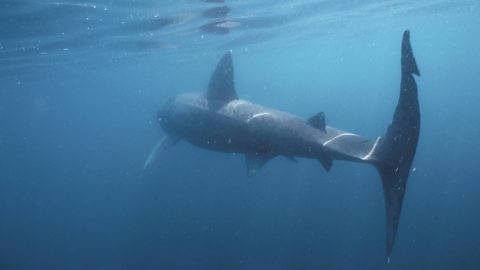
This magnificent, awesome creature is monstrous simply because of its relative size, but in the metaphorical sense it is clear the speaker now considers humanity to be the true monster.
The first line glides effortlessly into the second with a skilful piece of The use of run on sentences with no punctuation at the end of lines or across stanzas. as we are told how he grew "pale/For twenty seconds" as the huge fish itself glides away. The sheer size of the creature is conveyed by a number of techniques.
There is the mention of twenty seconds being the time the shark takes to pass him by, and the repetition of "sail after sail", referring to its fin and tail above the water. The metaphor comparing fin and tail to sails gives us the impression of vast surface areas and the shape is also nicely evoked. Perhaps MacCaig is suggesting the human invention of sails is just a copy of the shark's natural features.
sail after sail, / The tall fin slid away and then the tail.
There is a sequence of long vowels in "while", "sail", "tall", "slid away" and finally "tail" - all of these effectively combine to suggest the gradual exit of this vast animal.
The speaker's view of the creature has also been displaced at the end of the poem. No longer is it the clumsy, bulky "rock", "room" or "box" of the opening lines but something graceful and elegant. This reinforces the change in the speaker - just as he now has a different view of himself, so too his opinion about the shark has been altered.
The unanswered question at the end of this poem is typical of what is often described as MacCaig's metaphysical approach. His hair-raisingly close encounter with this monster of the deep has raised profound philosophical questions about our ethics and our place in the natural world. MacCaig avoids the temptation to conclude this meditation with an easy or glib answer, instead inviting his reader to draw their own conclusions.
What are the themes in Basking shark?
Evolution and the natural world
The central theme that emerges in Basking shark is evolution and humanity's place in the natural world.
The encounter with this enormous, almost primeval beast at the opening of the poem acts as a catalyst to consider the relationship between this creature and humans, and the contrasting paths such differing species took.
On one hand, basking sharks, have remained relatively unchanged for millions of years, while on the other, humans have vastly changed since the days when marine life first crawled ashore and adapted to a life on land.
Initially the shark seems alien and even horrifying to the speaker, stressed by how out of place it at first seems, and the fact that it is unseen beneath the water's surface.
But this close encounter makes MacCaig realise there is a connection between species.
Through his reflections, we are reminded that we have much more in common with the shark than we may initially believe. By rewinding time back to the origins of life itself, he creates a direct link between it and us through the idea of the evolutionary tree with its different connected branches.
Monstrosity
The key question in the poem - "So who's the monster?" - is the preoccupation at the heart of MacCaig's thoughts.
The shark, described as a "roomsized monster with a matchbox brain", at first seems both frightening and primitive. The comparison with "a rock where none should be" hints at its size and hardness while suggesting that it out of place. But quickly MacCaig reflects that it is the man who is actually out of place, a "decadent townee" who has become detached from nature.
He then links humanity to "dirt" and "slime", both unpleasant associations that suggest our species has perhaps not progressed as far as we might think.
MacCaig therefore forces us to revise our understanding of exactly what we mean when we use the term "monster", suggesting it is humanity and not creatures like the shark that are capable of true monstrosity.
Comparing Basking shark to other Norman MacCaig poems
Basking shark's emphasis on the natural world and man's place in it can be linked to Landscape and I, with its dialogue between the speaker and the landscape around him.
The speaker of Basking shark, refers to the creature "that once I met". The event is expressed in terms of a human encounter. This is similar to the familiar, very human language MacCaig uses at the opening of Landscape and I where the speaker says "Landscape and I get on together well."
MacCaig's reflection on humanity's link to the natural world around it also expressed in the central characters in Aunt Julia and Old Highland woman. Both these women are connected not only to the land, but to the past, and the collective history of the place and community who live there. This is similar to the way in which evolution and the concept of nature through time is handled in Basking shark.
The Old Highland woman, for example, is described as having "come through centuries": the "summation" of her people, who are "assembled in her bones". This neatly connects to the speaker of Basking shark saying "He shoggled me/Centuries back – this decadent townee/ Shook on a wrong branch of his family tree." The effect is similar - the reader is supposed to reflect on the things that have endured over all that time, and whether progress has been made.
A negative answer to this question can be found in Hotel room, 12th floor when we see the speaker surrounded by technology, an artificial landscape and apparent progress, but the atmosphere is intensely lonely and dangerous ("But midnight is not/so easily defeated"). In that poem, MacCaig suggests that humanity cannot escape its most basic nature, including its tendency to violence. This links to the imagery of Basking shark with its mention of "dirt" and "emerging from the slime of everything".
Revise Basking shark by Norman MacCaig
Revise Basking shark and other poems by Norman MacCaig with interactive quizzes and flashcards for Higher English.
Quizzes - Norman MacCaig. quiz
Test your understanding of Norman MacCaig poems with a series of interactive quizzes for Higher English.

More on Norman MacCaig
Find out more by working through a topic
- count3 of 7

- count4 of 7
- count5 of 7

- count6 of 7