Overview of Landscape and I by Norman MacCaig
The poem Landscape and I by Norman MacCaig explores MacCaig's love and respect for the sublime power of nature.
- He covers an number of ways that nature communicates.
- The poem reminds us to soak nature in, listen, and find our place within.
The poem deals with themes of :
- communication
- man's place in nature
- meaning and identity
You can read Landscape and I by Norman MacCaig on the Scottish Poetry Library website
Form and structure of Landscape and I
Landscape and I has a strict form and rhyme scheme.
- It is divided into six even stanzas of four lines each, These are known as A stanza of a poem made up of four lines.,
- There is a consistent AAAB rhyme scheme throughout.
- The first three lines of each of the stanzas are, broadly, in A line of poetry that has five metric feet or beats in it..
- Each final line is a dimeter, or two beat, line.
This structure creates rhythm in the piece. You can learn more about rhythm in poetry here: How to understand rhythm in poetry.
MacCaig's use of The use of run on sentences with no punctuation at the end of lines or across stanzas. gives the poem a conversational, looser quality within the strict form.
Having a strict rhyme scheme, and generally consistent metre throughout gives the poem a sense of order and mirrors MacCaig’s message that nature can be wild but also in fact cleverly crafted to deliver messages, if we only stop to listen.
Stanza one
Landscape and I by Norman MacCaig opens with a conversational statement, plainly communicating the strong bond the speaker has with nature.
Landscape and I get on together well.
The use of ‘he’ and ‘tell’ in line two personifies nature into someone equal: a close friend, perhaps. This is then compounded with the wry, humorous tone of:
Though I'm the talkative one
MacCaig firstly uses medical language to describe nature’s state of life in ‘symptoms of being’, as if nature is a patient describing their symptoms and the speaker is a doctor. This is further To give human qualities to something that isn't human. nature as a confidant, someone who shares their most intimate secrets.
He then uses a metaphor to illustrate how, if we listen, we will hear something valuable from nature:
the way a shell / Murmurs of oceans
The word choice of ‘Murmurs’ within this metaphor implies that understanding nature is challenging for some people - the message is quiet, indirect and mysterious. The contrast of a single shell and quiet murmur with the vast ocean suggests that all nature is reflected in its smallest details, and that we can find out much if we only pay close attention.
Revise word choice for National 5 English here: Analysing word choice
Stanza two
The word choice opening stanza two is immediately striking and unusual:
Loch Rannoch lapses dimpling in the sun.
Nature is further described as being alive in the phrase ‘lapses dimpling’. This description of movement for a static loch conveys an inherent force of life within the water. Again the detail and signs of life are small, in this case dimples.
The word ‘hieroglyphs’ again reminds us that nature has a message to understand but, like ‘Murmurs’ in the previous stanza, this message can be hard to decipher.
Its hieroglyphs of light fade one by one
The image of nature's messages fading makes the scene more specific, suggesting evening and sunlight dimming. This helps the reader visualise the scene MacCaig describes. It also suggests nature's signs are temporary as well as small.
But we are not to be dismayed if we miss nature's signs or struggle to understand them. The speaker tells us that the communications are able to ‘re-create themselves’‘For ever and ever’. Nature works in cycles, with day and night following each other. MacCaig gives us a sense of hope that we will have other opportunities to appreciate these messages:
But re-create themselves, their message done, / For ever and ever.
Stanza three
Life is further injected into the poem with a move away from surroundings and a focus on living creatures. We are reminded that nature is an encompassing thing, not only scenery but all that takes place within it.
MacCaig creates a sense of beauty, excitement, and power with phrases like ‘sprinkling lark’, ‘jerked upward’, and ‘daze to nowhere’.
We understand that while the bird is moving seemingly aimlessly through the skies, there is poetry and beauty in the way that it moves anyway, and again the speaker returns to the topic of communication:
leave himself in true/Translation
Mention of "Translation" recalls the image of hieroglyphics and the idea of decoding another language. Even after the lark has flown away, the grace of his movement and his ‘song’ - is left with the speaker, communicating something important for us to take away:
hear his song cascading through / His disappearance.
Stanza four
Nature is a complex thing, however, and we are reminded of this in the harsh, violent image of a hawk in stanza four.
The hawk knows all about it
While the speaker must work to understand nature, the hawk does so instinctively. But it shows a different side of nature. It cares nothing for beauty or poetry, and instead deals in pain, with words like ‘cramps’, ‘squeal,’ and ‘tear’ contrasting with the beauty of
Smooth fur, smooth feather
The "empty glove" creates an effective image of an animal caught by the bird, hanging limply from its claws. It also highlights the absence of man in this landscape. There is no falconer with a glove handling the hawk - it is free to fly and to kill, as is its nature.
Stanza five
MacCaig chooses one example of Scotland's landscape - the mountain ‘Schiehallion’ - as a A figure of speech in which a part is made to represent the whole or vice versa. for all of nature. He uses it to illustrate how the personified ‘he’ of nature communicates images to the speaker which are understood and remembered.
The simile of ‘like a hind / Couched in a corrie’ suggests a female deer, hidden in the dip on the mountainside. The idea of nature in the speaker's mind is also something beautiful, subtle and concealed, but it is definitely there. The image illustrates how special it can be to glimpse something otherwise unseen.
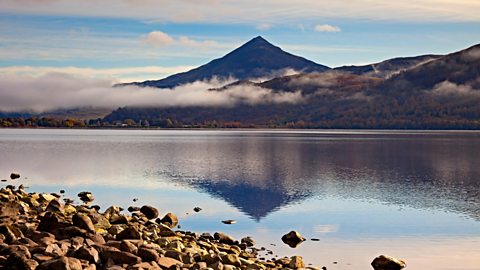 Image source, Arch White / Alamy
Stanza six
The poem ends with an inspirational call to action. Romantic language is used in the word ‘woo’, again personifying nature, and we are told that understanding once is not enough: the speaker intends to
know / The meaning of the meaning
showing us the true complexity of the natural world around us. Those layers have layers and it takes time to work through them to gain proper understanding of our place within the world.
The use of second person in ‘anywhere you go’ draws the reader into the conclusion and we are left with the instruction that wherever we are, wherever we go, there is a message in nature waiting for us. We just need to listen.
There's a Schiehallion anywhere you go./The thing is, climb it.
What are the themes in Landscape and I?
Communication
A major theme of this poem is communication - from the opening relationship between the speaker and the landscape ("Though I'm the talkative one") and the shell that "murmurs of oceans". Each stanza of the poem adds to the impression of nature constantly communicating with man, if we are prepared to listen and receive its messages.
There are "hieroglyphs to be read, there are translated songs sung by larks, the knowledge of the hawks and the messages from the mountains, all building up to the final communication from the speaker directly addressing the reader ("Oh,/There's a Schiehallion anywhere you go./The thing is, climb it")
Man’s Place in Nature
Landscape and I paints man as a naïve creature within a complex system and it is through the speaker’s eagerness to gain an understanding of his place in the world that we come to understand how beautiful and powerful the natural world truly is.
Man's participation in these relationships with all the elements of this system is dependent on being eager and open like the speaker - the final address to the reader invites this. The message is to be receptive to the lessons and messages from the natural world.
Meaning and identity
MacCaig’s message that ‘There’s a Schiehallion anywhere you go’ is an inspiring sentiment that we can gain meaning in life and further our own sense of identity if we simply take the time and pay attention to the world around us. What that meaning and that identity might be is left deliberately open to interpretation; much like how nature has variations, so to do we.
The idea that the speaker will "woo the mountain" until he knows "The meaning of the meaning, no less" highlights how rewarding and complex this can be: a completely different outlook on the world and our own place in it.
Comparing Landscape and I to other Norman MacCaig poems
Respect for the world around us and man’s small place in it is a key takeaway from Basking shark, with its feeling of awe and love for nature. The speaker of that poem describes encountering the animal as "I met him". This is similar to the familiar, very human language MacCaig uses at the opening of Landscape and I where the speaker says "Landscape and I get on together well." The concept of man as an inherent part of the natural world is also there in Basking shark:
I saw me, in one fling,/ Emerging from the slime of everything.
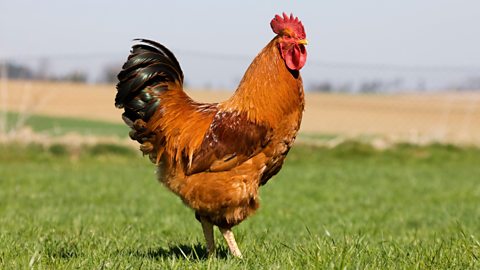
On Lachie's croft sees speaker and animal almost become one and the same, such is the close identification with the speaker with the rooster he encounters on the croft. The tone in Landscape and I is far more positive and happy, which suggests that man understanding his proper place in the system is crucial.
In Old Highland woman, MacCaig emphasises the need for human connection, with the old woman "relishing the life" in the gossip the neighbours share with her. In Landscape and I, MacCaig seems to be saying that you can connect with all living and natural things - mountains, birds - and relish the life in those, too.
The setting, atmosphere and message contrast wtih Hotel room, 12th floor, where the human landscape is harsh and unnatural and the radio and television set drown out the sirens and screams of the city.
Communicating through a barrier is also a theme present in Aunt Julia where, as the speaker is able to do with the mountain Schiehallion, a relationship can be built without necessarily speaking the same language. It is nature, through the call of a gull, that the speaker remains connected with his aunt, and what she was trying to tell him ("I hear her still, welcoming me /with a seagull’s voice").
Revise Landscape and I by Norman MacCaig
Revise Landscape and I and other poems by Norman MacCaig with interactive quizzes and flashcards for Higher English.
Quizzes - Norman MacCaig. quiz
Test your understanding of Norman MacCaig poems with a series of interactive quizzes for Higher English.

More on Norman MacCaig
Find out more by working through a topic
- count5 of 7

- count6 of 7
- count7 of 7

- count1 of 7