Key learning points covered in this guide
- Who were the British West Indies Regiment (BWIR)?
- What can source analysis tell us about the BWIR?
- What was the BWIR’s experience?
Created in partnership with Imperial War Museums.
Who were the British West Indies Regiment (BWIR)?
Play the video to watch the work of war from the British West Indies Regiment
Femi: When World War One began in 1914, Britain was ill-equipped and undermanned. It would need to use the full resourcesof its Empire to have any hope of victory. Men, food and raw materials were all funnelled into the army. Not just a British Army,but a British Empire Army. Yet the stories of the black men who fought in this conflict are underrepresented and often ignored, even though it was only through this worldwide effort that the war could be won.
Consider the British West Indies Regiment, recruited from a group of islands now collectively known as 'the Caribbean'. Alan, what impact did this regiment of black men have on the British war effort?
Alan: Well, this was a new regiment raised specifically to serve in World War One. Around 15,600 men served in its ranks and they risked their lives far from home in Europe, the Middle East and Africa. Quite often they served within German artillery range doing vital work such as building roads and railways, digging trenches and helping to maintain the ammunition supply for the British artillery.
Femi: Yet many people seem to see World War One as a 'white man's war'. How come stories of diversity in theBritish Army are so often overlooked?
Alan: Well that's because most of the narratives that Britain has around World War One are based on the fighting on the WesternFront in France and Belgium, and there, very few black soldiers were serving.
Femi: How come they didn't fight? Surely they would have been helpful if Britain needed people from across the Empire? I'm guessing they were treated differently too?
Alan: Yeah, well these men actually expected to fight but were given this vital labouring work to do instead and really across the British Empire, men were treated differently on account of their class and nationality, or even just the colour of their skin - which was the case for the men from the Caribbean.
Femi: I wonder how that must have felt for men who were trying to adjust to life at war.
At the time of World War One (1914-1918), Britain had a large empire of countries and territories which it controlled.
During WWI, the British called upon over 3 million soldiers from all over their empire to fight. Troops from the empire played a significant role in the war effort and often faced dangerous conditions and discrimination.
At this time the British The West Indies was a term first used during the period of European colonialism to refer to the islands in the Caribbean. was part of the The areas of the world once colonised and controlled by the British monarchy and government.. It consisted of British territories in the Caribbean; Barbados, the Bahamas, British Guiana, British Honduras, Jamaica, Trinidad & Tobago, Grenada, St Lucia, St Vincent and the Leeward Islands. These countries are now independent nations.
Initially, the British war office had refused to accept soldiers from the British West Indies, however, from 1915 onwards, this policy changed due to increasing war demands. The men who enlisted in the BWIR came from all backgrounds, working in many different trades and industries such as shipwrights, tailors, shoemakers, mechanics, blacksmiths, motor engineers, carpenters, painters, cooks and bakers.
The table shows the total numbers where the men came from and what rank they belonged to.
| Officers ⁽¹⁾ | Other ranks | |
|---|---|---|
| Barbados | 20 | 811 |
| the Bahamas | 2 | 439 |
| British Guiana | 14 | 686 |
| British Honduras | 5 | 528 |
| Jamaica | 303 | 9,977 |
| Trinidad & Tobago | 40 | 1,438 |
| Grenada | 4 | 441 |
| St Lucia | 5 | 354 |
| St Vincent | 0 | 305 |
| Leeward Islands | 4 | 225 |
| Total | 397 | 15,205 |
Source: Empire at War - Vol. 2 Sir Charles Lucas, Humphrey, Milford, Oxford University Press, 1923.
⁽¹⁾ Officers would have largely been white Caribbean of European descent, or white British.
What can source analysis tell us about the BWIR?
Play the video to discover how to become a World War One historian
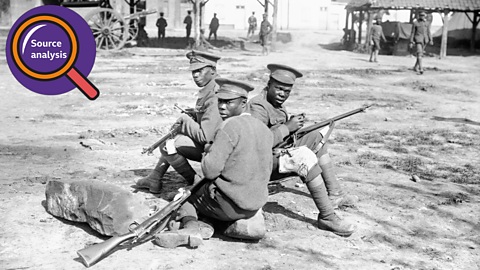
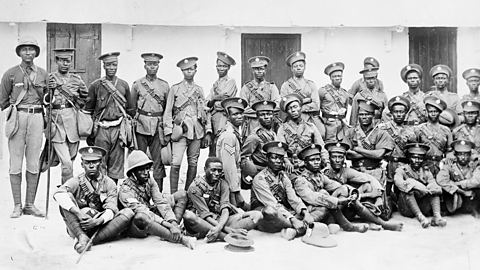
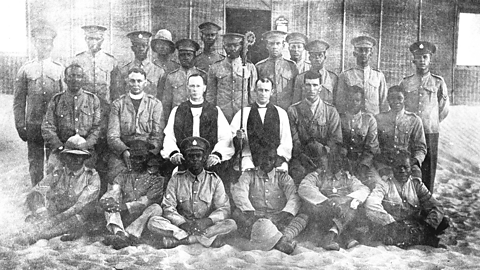
Femi: A historian's job is to look at sources and ask questions. When we first see a source like this photograph, we should come up with as many questions as we can.
What do you see?
Where are they from?
Who took this photograph?
From there, we can try and answer the questions based on what we see.
We could start with simple observations: the men are wearing uniforms and holding guns, we can safely assume that they are soldiers.
We can then make more complex conclusions.
The men are black, but they're dressed in uniforms from the British Army, so they might be members of the broader Empire Army.
This photo is not from the trenches, which leads us to assume these men are not currently on the front line.
Once we have made these conclusions, we can look at other sources to discover that these are members of the British West Indies Regiment in France.
We can then research the impact these men had on the conflict.
Or, if we are interested in how the men got there, we could look into recruitment and learn how they were promised the same treatment as British men, only to be denied equality.
Skilled historians can quickly refer to their knowledge of the time, but the first thing to do is to look carefully at a source and analyse all that you see.
You can make lots of interesting conclusions with just a photo.
Source analysis is an important skill used by historians. They look at sources and ask questions, and using their knowledge of the time, draw conclusions to help understand the past.
When historians analyse a source, they will consider the following:
- where it came from
- when it was created
- its purpose
- who was meant to see it
- the views of the time and the information people had access to
In the video above, we looked at the picture of soldiers from the BWIR and used source analysis techniques to think of more questions.
To find out more about the experience of these men, we can apply our source analysis skills to more sources from the same time period such as the recruitment posters below.
We know that men from the Bahamas and Britain were recruited for similar service but what differences can these sources tell us? Source analysis helps us identify the difference in language and tone between these two posters.
Why did people sign up?
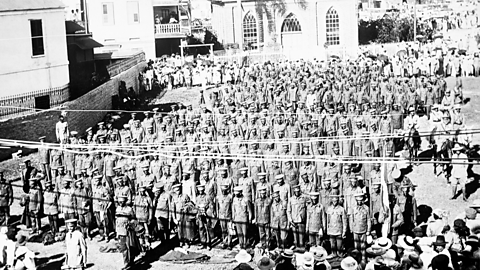
When World War One was declared in 1914, men in Britain signed up to join the war effort in their millions, most often from a sense of duty or for adventure, and the chance of a better life.
This was true for the young men from the Caribbean as well, but they were also fighting for their civil rights. Despite the abolition of slavery in the British West Indies, many of those who had been freed were unable to acquire land and were still treated as second class citizens.
Activists such as Marcus Garvey also encouraged men to sign up in the Caribbean as he saw an opportunity to legitimise A name given to a series of movements, events and leaders which together aimed to campaign for equal rights.. He believed that their service as soldiers for the British Empire would result in the people of the Caribbean being entitled to more rights from the Empire.
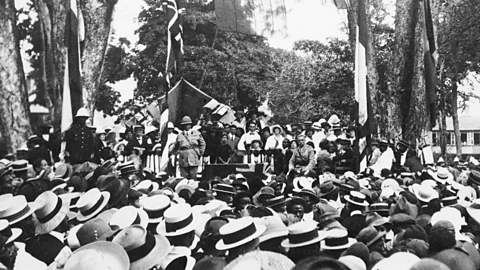
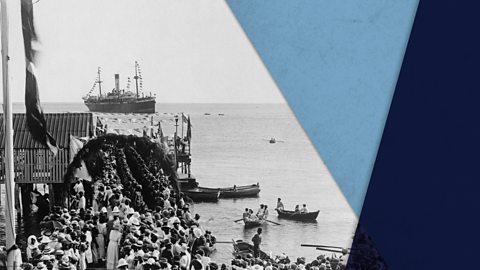
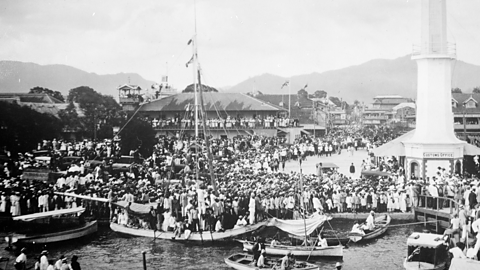
Image caption, A recruiting meeting at the Port of Spain, Trinidad, 1916
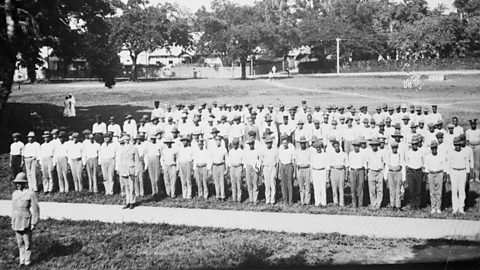
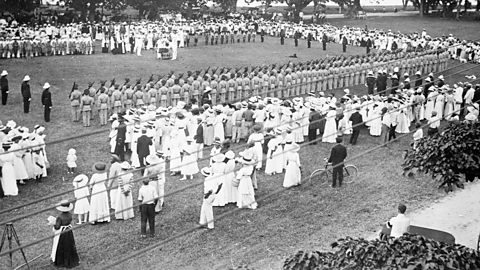
1 of 6
What was the BWIR’s experience?
The BWIR volunteered themselves as soldiers on the same conditions as British volunteer soldiers, which meant that they should have done the same work and received the same treatment, pay, uniform and living conditions. However, this was not always the case.
One strong motivator for the Caribbean men to sign up was the promise of equality within the structure of the army but they often experienced The act of making unjustified distinctions and treating people differently based on the colour of their skin or ethnic origin. from other soldiers and army authorities. When British troops were given a pay rise, the BWIR were initially denied a pay rise because they had been classified as 'natives'.
Despite many being suitable for leadership, the men of the BWIR could only rise to the ranks of NCOs are often experienced soldiers who have been promoted into a leadership position but are not as senior ranks as officers., even if their education and professional life before signing up was at a higher level than many of the white A leadership position usually responsible for a larger group of soldiers. Most officers start their military career in a leadership role and command larger units as their career progresses. who would command them during the war.
Watch this video to find out more.
Play the video to understand the treatment of the British West Indies Regiment
Femi: Let’s explore the context of this photograph.
At the time of World War One, a quarter of the world was ruled by Britain, and men were recruited from across this empire. They signed up for a variety of reasons: out of duty, for honour, for adventure, for the chance of a better life.
The War Office actively tried to discourage recruiting black people. But the need for men was too great, and the compromise of the War Office was to use the British West Indies Regiment in France as labourers.
They travelled far from home, and the European winter was difficult for the Caribbean men. The cold could be lethal. For example, 600 members of the 3rd Jamaican Contingent suffered from frostbite due to poor heating and clothing after a ship en route to Britain was forced to detour through Canada. Five men would die.
Although they wore the same uniform as British soldiers, their rifles often dated from a decade before. The British government had already decided that the British West Indies Regiment would not fight, so saw little point in updating the guns, but allowed the men to keep weapons to maintain morale. Instead, they dug trenches, built roads and moved ammunition - vital work for the war effort.
How does this new knowledge affect your understanding of this photograph?
What have these men had to overcome to get here?
What were their expectations, and were they met?
What did the BWIR do?
Two An army unit that forms part of a regiment. A soldier will often have a strong association with their battalion during their service in the Army. were sent to France to assist with labouring duties in August 1916. They built roads and railways to transport men and resources to the front line – hugely important work. But as soldiers, this was not what they had signed up for and expected to be doing.
They would also transport great amounts of ammunition to the Western Front, often putting themselves in the firing line.
The rest of the BWIR were sent to many places around the world to fight during WWI. For example, the An army unit with a distinct identity and usually a combat role. was sent to Egypt to defend the Suez Canal from the Turkish Army. All their combat and fighting experience was in and around East Africa and the Middle East.
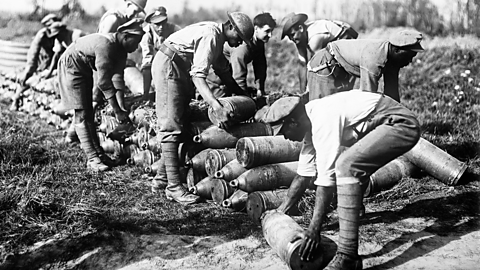
Image caption, BWIR troops moving artillery shells on the Western Front
1 of 2
Archive images and footage provided by Imperial War Museums
Play the History Detectives game! game
Analyse and evaluate evidence to uncover some of history’s burning questions in this game.
More on World War One
Find out more by working through a topic
- count1 of 6