Key learning points covered in this guide
- What was the end of the war like for the British West Indies Regiment (BWIR)?
- How did the BWIR return home?
- The legacy of World War One for the BWIR
Created in partnership with Imperial War Museums.
What was the end of the war like for the British West Indies Regiment?
On 11 November 1918, World War One ended with the signing of the When the two opposing sides in a war agree to stop fighting. This marks the end of a war.agreement. Thousands of soldiers returned home, and many Allied forces were met with victory parades to celebrate the end of the war.
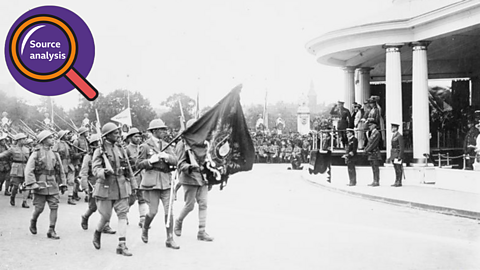
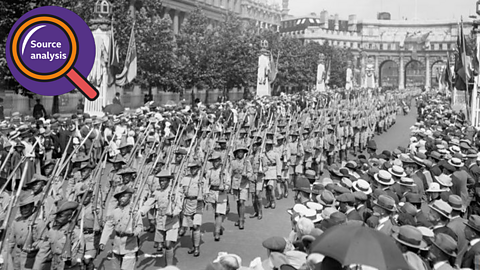
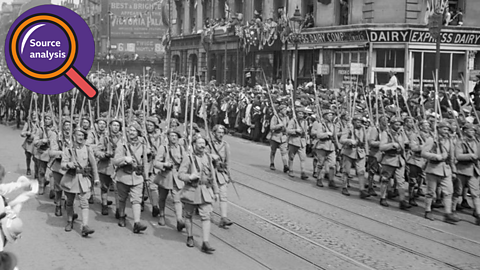
In July and August 1919, victory parades in London celebrated peace in Europe. The parades included soldiers from British and The areas of the world once colonised and controlled by the British monarchy and government. forces plus Allied armies. However, despite their significant contribution to the war effort, the BritishThe West Indies was a term first used during the period of European colonialism to refer to the islands in the Caribbean.An army unit with a distinct identity and usually a combat role. (BWIR) did not attend the parades.
Watch the video below to learn why it’s important to investigate primary sources, like an official photograph, to find out the real stories behind these photos.
Play the video to find out what happened to the wider empire troops after the war
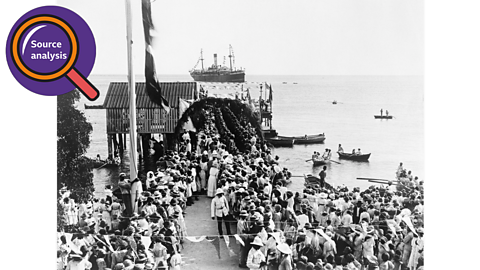
Alan: Take a look at this photograph, what do you see?
Femi: Hmm. It's clearly some sort of celebration. There are flags, people waving. Ah I can see the sea! Perhaps we're on an island?
Alan: Yeah. I mean the record for this photograph says it was taken in 1919 in St Vincent in the Caribbean.
Femi: I can see a ship. Would this island be part of the British Empire at that point?
Alan: Yes it was.
Femi: And World War One finished on 11th of November 1918, so maybe these are returning troops, having fought in the war?
Alan: Yeah, these are men from the British West Indies Regiment coming home. The 'West Indies' of course, was a colonialterm for what we today call the Caribbean.
Femi: So this must be a victory parade, to celebrate the troops coming home to St Vincent?
Alan: Yes. What does the atmosphere look like?
Femi: It seems like a big party. But…
Alan: What are you thinking?
Femi: Well, weren't there also parades in Britain? Were they a part of those?
And, what happened to them after the parade?
Alan: Well, these are all questions that historians ask, and now we've got our thoughts together on this, we can do further research.
Femi: How much information is out there?
Alan: There are lots of stories from the former British colonies, countless tales and things to learn about, many lenses from which we can view them. A historian is really like a detective!
Femi: It's interesting that people from around the world helped Britain. I wonder how successful the British Army would have been if it weren't for the efforts of these men.
Alan: Yeah, well it is called a World War for a reason, and we should look beyond the fighting in Europe, to tell everyone's story.
Victory parades in London celebrated peace in Europe
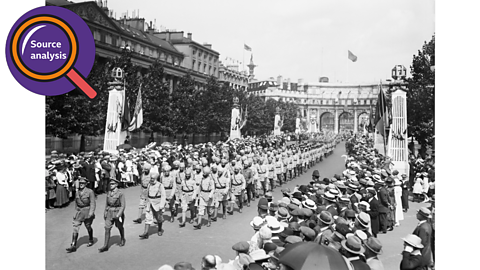
Image caption, Indian troops march during victory parades in London
1 of 5
How did the BWIR return home?
Watch the video to find out why and how the BWIR had already returned home to the Caribbean before the Peace Day parades in London.
Play the video to find out about the mounting tension in the British West Indies Regiment after WW1
Femi: In this photo, it looks like cheers greet victorious men as the British West Indies Regiment return home to Saint Vincent.
Note the bunting and the crowds, the celebration for a war finally won. Yet we don't see the armed soldiers on standby to stomp out any trouble, or the British warships gliding into docks in case of unrest.
Tensions were running high between the British Government and the Regiment. The soldiers were angry that they were paid less than white men despite the promise of equality.
The British Government had good reason to be worried. This resentment had recently erupted in an incident in Taranto, Italy.
On the 6th of December, 1918, a four-day protest broke out after the men were asked to clean toilets for Italian civilian workers below their rank, adding further insult to their unequal pay. This protest meant that they refused to obey orders. We would refer to this today as a strike. But the Government was keen to use the term 'mutiny'.
The protest was quickly crushed, and as punishment 60 men were convicted with sentences ranging between 5 and 20 years imprisonment.
The British Government then scrambled to relieve the soldiers of their duties and return them home, a process known as demobilisation, or demobbing.
Do you think the Government's response to the protest was effective?
What does this protest tell us about how these men felt when they returned home?
Although fighting had stopped in November 1918, the soldiers were not able to return home just yet.
They continued to be in active service until the peace treaties had been signed. The BWIR were then sent home through a process called Releasing a person from serving in the Army. or ‘demobbing’ for short.
Demobbing means that men are officially released from their military duties and returned to civilian life. All men were demobbed when they returned to their home countries. For the BWIR this was a long journey by sea from Italy.
The end of the war was hard for everyone returning home. People from across the world came home to struggling economies, low wages and high unemployment rates. This was also the case for the men of the BWIR returning home to the Caribbean.
The Taranto Mutiny
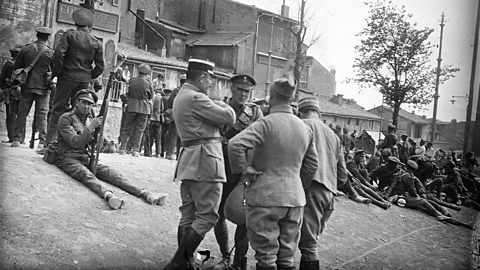
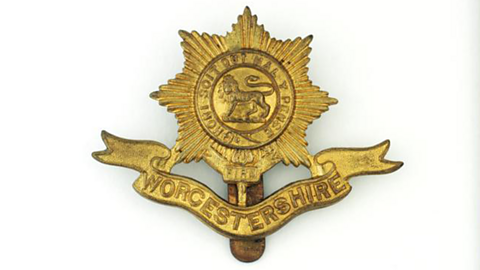
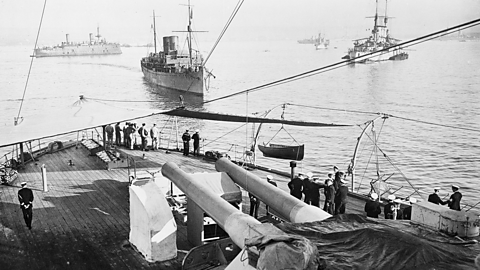
After the Armistice agreement, 11 BWIR An army unit that forms part of a regiment. A soldier will often have a strong association with their battalion during their service in the Army. based in Taranto, Italy, were preparing to be demobbed when a The name given to the actions of two or more soldiers disobeying their orders. broke out. The BWIR protested against the British Army as they were upset about The act of making unjustified distinctions and treating people differently based on the colour of their skin or ethnic origin. with unequal pay and division of labour. Segregated facilities meant men in the BWIR didn't have access to recreation building or the soliders hospital, they were treated in the labourers' hospital instead
This slideshow gives an overview of the key events of the mutiny in Taranto and examples of racial discrimination.
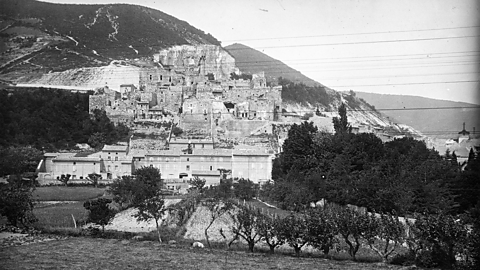
Image caption, The BWIR were recruited under the same pay and conditions as British soldiers, but a pay increase was denied to them. Due to a shortage of labour at Taranto, the BWIR were made to do manual labour such as kitchen duties and cleaning toilets for Italian civilian labourers who were below the military rank of the BWIR.
1 of 4
The legacy of World War One for the BWIR
In this video, explore what happened to the soldiers who served in the BWIR after they returned home from the war in 1918.
Play the video to discover what happened after World War One
Femi: After the end of World War One in 1918, the British West Indies Regiment returned home.
They may have played an important part in the defeat of Germany and its allies, but post-war circumstances forthese men were very challenging.
‘When the war finished, there was nothing. I had to come and look for work. The only thing we had is the clothes and uniform we got on. The pants, the jacket, the shirt, and the boots.'
The British West Indies Regiment had fought in the Middle East and did vital war work in France.
Now, like many around the world, the returning soldiers faced low wages, mass unemployment and a struggling economy.
In 1919, a secret colonial memo circulated in the British Government.
'Nothing we can do will alter the fact that the black man has begun to think and feel himself as good as the white.'
In many countries, the authorities feared these returning men. They realised these highly trained, well-disciplined individuals - some with combat experience - might be returning home with revolutionary ideas. This threatened the stability of the British Empire.
Some see this as the beginning of the end for the British Empire.
These returning men knew they had the power to resist control and joined a different fight… The fight for independence.
By the 21st Century, many members of the British Empire gained their independence, meaning freedom to rule themselves.
In what way do you think the war impacted the British Empire?
Many historians see World War One as the beginning of the end for the British Empire.
Some members of the BWIR questioned their relationship with Britain after their experiences during the war. Several returning soldiers went on to become political figures and activists who would fight for equal rights and independence from the British Empire.
After the war, the spread of ideas from activists such as Marcus Garvey and campaigns for independence led to incidents of unrest in many of the Caribbean islands including Barbados, Jamaica and Trinidad as A name given to a series of movements, events and leaders which together aimed to campaign for equal rights. grew and more people wanted to split from the Empire.
However, despite these movements, it wasn’t until after World War Two that most colonies gained full independence from the British Empire.
Archive images and footage provided by Imperial War Museums
Play the History Detectives game! game
Analyse and evaluate evidence to uncover some of history’s burning questions in this game.
More on World War One
Find out more by working through a topic
- count1 of 6