Key learning points covered in this guide
- Who were the South African Native Labour Corps (SANLC)?
- What can we learn about the SANLC through source analysis?
- What happened to the SANLC after the war?
Created in partnership with Imperial War Museums.
This page discusses racism and contains offensive language.
Who were the South African Native Labour Corps (SANLC)?
In 1916 South Africa approved the formation of the South African Native Labour Corps (SANLC), a new group of men created due to a shortage of labour in World War One.
This video explains who the SANLC were and the important work they carried out during World War One.
Play the video to find out what the jacket tells us about World War One
Alan: So Femi, who do you think would have worn a jacket like this?
Femi: Right. I'm thinking like a historian here. It's clearly a military jacket.
Alan: Yes it is. Yep.
Femi: It doesn't have any decorations, so it's probably for someone fairly low rank.
Alan: Well it was worn by a member of what the British Government called the South African Native Labour Corps.
Femi: I'm guessing a Labour Corps means they worked behind the front lines.
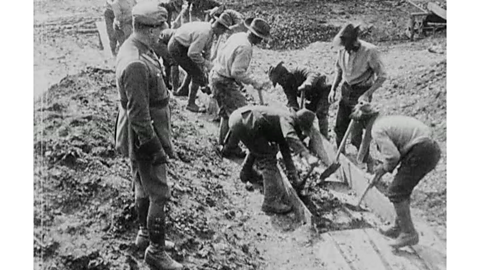
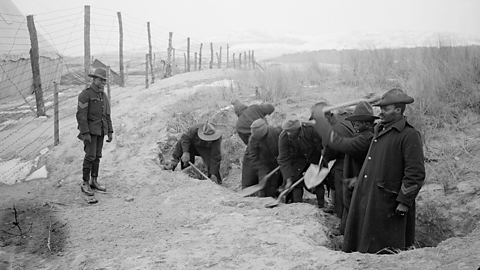
Alan: Yeah, mainly in Northern France. And they were doing work such as loading and unloading ships, building roads and railways, carrying ammunition, quarrying stone and felling timber.
Femi: It's easy to forget how much has to happen behind the front lines. I usually just think about the trenches.
Alan: Yeah, I mean it really is. And this is all vital work. And by 1918 there were 25,000 South African men serving in that Corps. Including lots of teachers and local leaders.
Femi: Some of them were highly educated. Did they not fight at all?
Alan: Well, Labour Corps, including the British Labour Corps, knew that their main role wasn't to fight, but the South Africans weren't even given that opportunity by their government because they thought that white and black men serving side by side as soldiers would have undermined white rule in South Africa.
Femi: And that's just because they were black?
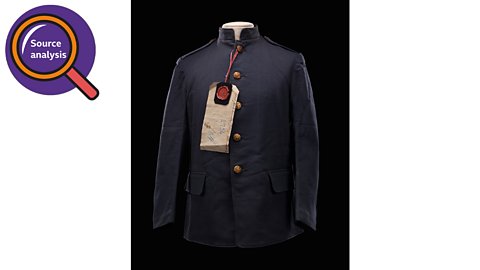
Alan: Yeah, I mean that racism is really deep rooted. I mean if we look at this label here, the k-word on that label was a term used to describe black people in South Africa at the time.
Femi: I know how incredibly offensive that term is today. And it's disturbing to see this on an official World War One military uniform.
Alan: Yeah, it is really shocking.
Femi: It seems like racism was a part of everyday life for the South African Native Labour Corps. I wonder how the men felt about it.
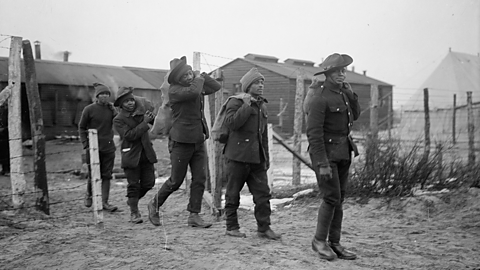
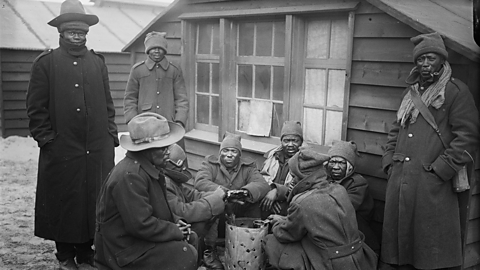
The SANLC carried out war work that was vital to the success of Britain and its allies in World War One, as shown in the slideshow below.
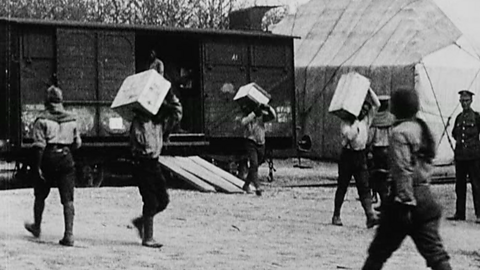
Image caption, Loading and unloading supply trains along the front line with essential materials, including food, ammunition, timber, corrugated iron, cement, horses and mules
1 of 4
Segregation
In the 20th century, South Africa had a policy of The routine separation of people (based on the colour of their skin)., which meant that people were separated and treated differently because of the colour of their skin.
A white South African government refused to send men to help with the war effort unless this segregation continued during the war. The British government agreed as they believed the need for men was too great.
Behind the front lines, men of the SANLC, other labour corps and soldiers lived in camps during the war. Although the British government did not have an official segregation policy within the army, there was nothing in place to stop this happening. This allowed the British military to agree to the South African government's demands for segregation to be applied to the SANLC.
What can we learn about the SANLC through source analysis?
Discover how the particular language used by those in power during World War One gives us an insight into the experiences of the SANLC in the video below.
This video contains a historical source which features racist language and may be distressing
Femi: This jacket seems an unremarkable uniform. But the language surrounding it makes it an important source for understanding the treatment of the South African Native Labour Corps in World War One.
Historically, the term ‘native’ was used to describe non-European people who were the first to live in an area. This offensive term was used to describe South Africans in order to divide citizens by their heritage. The word on this label, the k-word, is an extremely offensive term for a black person.
This jacket was a sample sent to a manufacturer as a guide for how it should be produced. The label would have been written up and attached to the jacket by a member of staff working at the British Army Clothing Depot. We think perhaps the word came from an official source. If so, it is a stark and shocking example of the official attitudes of the time. This racism was a part of the very mechanics of the war effort.
In 20th century South Africa, the policy of segregation meant that people were separated simply because of their skin colour, and the Government refused to send men unless this continued during the war. Despite not having an official segregation policy, the British Government agreed as they believed the need for men was too great. In fact, it wasn’t until 2000 that a Parliamentary Bill specifically outlawed the 'k-word' as hate speech in South Africa.
What do you think this label tells us about the experience of men who joined the South African Native Labour Corps?
What other sources might we need to find to uncover how and why the term ended up on the label?
When analysing historical events, it’s important to consider the impact of those events on people at the time they occurred and how those events have shaped and changed the world we live in today.
Historical sources help us ask questions and think critically to better understand the period. By looking at the smaller details and a variety of everyday items such as clothing, food and housing, we can learn about these men's lives.
We can also use these historical sources to analyse the language used to describe the SANLC to better understand the views of the time.
When a country takes control of another territory or land even if there are already others living there. occurs when a powerful nation takes control of other territories, imposing its customs and beliefs. In this context, the word ‘native’ takes on a different meaning. It represents the language used by white people during the period of European colonialism to express their false ideas of superiority over the people they rule. Therefore, for many people the word “native” is a colonial word that should not be used today.
What can this jacket tell us?
This jacket is a factory sample of the uniform worn by the SANLC. It has been archived with a highly offensive, racist term (the 'k-word') written on the label.
The term is so offensive it is now illegal to say in South Africa. This label can tell us about the daily inequality these men faced. This is not something we can easily discover from just looking at photos of the men working.
This dehumanising word was commonly used to racially discriminate against black people in South Africa. This language has always been offensive and is not acceptable today.
What happened to the SANLC after the war?
The video below explains what happened to the SANLC during and after the war.
Play the video to find out about the wider context of the South African Native Labour Corps
Femi: To expand our understanding of the South African Native Labour Corps in World War One, let’s explore the wider context.
The living conditions in France were difficult. South African men were segregated as far as possible from British and French soldiers and civilians.
Despite the tough conditions under which they served, the men of the South African Native Labour Corps provided invaluable support to the British Army: building and maintaining roads and railways, cutting timber and moving huge amounts of ammunition.
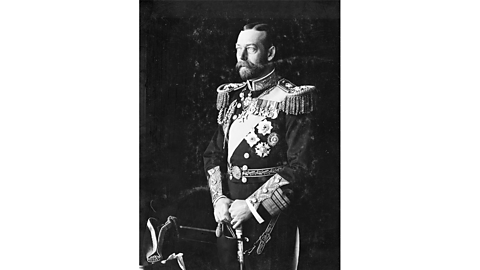
King George V personally visited the Corps in 1917 and highlighted their importance in the war effort. 'You also form part of my great armies, which are fighting for the liberty and freedom of my subjects of all races and creeds throughout my Empire. Such loyalty will not be forgotten.'
However, this is not obvious when we consider what happened at the end of their involvement. Pressure grew back home from white minority rule political groups who feared their loss of control over the black men, and in January 1918, the Corps were sent home. There were ten months left of the war.
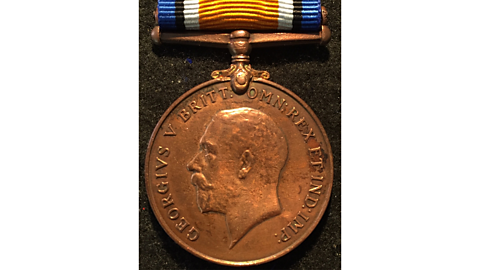
On leaving France, the work of the Corps was praised by British Commander-in-Chief, General Sir Douglas Haig. Yet the Corps was not rewarded – returning to continued segregation, and the South African Government even denied them the British War Medal.
In 1919, a contingent of the Corps quoted King George’s words back to him – questioning when they would receive their ‘liberty and freedom’. He did not answer.
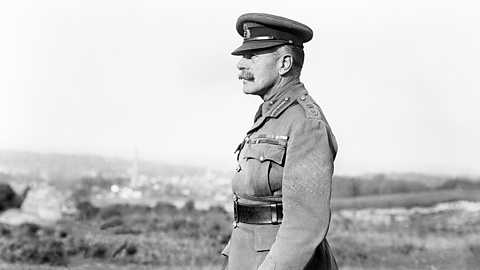
Below is a timeline of the key events at the end of the war showing how the SANLC were given limited recognition for their essential contribution.
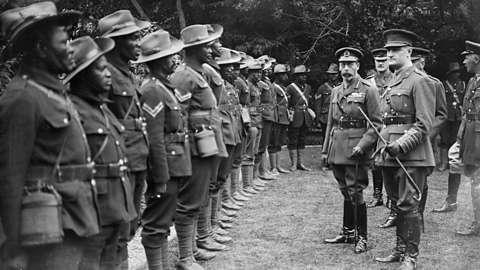
Image caption, 10 July 1917
When addressing the SANLC in France, King George V said: "You also form part of my great armies, which are fighting for the liberty and freedom of my subjects of all races and creeds throughout my Empire. Such loyalty will not be forgotten."
1 of 4
Archive images and footage provided by Imperial War Museums
Play the History Detectives game! game
Analyse and evaluate evidence to uncover some of history’s burning questions in this game.

More on World War One
Find out more by working through a topic
- count1 of 6