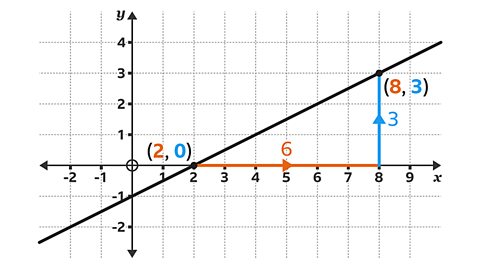
Key points about straight line graphs

Coordinates such as (3, 8) have an 𝑥-coordinate (3) and 𝑦-coordinate (8) to show how far a point has moved horizontally and vertically from the The point (0,0) on a set of axes. It is the point where the 𝑥-axis and 𝑦-axis meet. .
Straight line graphs are represented by A mathematical statement showing that two expressions are equal. The expressions are linked with the symbol =. such as 𝑥 = 2, 𝑦 = 3𝑥 + 7 or 𝑥 + 2y = 10. The 𝑥 and 𝑦 A quantity that can take on a range of values, often represented by a letter, eg 𝑛, 𝑥, 𝑦, 𝑧, 𝑡 … etc. in the equation relate to the 𝑥 and 𝑦 coordinates.
To help draw a straight line graph from its equation, fill in a table of 𝑥 and 𝑦 values. Plot the pairs of values as coordinates and join to make a line.
Make sure you are confident with substituting values into expressions and solving equations to understand how to plot straight line graphs.
Check your understanding
Plotting straight line graphs
Coordinates are points that are written in the form (𝑥, 𝑦). They can be plotted on a set of Two reference lines, one horizontal (the 𝑥 axis) and one vertical (the 𝑦 axis) that cross at right-angles on a grid. Axes is the plural of axis. where (0, 0) is the The point (0,0) on a set of axes. It is the point where the 𝑥-axis and 𝑦-axis meet. .
Some straight line graphs are represented by equations with one , such as 𝑥 = 3 or 𝑦 = 1. Their graphs are either The up-down direction. or The left-right direction. .
A straight line graph with two variables is represented by an equation such as 𝑦 = 3𝑥 – 7. The equation shows the link between the 𝑥 and 𝑦-coordinates.
To plot a graph from its equation, substitute different values of 𝑥 into the equation to give the corresponding 𝑦-coordinates. The pairs of 𝑥 and 𝑦 values can be recorded in a table.
Follow the working out below
GCSE exam-style questions
- Complete the table for 𝑦 = 3𝑥 − 2.
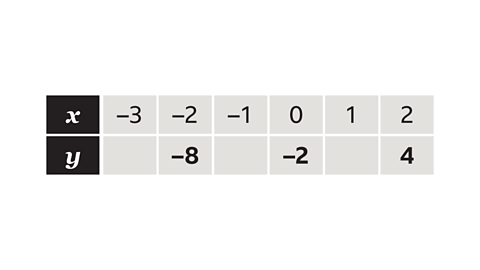
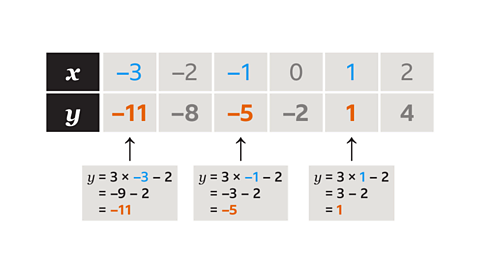
Substitute each 𝑥 value into the expression 3𝑥 − 2.
- When 𝑥 = −3, 𝑦 = −11.
- When 𝑥 = −1, 𝑦 = −5.
- When 𝑥 = 1, 𝑦 = 1.
- Use the table of values to write five coordinates that would exist on the line 𝑦 = 3𝑥 − 2.
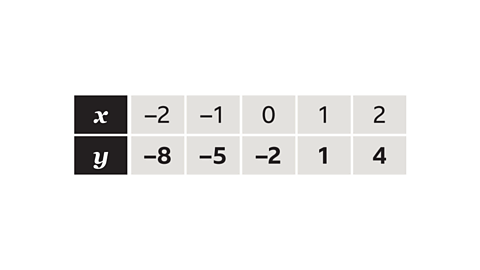
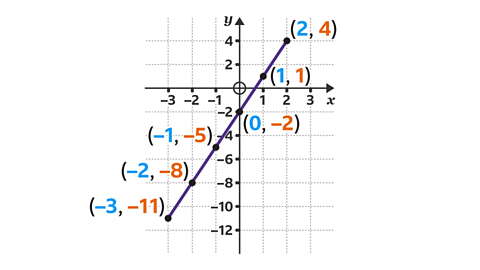
Each column of the table represents a set of coordinates to plot.
Eg, the first column represents the coordinates (– 2, –8).
Plotting more complex straight line graphs
The equations of some straight line graphs contain a negative of 𝑥, such as 𝑦 = 5 − 3𝑥.
When filling in a table of values for 𝑥 and 𝑦, the of 𝑥 values leads to calculations with negative numbers.

Remember:
Subtracting a negative value gives the same result as adding. For example:
3 − −2
= 3 + 2
= 5
To draw the equation of a line that does not begin with “𝑦 =”, such as in the example 2𝑥 + 3𝑦 = 12, the table of values can be reduced to two pairs of values.
One set of values is the point where 𝑥 = 0, and the other is where 𝑦 = 0.
To draw the equation of the line, plot these two points on a set of axes and draw a line between them.
Follow the working out below
GCSE exam-style questions
- Complete the table for 𝑦 = 5 − 3𝑥.
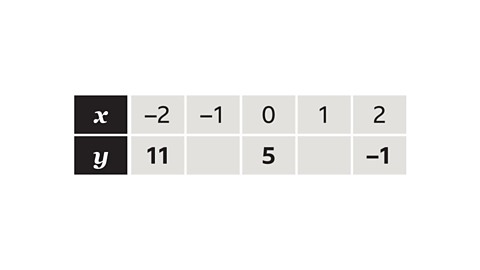
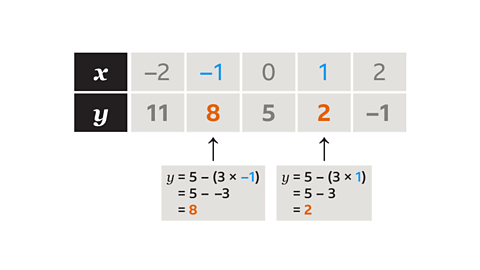
Substitute each 𝑥 value into the expression 𝑦 = 5 − 3𝑥.
- When 𝑥 = −1, 𝑦 = 8.
- When 𝑥 = 1, 𝑦 = 2.
- At which two coordinates would the line 𝑥 − 2𝑦 = 4 cross the 𝑥 and 𝑦-axis?
(4, 0) and (0, −2)
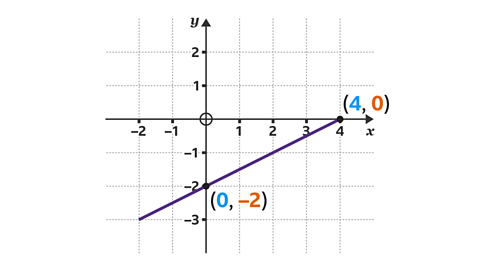
The line crosses the 𝑥-axis when 𝑦 = 0. Substitute 0 in place of 𝑦 in the equation 𝑥 − 2𝑦 = 4, then solve to find 𝑥:
- 𝑥 − 2 × 0 = 4
- 𝑥 = 4
The coordinate is (4, 0).
The line crosses the 𝑦-axis when 𝑥 = 0. Substitute 0 in place of 𝑥 in the equation 𝑥 − 2𝑦 = 4, then solve to find 𝑦:
- 0 − 2𝑦 = 4
- −2𝑦 = 4
- 𝑦 = −2
The coordinate is (0, −2).
Note that the two coordinates could be plotted and joined to draw the line 𝑥 − 2𝑦 = 4.
Quiz – Plotting straight line graphs
Practise what you have learned about plotting straight line graphs with this quiz.
Now that you have revised how to plot straight line graphs, why not try taking a look at equations of parallel and perpendicular lines?
Play Sudoku with BBC Bitesize!
Every weekday we release brand new easy, medium and hard Sudoku puzzles. Perfect for testing your skill with numbers and logic.

More on Algebra
Find out more by working through a topic
- count14 of 17
- count15 of 17

- count16 of 17