Key points
The Tempest is a play by English playwright William Shakespeare. It was first performed in 1611.
Themes are the main ideas that appear repeatedly in a play. The important themes in The Tempest are:
Freedom
Empathy and forgiveness
Nature versus To help someone develop and to care for them while they are growing up.
Did you know?
Some themes appear in a number of Shakespeare’s plays, for example, freedom. In The Tempest, Ariel and Prospero do not have freedom. Similarly, the young lovers in Romeo and Juliet are not free to love each other.
Freedom
Freedom is the right or ability to do or say what one wants.
Watch this video about freedom in The Tempest:
Narrator: Freedom.
Everyone loves a Disaster movie. It’s not just because of the action. It’s because of the freedom! Imagine if zombies attacked you now. You could run around with a cricket bat and do all the things you normally can’t do, because the old rules wouldn’t apply!
The Tempest is a disaster for the people on board the ship. But in the chaos, people try to rip up the old rules. Sebastian and Antonio try to kill King Alonso.
Caliban tries to free himself from Prospero by plotting with Trinculo and Stephano. Which is odd, because Caliban has already agreed to be Stephano’s slave. Maybe Caliban is afraid of freedom?
But Prospero, who summoned the tempest, is on a mission to free himself. Not just from the island he was marooned on. But from his own past, and need for revenge. He frees himself, and all his servants.
In this play Shakespeare suggests that to forgive and be forgiven is the greatest freedom that we can have. The big softie.
Many of the characters in The Tempest do not have freedom, or have had their freedom taken away. For example:
Prospero and Miranda have been banished to the island and have lived there for 12 years.
The King of Naples and his followers are trapped on the island after the shipwreck.
Ariel was imprisoned in a tree by the witch Sycorax and was freed by Prospero when he arrived on the island. However, Ariel was then forced to sacrifice his personal freedom to become Prospero’s servant. He asks Prospero for his freedom throughout the play, which Prospero eventually grants him.
Caliban lived freely on the island alongside Prospero and Miranda until he tried to attack Miranda. Prospero then To take away a person’s freedom and make them work for nothing. him and uses magic to control him and make him do tasks. This is an example of To use someone unfairly.. Although Caliban wants to be free from Prospero’s control, he also offers to become Stephano’s servant. By the end of the play he regrets this offer.
Prospero’s very last words in the play are addressed to the audience:
As you from crimes would pardoned be,
Let your indulgence set me free.
Prospero
Act 5, epilogue
What does Prospero mean by this?
In Prospero’s speech at the end of the play, he asks for the audience’s indulgence to set him free. By indulgence, he means applause, and by set him free, he means to end the play, because it is after the end of the play that the characters leave the island and return home.
Empathy and forgiveness
Empathy is the ability to understand what someone else is feeling. Forgiveness is the act of forgiving someone for something they have done wrong. Both are important themes in The Tempest.
Watch this video about empathy and forgiveness in The Tempest:
Narrator: Empathy and forgiveness.
Empathy is the ability to feel what somebody else might be feeling. Like if we see someone hurt, we can feel how they might feel. Our ability to put ourselves in other people’s shoes means that we’re likelier to treat them as we ourselves would like to be treated. Or to put it simply, empathy makes us kind.
Shakespeare knew that people can be unkind. Prospero begins the play pretty hard hearted. He uses Ariel like a slave, ignoring the spirit’s pleas for freedom. Prospero treats Caliban badly. Certainly, Caliban is no saint, but he was here first!
However, Prospero begins to empathise with his old foes, and in doing so, learns to empathise with his servants. Someone who didn’t have to learn is Prospero’s daughter Miranda. She naturally empathises with everyone.
Shakespeare knew that it’s hard to be kind and forgiving to selfish people. We just have to hope that they learn their lesson. Before they meet someone as bad as them.
At the start of the play, Prospero does not show much empathy for others. Ariel teaches Prospero empathy by encouraging him to pity the shipwrecked characters. Later in the play, Prospero seems to develop empathy, and this allows him to forgive his enemies, Alonso and Antonio. Alonso and Prospero are brought together by their children’s engagement. While Alonso seems happy to be forgiven by Prospero, Antonio says nothing.
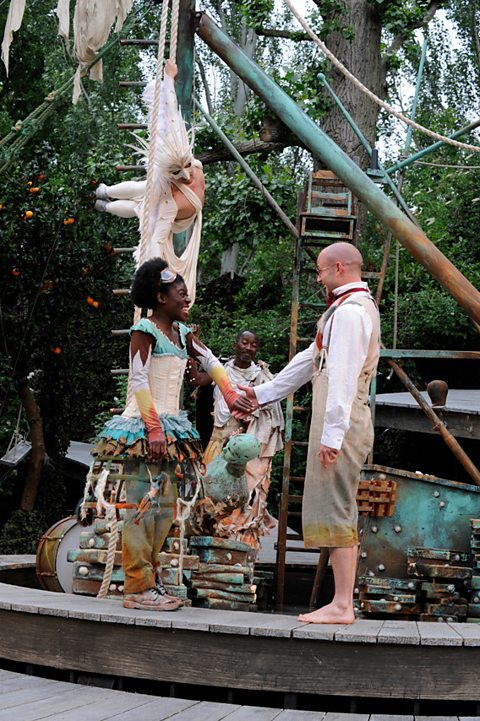
Miranda has a strong sense of The ability to understand someone else's feelings. which is shown throughout the play. This is shown in her response to the shipwreck at the start of the play, when she imagines what the people involved are feeling and shows concern for them. Miranda also feels empathy for Ferdinand, when Prospero forces him to carry out hard physical labour.
The engagement of Miranda and Ferdinand helps reinforce the theme of forgiveness at the end of the play, as their union brings Prospero and Alonso together.
By the end of the play, Caliban says he will “seek for grace”, which means to ask for forgiveness.
Nature versus nurture
Nature versus nurture is the debate over whether people’s personality is something that they are born with - nature - or whether their personality is shaped by how they were raised - nurture.
Watch this video about nature versus nurture in The Tempest:
Narrator: Ooh. The cinema. I want a choc ice. Nature versus Nurture? I hope this is educational. It’s the age-old question. Whether our character is more influenced by what we are born with? Or by the environment in which we are raised? For example, are some people naturally bad, like Shakespeare’s Caliban? Certainly Prospero thinks so.
Other people seem to be naturally good, like Prospero’s daughter Miranda. Nature itself is mastered and controlled by Prospero through magic. Whereas Gonzalo suggests that we would be much happier if we lived in harmony with nature. So what is more important? Nature or nurture? The answer is…
Well, Mr Shakespeare. What do you think? You don’t know. That’s why you wrote the play. Explore the issues about the positive and negative in both nature and civilisation. And whether we can change nature for the better. Or are we stuck with what we’re born with?
Ah, get me a choc-ice! I’m hungry. On you go. I can’t help it! It’s my nature! And find out what’s on next! That last film was rubbish!
Prospero believes that Caliban’s basic nature is wicked, and no amount of kind nurture can change this:
A devil, a born devil, on whose nature
Nurture can never stick.
–Prospero,
Although Prospero at first tried to educate and nurture Caliban, he believes his violent nature is too strong and that this led him to attack Miranda. In contrast, Miranda is presented as having a good and gentle nature.
Test your knowledge
Solve the Story!
An exciting new series from the Other Side of the Story, designed to help young people strengthen their media literacy skills.

More on The Tempest
Find out more by working through a topic
- count3 of 6
- count4 of 6
- count5 of 6
- count6 of 6