Key points
The Tempest is a play by English playwright William Shakespeare. It was first performed in 1611.
Caliban is the son of Sycorax, a witch. He was born on the island.
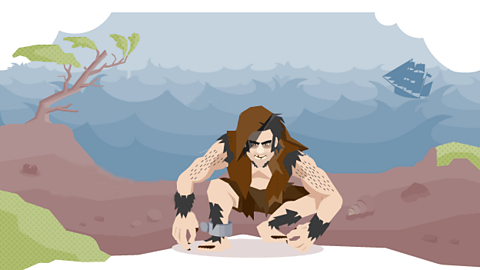
When Prospero and Miranda first arrived on the island, Caliban lived with them. However, after Caliban attacked Miranda, Prospero To take away a person’s freedom and make them work for nothing. him and uses magic to control him.
Caliban hates Prospero and looks for ways to overthrow him, but by the end of the play regrets his actions and asks for forgiveness.
Video - Casting Caliban
Watch the following video to learn about how a director might cast the role of Caliban.
Presenter: Caliban! A tricky part to cast. Some say he’s a man and some say he’s a monster. Some say savage and some say sad. Some find him funny and some find frightening. Some say evil and some say mad. I say it’s time someone made their flipping mind up because this is Casting Caliban.
Interesting! Caliban is described as a strange beast and he’s even mistaken for a fish when he’s first found so this snaky thing could work.
Caliban 1: Sometime am I all wound with adders who with cloven tongues do…
Director: Excuse me. I appreciate the effort but Stephano specifically says, this is some monster of the isle with four legs. So this isn’t quite working for me really.
Caliban 1: Right fine. Fine I’ll go then. But you’re making a big mistake.
Presenter: I think it’s storming out. This could take a while.
Caliban 2: Do not torment me prithee. I’ll bring my wood home faster.
Director: Hey. Yeah great. Can I just stop you for a moment? Caliban is part man for sure but you’re kind of all man at the moment.
Caliban 2: Ehh!
Director: Yeah! Great!
Presenter: Blimey, there’s a monster in him after all.
Caliban 2: Eh, eh, eh! Do not torment me prithee, I’ll bring my wood home faster.
Director: Love it!
Caliban 2: Eh, eh, eh, eh…ooh that’s better. Eh, eh, eh.
Director: Next!
Presenter: He looks more miserable than monstrous. But Caliban certainly is Prospero’s prisoner. Savage, yet enslaved.
Director: So do you have an agent?
Caliban 3: I did. But I killed him and ate him.
Director: No, um, agent. No agent.
Presenter: It’s been a strange afternoon that’s for sure. But this is a fascinating interpretation. Lots going on here. Maybe monstrous, possibly magical, man or beast. And he really stinks. This is method acting and no mistake.
Caliban 4: Ooh look at that. … It's for you.
Director: Like it. Nice touch. So how did you hear about the audition?
Caliban 4: What is audition? Boop.
Did you know?
Caliban’s mother, the witch Sycorax, trapped Ariel in a tree before the events of the play.
Plot summary
Caliban’s key moments
Click through the slideshow to see Caliban’s key moments
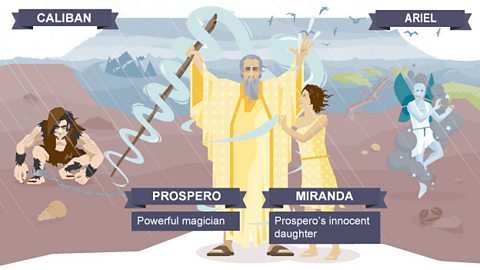
Image caption, Caliban is an original inhabitant of the island. His mother was the witch Sycorax, who died before the events of the play and left the island to Caliban. He attacked Miranda soon after she and her father arrived, so Prospero enslaved him and uses his magic to control him.
1 of 3
Character traits
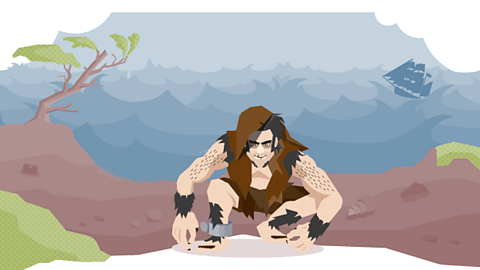
Prospero says that Caliban is “not honour’d with a human shape”, which suggests that Caliban is not a fully human character. He is called a variety of insulting names, including “strange fish”, “demi-devil” and “monster”.
Violent
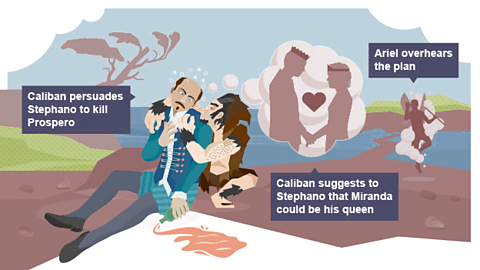
Caliban has a violent side to his character. Before the events of the play, he attacked Miranda, and in the play he plans to murder Prospero.
Bitter
Caliban feels the island has been taken from him. He feels that he is the rightful ruler of the island as he inherited it from his mother, the witch Sycorax. He complains and curses Prospero.
Sensitive
Caliban also has a more sensitive side to his character. For example, he uses beautiful language to describe the island.
Which one of these statements are true?
Caliban believes that Prospero has taken the island from him.
Caliban is a violent character who shows no signs sensitivity.
Caliban attacked Miranda and plans to murder Prospero.
Statements 1 and 3 are true.
Statement 2 is false. Despite his violent character, he does shows signs of sensitivity in his poetic description of the island.
Relationships
Caliban has difficult relationships on the island.
Miranda is a gentle, kind character but she can’t bear to even look at Caliban and calls him an “villain”.
Caliban curses Prospero for taking his freedom and challenges Prospero’s authority. Prospero controls Caliban with his magic and physically punishes him.
Caliban offers to serve Stephano. At the end of the play, he regrets his loyalty to Stephano and asks for forgiveness.
Did you know?
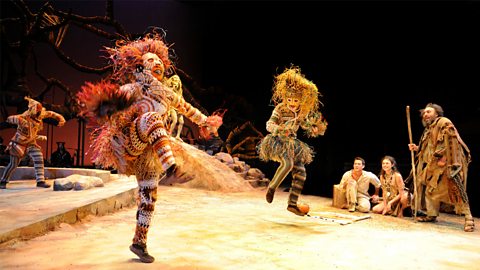
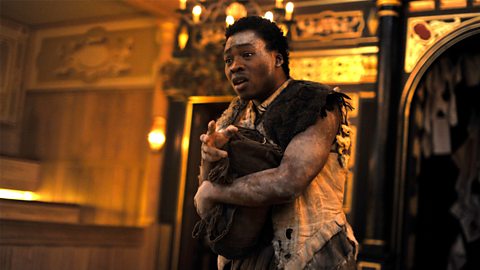
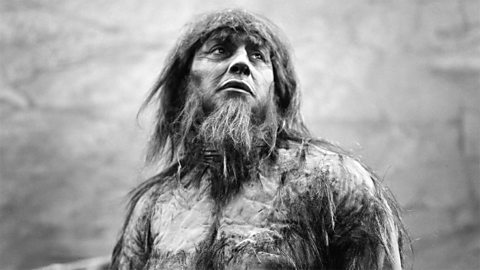
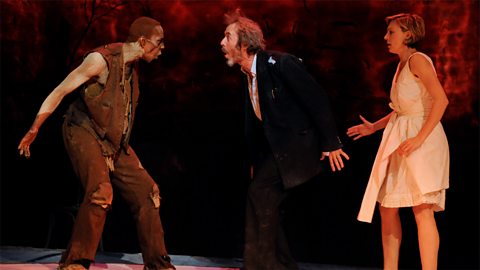
The character of Caliban has fascinated artists and designers over the years, because of his mysterious appearance. In productions he has been presented as half-human, half-monster, a dog, a fish and even a tortoise.
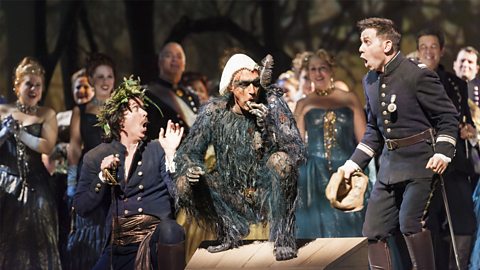
Image caption, Scottish actor and singer Alan Oke as Caliban in a 2012 opera version of the play.
1 of 4
Changes in character
When Prospero and Miranda first arrived on the island, Caliban lived peacefully alongside them and helped them survive. Caliban suggests they had a good relationship at first. However, this changed following Caliban’s attack on Miranda.
Caliban hates Prospero for enslaving him and plots to overthrow him, but this plan is stopped by Ariel.
At the end of the play, it’s left unclear what happens to Caliban. Unlike Ariel, we do not see Prospero grant him freedom, but as Prospero and Miranda return to Milan without Caliban, it seems that he is left alone on the island.
How can Caliban represent When one group of people has power over another group, usually by taking over control of their country.?
In The Tempest Prospero enslaves Caliban. He takes control of Caliban’s island, forces him to use his language and controls him with magic.
Some productions use Caliban’s character to explore the history of European colonialism and the transatlantic slave trade.
Activity - Order it
What do these key quotations mean?
This island’s mine, by Sycorax, my mother
Caliban
Act 1, scene 2
Caliban was born on the island, and since the death of his mother has lived alone. He believes that he is the rightful owner of the island, and that Prospero has stolen it from him.
I will kiss thy foot. I prithee, be my god.
Caliban
Act 2, scene 2
When Caliban is drunk, he asks Stephano to be his master.
Be not afeard; the isle is full of noises,
Sounds and sweet airs that give delight and hurt not.
Caliban
Act 3, scene 2
These lines show a more poetic and sensitive side to Caliban’s character. He seems to appreciate the beauty of the island and the music made by the spirits.
How does Caliban’s language show his more sensitive side?
At times, Caliban speaks in verse and uses poetic language. For example, the gentle alliteration of “sounds and sweet airs”. These language choices show a more sensitive side to his character and an appreciation of the charms of the island. This is in contrast to his brutal and aggressive language at other points in the play.
Listen to a scene
In Act 1, scene 2, Caliban and Prospero are arguing. Listen to this audio clip of their conversation:
Caliban: I must eat my dinner.
This island’s mine by Sycorax my mother,
Which thou tak’st from me. When thou cam’st first
Thou strok’st me and made much of me; wouldst give me
Water with berries in’t, and teach me how
To name the bigger light, and how the less,
That burn by day and night. And then I loved thee
And showed thee all the qualities o’th’isle,
The fresh springs, brine-pits, barren place and fertile -
Cursed be I that did so! All the charms
Of Sycorax - toads, beetles, bats, light on you!
For I am all the subjects that you have,
Which first was mine own king; and here you sty me
In this hard rock, whiles you do keep from me
The rest o’th’island.
Prospero: Thou most lying slave,
Whom stripes may move, not kindness! I have used thee,
Filth as thou art, with human care, and lodged thee
In mine own cell, till thou didst seek to violate
The honour of my child.
Caliban: O ho, O ho! Would’t had been done.
Thou didst prevent me - I had peopled else
This isle with Calibans!
Test your knowledge
Play Bitesize secondary games. game
Have fun playing science, maths, history, geography and language games.

More on The Tempest
Find out more by working through a topic
- count5 of 6
- count6 of 6
- count1 of 6

- count2 of 6