Key points
The Tempest is a play by English playwright William Shakespeare. It was first performed in 1611.
Prospero is the central character of the play. He is a powerful magician who was once the Duke of Milan.
However, Prospero’s brother, Antonio, betrayed him and took his title, banishing him to live on an island with his daughter Miranda.
At the start of the play, Prospero and Miranda have lived on the island for 12 years.
Prospero creates a storm to punish his enemies and shipwreck them on the island. Although he wants to see his enemies suffer, by the end of the play he has forgiven them.
Did you know?
The phrases ‘in a pickle’, ‘into thin air’ and ‘brave new world’ were first recorded in The Tempest.
Plot summary
Prospero’s key moments
Click through the slideshow to see Prospero’s key moments
Prospero’s key moments
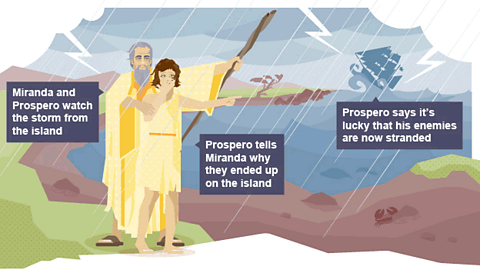
Image caption, Prospero causes a storm using his magical powers. The storm wrecks a ship and strands his enemies – Alonso and Antonio – on the island, along with other passengers such as Gonzalo, Sebastian and Ferdinand.
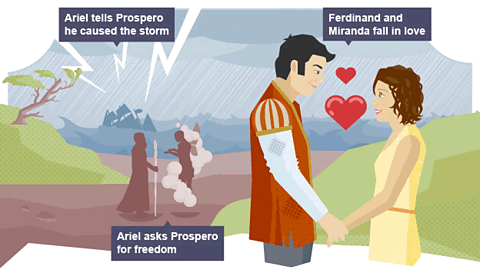
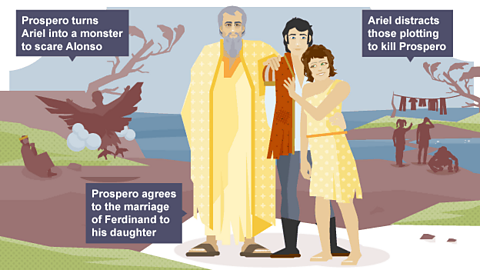
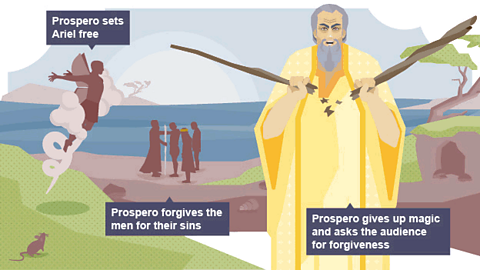
1 of 4
Character traits
Prospero is a magician who used to belong to Milan’s A class of people just below the king in rank and social status. They often controlled a large area of land which helped give them power and wealth. before he was banished to an island.
Educated
Prospero reads a lot and is very knowledgeable. He has taught himself to use magic and control nature.
Powerful
His power as a magician allows him to control people and events on the island. He uses the spirits on the island, including Ariel, to increase his power. He punishes Caliban with magic when he doesn’t do as he is told.
Controlling
Prospero controls Ariel and Caliban. He is protective of his daughter Miranda and tries to control her actions on the island. He even uses magic to send Miranda to sleep at the start of the play, to prevent her asking any more questions about their past. He also controls the relationship between Miranda and Ferdinand.
Forgiving
Ariel encourages Prospero to become more forgiving and by the end of the play he has forgiven his enemies.
Did you know?
Directors of Shakespeare plays sometimes change the gender of a character, which can have an interesting impact on the play. For example, Prospero is sometimes played by a woman.
Relationships
Miranda
Prospero has a close relationship with his daughter. He has educated and cared for her on the island. He is a protective father and, although he approves of Ferdinand as a potential match for Miranda, Prospero still wants Ferdinand to prove himself before he agrees to the marriage.
Caliban
Prospero treated Caliban well until Caliban attacked Miranda. After the attack Prospero To take away a person’s freedom and make them work for nothing. Caliban. Caliban has no choice but to complete work for Prospero, who threatens him with magic.
Ariel
When Prospero came to the island, Ariel had been trapped in a tree by Caliban’s mother, the witch Sycorax. Prospero rescued him and then made him his servant. Prospero becomes angry when Ariel asks to be set free, but he does grant him freedom at the end of the play. He seems to have feelings of affection for Ariel and says that he will miss him.
Changes in character
Prospero at the start of the play
At the beginning of the play, Prospero is vengeful and uses magic to punish his enemies harshly, including making Alonso think that his son has died. He treats Caliban, whom he has enslaved, cruelly and refuses Ariel’s request to set him free.
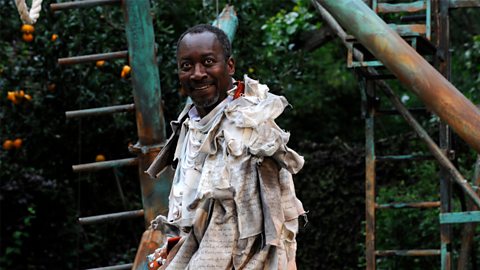
Prospero at the end of the play
Ariel manages to convince Prospero to be more forgiving and at the end of the play Prospero keeps his promise to Ariel and sets him free. Prospero welcomes Miranda and Ferdinand’s engagement, organising a A type of spectacular performance involving poetry, dance, music, scenery and costumes. to celebrate. Prospero also forgives his enemies, and by the end of the play has given up magic.
Activity - Order it
What do these key quotations mean?
…thou shalt be pinch’d
As thick as honeycomb, each pinch more stinging
Than bees that made ’em.
Prospero
Act 1, scene 2
This quotation is a threat from Prospero to Caliban.
This simile reveals a crueller side to Prospero, who threatens to use his powerful magic to give pain to Caliban.
My high charms work,
And these, mine enemies, are all knit up
In their distractions. They now are in my power.
Prospero
Act 3, scene 3
These lines reveal Prospero’s pleasure that he can control his enemies.
As you from crimes would pardoned be,
Let your indulgence set me free.
Prospero
Act 5, epilogue
In these lines Prospero admits that he is giving up magic and returning to Milan.
How would a Shakespearean audience react to Prospero’s magical powers?
A belief in folklore and magic was common in Shakespeare’s day and many people believed in the existence of fairies and spirits.
The audience may also have seen Prospero as a type of magus - an educated man who studied science and was believed to gain magical powers through their studies. A magus could use their powers for good or might be tempted to use dark magic.
Dark magic in the play is represented by Caliban’s mother, a witch called Sycorax, who imprisoned Ariel in a tree some years before the events of the play.
Listen to a scene
Some historians believe that The Tempest is the last play Shakespeare wrote. At the very end of The Tempest, Prospero speaks to the audience in an A final speech made at the end of the play after the main action has finished.. Some people see this epilogue as a goodbye speech from Shakespeare himself.
Prospero: Now my charms are all o’erthrown,
And what strength I have’s mine own -
Which is most faint. Now, ’tis true
I must be here confined by you,
Or sent to Naples, let me not,
Since I have my dukedom got
And pardoned the deceiver, dwell
In this bare island, by your spell;
But release me from my bands
With the help of your good hands.
Gentle breath of yours my sails
Must fill, or else my project fails,
Which was to please. Now I want
Spirits to enforce, art to enchant,
And my ending is despair,
Unless I be relieved by prayer
Which pierces so, that it assaults
Mercy itself, and frees all faults.
As you from crimes would pardoned be,
Let your indulgence set me free.
Test your knowledge
Solve the Story!
An exciting new series from the Other Side of the Story, designed to help young people strengthen their media literacy skills.

More on The Tempest
Find out more by working through a topic
- count4 of 6
- count5 of 6
- count6 of 6
- count1 of 6