Key points about describing accommodation
- The Means ‘a’ or ‘an’. Indefinite articles change depending on whether the nouns they go with are masculine or feminine. (a, an or some) is usually used in the same way as it is in English.
- The Means 'the'. Definite articles change depending on whether the noun it goes with is masculine, feminine, singular or plural. (the) is used differently in French.
- Use the conditional tense to express what would, could or should happen.
- This guide contains reading and listening practice.
Vocabulary - Talking about holiday accommodation
Options for places to stay on holiday include:
| French | English | French | English |
|---|---|---|---|
| Check your connection, refresh the page and try again. | in an apartment | Check your connection, refresh the page and try again. | on a boat |
| Check your connection, refresh the page and try again. | on a campsite | Check your connection, refresh the page and try again. | in a castle |
| Check your connection, refresh the page and try again. | in a hotel | Check your connection, refresh the page and try again. | with family |
| Check your connection, refresh the page and try again. | on a farm | Check your connection, refresh the page and try again. | with friends/at my friends’ |
For example:
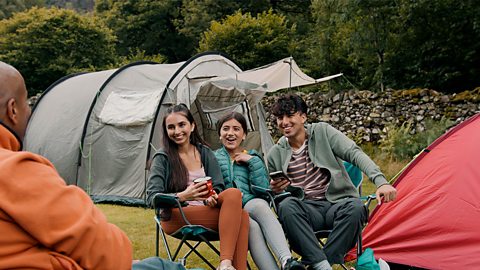
Nous restons dans un camping. - We stay / we are staying on a campsite.
On a reservé deux chambres dans un hôtel. - We reserved two rooms in a hotel.
Je vais passer les vacances dans ma famille ou chez mes copains. - I am going to spend my holidays staying with family or friends.
Booking accommodation
Useful phrases for booking accommodation inlcude:
| French | English | French | English |
|---|---|---|---|
| Je voudrais réserver … | I would like to book … | pour trois personnes | for three people |
| une chambre double | a double room | avec accès aux personnes handicapées | with wheelchair access |
| une chambre à deux lits | a twin room | avec toilettes privées | with en suite toilet |
| une chambre familiale | a family room | pour deux nuits | for two nights |
| une tente | a tent | pour une semaine | for one week |
| un logement | accommodation | en juin/juillet/août | in June/July/August |

For example:
Je voudrais réserver une chambre familiale pour quatre personnes. - I would like to book a family room for four people.
Avez-vous un logement avec accès aux personnes handicapées? - Do you have accommodation with wheelchair access?
Grammar - Definite and indefinite articles
In English, the definite article is always ‘the’ and the indefinite article is either ‘a’ or ‘an’ (before a vowel).
In French, the words for ‘the’ and ‘a/an’ change, depending on whether the noun is masculine, feminine or plural.
| English | masculine | feminine | plural |
|---|---|---|---|
| the | Check your connection, refresh the page and try again. | Check your connection, refresh the page and try again. | Check your connection, refresh the page and try again. |
| a (or an), some | Check your connection, refresh the page and try again. | Check your connection, refresh the page and try again. | Check your connection, refresh the page and try again. |

Remember
Le and la become l’ before a noun which starts with a vowel or a silent h.
The definite article
In English, the definite article is 'the' and there are differences between the way in which it is used in French and in English.
Have a look at the table to see how the definite article is used in French when it is not used in English.
| Example | English | |
|---|---|---|
| 1. Expressions of liking, disliking and preferring | J’adore les vacances scolaires. | I love school holidays. |
| 2. To express a generality | Les hôtels coûtent chers. | Hotels (in general) are expensive. |
| 3. With school subjects and languages | J’étudie l’histoire. | I study history. |
| 4. With countries | L’Algérie est un pays chaud. | Algeria is a hot country. |
| 5. With parts of the body | J’ai les yeux bleus. | I have blue eyes. |
| 6. In time phrases. | le weekend dernier | last weekend |
The definite article can also be used to turn an adjective into a noun.
For example:
seul (alone, only, lonely) becomes le seul (the only one)
anglais (English, adjective) becomes l’Anglais (the English person)
The definite article is omitted in French in the following situations.
- After expressions of quantity including:
beaucoup de (a lot of)
plus de (more)
trop de (too much)
peu de (little, few)
assez de (enough):
For example:
Il y a beaucoup de bateaux ici. – There are a lot of boats here.
Nous avons trop de choix. – We have too much choice.
- After negative expressions including:
ne … pas de (none/not any)
ne … jamais de (never any):
For example:
On n’a pas de réservation. – We don’t have a reservation.
Je n’ai jamais d’argent. – I never have any money.
Definite and indefinite articles - Mini quiz
Find out more about using articles in the Definite and indefinite articles in French guide.
Reading practice
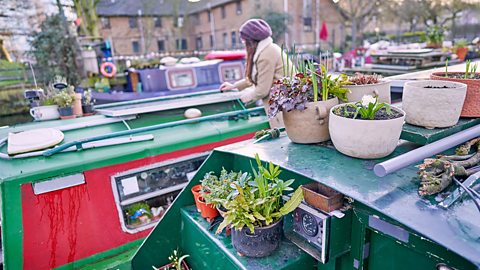
Match the type of accommodation which best fits the descriptions in the adverts.
A. A castle
B. A youth hostel
C. A farm campsite
D. A boat
- Réservez en ligne pour votre groupe scolaire. Chaque chambre a dix lits et les adolescents peuvent préparer leurs propres repas dans notre grande cuisine.
The answer is B - a youth hostel.
Translation
Book online for your school group. Each room has ten beds and the young people can prepare their own meal in our large kitchen.
- Pour les touristes qui apprécient l’histoire, nos chambres offrent un voyage dans le passé. Vous pouvez même dormir dans la vieille tour!
The answer is A - a castle.
Translation
For tourists who appreciate history, our rooms offer a journey into the past. You can even sleep in the old tower.
- Imaginez des vacances sur l’eau où vous êtes libre de découvrir un nouvel endroit chaque jour ! Sur un lac ou bien une rivère, c’est toujours calme et relaxant.
The answer is D - a boat.
Translation
Imagine a holiday on the water where you are free to discover a new place each day! Whether a lake or a river, it is always calm and relaxing.
- Si vous aimez la nature, pourquoi pas dormir sous les étoiles dans nos champs ? C’est idéal pour les familles car les enfants adorent les animaux et la liberté.
The answer is C - a farm campsite.
Translation
If you like nature why not sleep under the starts in our fields? It's ideal for families as children love animals and freedom.
Vocabulary - Holiday facilities
Useful phrases for talking about holiday facilities include:
| French | English | French | English |
|---|---|---|---|
| Le lit était très confortable. | The bed was very comfortable. | L’internet ne marchait pas. | The internet wasn’t working. |
| Il y avait un bon restaurant. | There was a good restaurant. | La piscine était trop froide. | The swimming pool was too cold. |
| Il y avait une belle vue sur la mer. | There was a lovely sea view. | La chambre n’était pas propre. | The room was not clean. |
| La chambre était très calme. | The room was very quiet. | La fenêtre n’ouvrait pas. | The window didn’t open. |
| Ce n’était pas du tout cher. | It wasn’t expensive at all. | Il y avait un problème avec la clé. | There was a problem with the key. |

Malheureusement, il y avait beaucoup de problèmes avec la chambre. - Unfortunately, there were a lot of problems with the room.
J’étais content car le lit était extrêmement confortable. - I was pleased because the bed was extremely comfortable.
All Foundation Tier vocabulary listed in the guide can be found on the vocabulary sheet below.
Grammar - Using the conditional tense

The conditional is used in the following situations to express what would, could or should happen. It is also used to say what would happen if certain conditions were fulfilled.
1. Using the verb vouloir (to want to)
je voudrais - I would like
tu voudrais - you singular informal would like
il / elle voudrait - he/she would like
on voudrait - we would like
For example:
Je voudrais une chambre pour deux personnes. I would like a room for two people.
2. For politeness when making requests
For example:
Je voudrais un café. I would like a coffee - is more polite than je veux un café - I want a coffee.
3. Using vouloir with an The basic form of the verb. In French, all infinitives end in '-er', '-ir' or '-re'. verb to say what someone would like to do
For example:
Je voudrais aller en Italie. I would like to go to Italy.
4. With a variety of verbs
For example:
Je regarderais la télévision toute la journée. Ce serait super ! - I would watch TV all day. It would be great!
The conditional - Mini quiz
Translate the following sentences into French.
I would like to visit Canada.
Je voudrais visiter le Canada.
The conditional with vouloir is often used with an infinitive verb to say what someone would like to do.
We would like two rooms, please.
On voudrait deux chambres, s’il vous plaît.
Use the on form of the conditional to mean ‘we’.
If she were rich, she would like to live in Paris.
Si elle était riche, elle voudrait habiter à Paris.
Use the structure ‘if’ followed by imperfect tense and the conditional tense to say what you would like to do if things were different.
I think it would be brilliant!
Je pense que ce serait génial !
Use the phrase ce serait to say what you think things would be like.
Find out more about using the conditional tense in the The conditional in French guide.
Listening practice
You are listening to a podcast interview with a French student talking about a trip to England last year.
Choose the correct option for each question.
Question 1
They went to London…
| A | with their family |
| B | with their school |
| C | with their team |
The answer is B - with their school
Question 2
The hotel was…
| A | big |
| B | dirty |
| C | expensive |
The answer is B - dirty
Question 3
The room was…
| A | comfortable |
| B | cold |
| C | hot |
The answer is C - hot
Question 4
They also had a problem with…
| A | the key |
| B | the door |
| C | the food |
The answer is A - the key
Click on Show more to see the transcript and translation.
Transcript
Quand j’étais étudiant au lycée, je suis allé à Londres avec un groupe scolaire. On est restés dans un petit hôtel terrible. Ce n’était pas propre !
Il faisait trop chaud dans la chambre et la fenêtre n’ouvrait pas. En plus, le lit n’était pas du tout confortable.
La clé ne marchait pas et l’Internet était très cher. Je ne voudrais jamais retourner dans cet hôtel !
Translation
When I was a student at sixth form college, I went to London with a school group. We stayed in a terrible little hotel. It wasn’t clean!
It was too hot in the bedroom and the window didn’t open. What’s more, the bed was not at all comfortable.
The key didn’t work and the Internet was very expensive. I never want to return to that hotel!
Vocabulary sheet
Click or tap on the image below for a list of useful vocabulary to use when describing accommodation.

Higher Tier - Grammar - Forming the conditional
The conditional is formed by adding the imperfect tense ending to the infinitive for regular er verbs.
| Stem | Conditional endings | Example | English | |
|---|---|---|---|---|
| Check your connection, refresh the page and try again. | manger | ais | Check your connection, refresh the page and try again. | I would eat |
| Check your connection, refresh the page and try again. | jouer | ais | Check your connection, refresh the page and try again. | You would play |
| Check your connection, refresh the page and try again. | gagner | ait | Check your connection, refresh the page and try again. | He would earn / He would win |
Forming the conditional tense with irregular verbs
The following four common irregular verbs all have irregular stems in the conditional, but the same endings:
avoir - to have
être - to be
aller - to go
faire - to do/make
| Infinitive | English | Stem | Example | English |
|---|---|---|---|---|
| Check your connection, refresh the page and try again. | to have | aur | Check your connection, refresh the page and try again. | I would have |
| Check your connection, refresh the page and try again. | to go | ir | Check your connection, refresh the page and try again. | You would go |
| Check your connection, refresh the page and try again. | to be | ser | Check your connection, refresh the page and try again. | She would be |
| Check your connection, refresh the page and try again. | to do/make | fer | Check your connection, refresh the page and try again. | He would do/make |
Higher Tier - How to use the conditional
The conditional is often used with ‘if’ clauses and the imperfect to say what you would do if the circumstances were different.
For example:
Si c’était possible, je voudrais ma propre chambre. - If it were possible, I would like my own room.
S’il avait plus d’argent, il irait en France. - If he had more money, he would go to France.
Find out more about using the conditional tense in The conditional in French guide.
Now you have revised the important vocabulary and key grammar points for describing accommodation, why not have a look at Describing social activities in French.
Careers advice and tips from BBC Bitesize
Future careers, further studies and the world of work - we're here to help with advice from experts and from young people who've found their path.

More on Travel and tourism
Find out more by working through a topic
- count2 of 4