The shadow of empire and enslavement
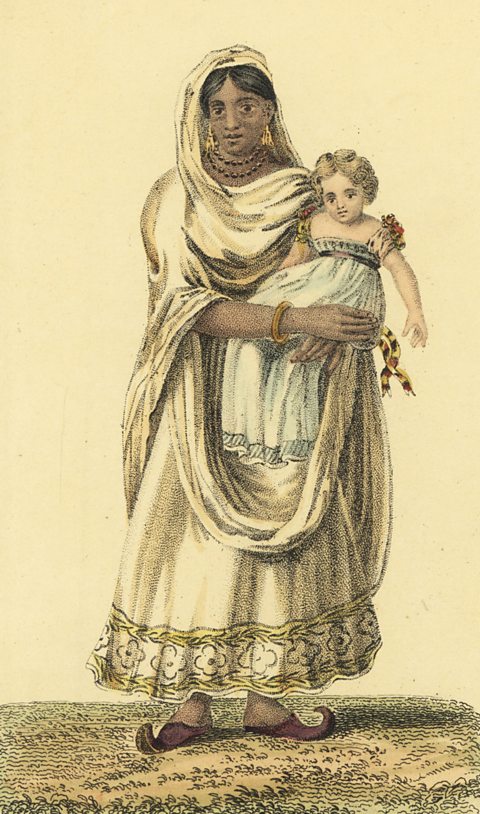
From the late 1600s, life for people in Britain of African and Asian origin became more difficult. The growth of the All the territory across the world that was ruled by Britain. At its height in the 1920s it covered near a quarter of the world's land and included one fifth of the world's population. and the trade in enslaved Africans brought larger numbers of African and Asian A person who arrives from another country., many of them forced migrants, and new ideas about racial superiority took hold.
Indian child servants and ayahs (nannies) arrived with East India Company families, while African servants were brought from the Caribbean or directly from Africa. The fashion for wealthy families to have and show off African or Indian child servants - seen in many paintings of the time - meant that many children lived far from their families. They were often well looked after, but also patronised. Their lives may have been lonely, surrounded by people of an A foreigner, someone who has come from another country. culture and language. Some, when they were no longer children, were abandoned.
Meanwhile the Royal African Company was managing a growing trade in enslaved Africans, taken to work on sugar and tobacco plantations in the Americas. Ideas of a racial hierarchy based on skin colour developed as a way of justifying slavery and empire.
The law was confused. Enslavement in the colonies was allowed by law, but not lawful in Britain. Some Africans and Indians working as servants were not free, as is clear from court cases and advertisements about runaways. However, court and parish records also show that others were treated equally.
Treatment of servants varied from kindness to extreme violence. In a few cases black people were actually sold into slavery in Britain, and some owners treated their servants as slaves even though the law in theory protected them. Most black residents appear to have lived ordinary lives and worked alongside white maids, washerwomen, labourers, cooks and sailors, sharing their lives. There were black people in many occupations including innkeepers, barmaids and farm labourers.
Revision tip
‘Britain welcomed immigrants in the period between 1500 and 1750’. How far do you agree with this statement?
Go through this guide and make a list of all the examples you can find that support the statement, ie. examples of a welcoming Britain.
Then go through and list all the examples you can find that oppose the statement, ie. examples of an unwelcoming Britain.
How far do you agree with the statement, and why?
More guides on this topic
- Migration to Britain c1000 to c2010 overview - OCR A
- Medieval 1000-1500 overview - OCR A
- Reasons for immigration in the Medieval era - OCR A
- Experiences of immigrants in the Medieval era - OCR A
- Impact of immigration in the Medieval era - OCR A
- Immigration in the Early Modern era, 1500-1750 overview - OCR A
- Reasons for immigration in the Early Modern era, 1500-1750 - OCR A
- Impact of immigration in the Early Modern era, 1500-1750 - OCR A
- Immigration in the Industrial era, 1750-1900 overview - OCR A
- Reasons for immigration in the Industrial era, 1750-1900 - OCR A
- Experiences of immigrants in the Industrial era 1750-1900 - OCR A
- Impact of immigration in the Industrial era 1750-1900 - OCR A
- Immigration in the Modern era 1900 - present overview - OCR A
- Reasons for immigration in the Modern Era 1900 - present - OCR A
- Experiences of immigrants in the Modern era, 1900 - present - OCR A
- Impact of immigration in the Modern Era 1900 - present - OCR A
- Migration to Britain c1000 to c2010 - exam preparation - OCR A
