Describing personality
Wie bist du? – What are you like?
To describe your personality, you need to know some adjectives.
Question
Sort the following adjectives into the following categories:
- positiv
- negativ
- egal
| positiv | negativ | egal |
| fleißig – hard-working | doof – silly | ruhig – quiet |
| freundlich – friendly | faul – lazy | schüchtern – shy |
| geduldig – patient | laut – loud, noisy | |
| gut gelaunt – good-humoured | nervig – annoying | |
| hilfsbereit – helpful | ||
| künstlerisch – artistic | ||
| lustig – funny | ||
| musikalisch – musical | ||
| nett – nice | ||
| sportlich – sporty | ||
| vernünftig – sensible | ||
| zuverlässig – reliable |
| positiv | fleißig – hard-working |
|---|---|
| negativ | doof – silly |
| egal | ruhig – quiet |
| positiv | freundlich – friendly |
|---|---|
| negativ | faul – lazy |
| egal | schüchtern – shy |
| positiv | geduldig – patient |
|---|---|
| negativ | laut – loud, noisy |
| egal |
| positiv | gut gelaunt – good-humoured |
|---|---|
| negativ | nervig – annoying |
| egal |
| positiv | hilfsbereit – helpful |
|---|---|
| negativ | |
| egal |
| positiv | künstlerisch – artistic |
|---|---|
| negativ | |
| egal |
| positiv | lustig – funny |
|---|---|
| negativ | |
| egal |
| positiv | musikalisch – musical |
|---|---|
| negativ | |
| egal |
| positiv | nett – nice |
|---|---|
| negativ | |
| egal |
| positiv | sportlich – sporty |
|---|---|
| negativ | |
| egal |
| positiv | vernünftig – sensible |
|---|---|
| negativ | |
| egal |
| positiv | zuverlässig – reliable |
|---|---|
| negativ | |
| egal |
Intensifiers
When describing someone's personality, your language will always sound better if you add intensifiers.
Here are some adverbs which help make the meaning clearer.
- ab und zu – from time to time, now and then
- immer – always
- manchmal – sometimes
- meistens – mostly
- nie – never
- oft – often
Question
How would you say these sentences in German?
- I'm never lazy, but I am sometimes shy.
- I'm always friendly and often sensible.
- Ich bin nie faul, aber ich bin manchmal schüchtern.
- Ich bin immer feundlich und oft vernünftig.
Giving opinions
Sometimes it's useful to be able to give an opinion. You can do this in German by using these phrases:
- Ich denke, dass... – I think that... (dass will send the verb to end)
- Ich glaube, dass... – I believe that... (dass will send the verb to end)
- Ich würde sagen, dass... – I would say that...(dass will send the verb to end)
- Meiner Meinung nach... – In my opinion... (verb must come next – verb as the second idea)
Question
What do these examples mean?
- Ich denke, dass ich meistens zuverlässig bin.
- Ich glaube, dass ich ab und zu nervig bin.
- Ich würde sagen, dass ich immer sehr fleißig bin.
- Meiner Meinung nach bin ich ziemlich geduldig und auch nett.
- I think that I am mostly/usually reliable.
- I believe/think that I am annoying from time to time.
- I would say that I am always really hard-working.
- In my opinion, I am fairly patient and also nice.
Question
Translate this description into German:
I'm not very tall, but I am fairly slim. I have mid-length, straight, ginger hair and green eyes. I don't wear glasses. I think that I'm usually sensible, but I would say that sometimes I am also a bit silly.
Ich bin nicht sehr groß, aber ich bin ziemlich schlank. Ich habe mittellange glatte rote Haare und grüne Augen. Ich trage keine Brille.Ich denke, dass ich meistens vernünftig bin, aber ich würde sagen, dass ich auch manchmal ein bisschen doof bin.
Did you know?
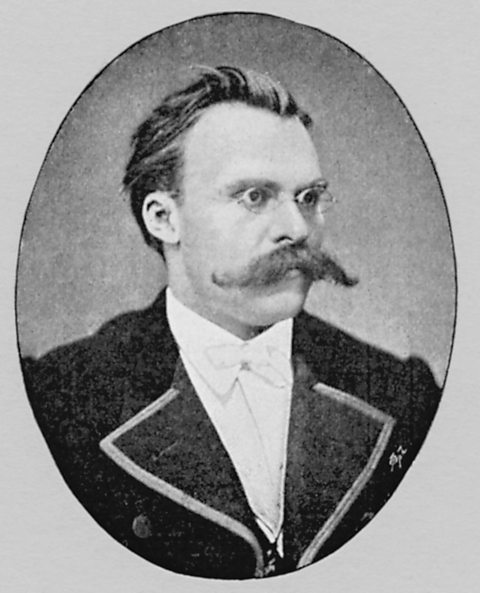
A philosopher is someone who, after thinking deeply, reaches firm views on questions such as 'Who am I?' or 'Why do we exist?'
Germany was often once referred to as ein Volk der Dichter und Denker – a nation of poets and thinkers – as it has produced a number of famous philosophers, for example Immanuel Kant (1724-1804), Karl Marx (1818–1883) and Friedrich Engels (1820–1895).
Many of their ideas have become famous quotations that are used to this day.
Friedrich Nietzsche (1844-1900) was born near Leipzig, and became a world-famous philosopher.
He philosophised that you should become what you are – “du sollst der werden, wer du bist”.
He also coined the famous quote “was mich nicht umbringt, macht mich stärker” – “what doesn't kill me, makes me stronger”.
