Client-servers and peer-to-peer networks
There are different models for connecting computers over a A group of interconnected computers/devices..
Two of the most common are:
- A form of computer networking where the data or web application is hosted on a server and accessed by client computers. networks
- A type of network model where all computers on the network share responsibility and there is no one central server. networks
Client-server networks
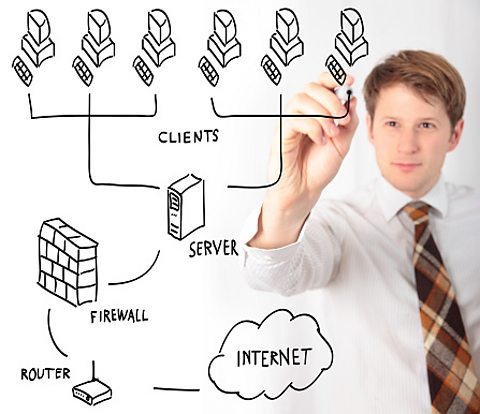
This type of network separates computers into one of two classifications - A computer that holds data to be shared with other computers. Servers require server software. and The computer on a network that request data from a server..
A server is a computer that manages and stores Anything you save. It could be a document, a piece of music, a collection of data or something else., or one that provides services to other computers on the network. They control the network and allow other computers to share and communicate. In effect, they serve other computers. Typical servers include:
- A networked computer that provides large amounts of shared storage, it can be accessed by workstations on the same network. - hold and maintain user files
- Software that handles scripting and programming on the server for a website. - allow programs to be run over a network
- A computer that serves web pages to users. - hold and share web pages
- A server on a network that facilitates printing. - manage printing across a network
- A server on a network that provides email facilities. - handle emails between users
Servers tend to be quite powerful machines. They need the processing power because many other computers connect to them.
A client is a computer that relies on other computers (servers) to provide and manage Units of information. In computing there can be different data types, including integers, characters and Boolean. Data is often acted on by instructions.. The computer a person uses on a network is a client.
Clients do not usually store data. Furthermore, they have no control over the network as a whole or over individual computers.
Client-server networks are best suited to organisations with many computers, or to situations where many computers need access to the same information. Many schools use this type of model.
Peer-to-peer networks
In a peer-to-peer (P2P) network, all computers have equal status - no computer has control over the network. There are no servers or clients. Instead, each computer is known as a On a network, a computer that has equal rights and control.. Peers store their own files, which can be accessed by other peers on the network. Therefore, a peer is both a client and a server.
P2P networks are best suited to smaller organisations that have fewer computers, or where fewer computers need access to the same data.
