Irregular past participles
It’s a good idea to learn as many irregular past participles as possible. This list will get you started:
Hilfsvokabeln– Helpful vocabulary
- bleiben – to stay > ich bin geblieben – I stayed
- essen – to eat > ich habe gegessen – I ate
- fahren – to travel/go > ich bin gefahren – I travelled/went
- gehen – to go > ich bin gegangen – I went
- lesen – to read > ich habe gelesen – I read
- schreiben – to write > ich habe geschrieben – I wrote
- sehen – to see/watch > ich habe gesehen – I saw/watched
- trinken – to drink > ich habe getrunken – I drank
You will see that as with regular past participles ge- is added to the beginning, but while the -en or -n endings remain, the vowel sounds within the main verb often change, eg
- schreiben - to write > geschrieben - wrote
Here the ei > ie
- trinken - to drink > getrunken - drunk
Here the i > u
Question
How would you write these sentences in German?
- I went to Germany.
- I drank lemonade.
- I read a newspaper.
- I ate Spätzle.
- I went on foot.
- Ich bin nach Deutschland gefahren.
- Ich habe Limonade getrunken.
- Ich habe eine Zeitung gelesen.
- Ich habe Spätzle gegessen.
- Ich bin zu Fuss gegangen.
Did you know?
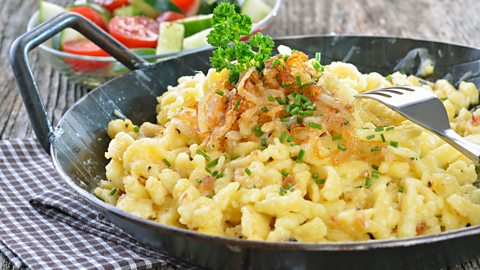
Spätzle are a typical type of noodle made with flour and cooked by pouring the mixture through something that looks very much like grater – Spätzlehobel. The word Spätzle comes from the word for 'sparrow' – Spatz + the diminutive form -le. When the noodles were formed by hand in the olden days, their shape often resembled tiny sparrows.
The noodles are usually short and fat and served with a variety of meat dishes instead of chips or potatoes. Sometimes they're served on their own with fried onions and cheese melted over them. This dish is known as Käsespätzle. Delicious – lecker.