Opposition to McCarthy
McCarthyism’s popularity was at its peak in 1953, but people were speaking out against his methods. His popularity rapidly decreased as his attacks became more difficult to defend. Congress A formal statement made by the Senate or the House of Representatives announcing disapproval of an individual's behaviour. It is issued if the majority votes in its favour and it has a negative impact on a politician or elected individual's reputation. him in December 1954. This ended McCarthyism and the influence of the House Un-American Activities CommitteeHouse Un-American Activities Committee investigated individuals suspected of communist beliefs or ties in America from 1938 onwards. Led by Senator Joseph McCarthy in the 1950s.
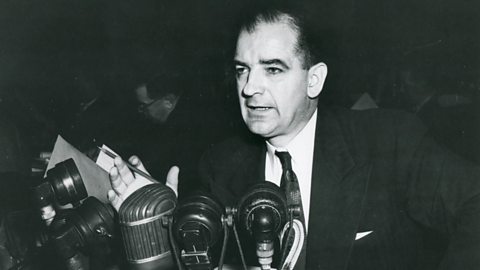
Government opposition
Many senators spoke out, focusing on McCarthy’s aggressive methods of investigating individuals. For example, they mentioned his speeches attacking army generals and his use of weak evidence during A chamber of the United States Congress, which together with the House of Representatives, makes up the legislature of the United States. hearings, official meetings in court. In 1954, Ralph Flanders of the Political party in the United States. Democrats tend to hold a more liberal viewpoint on politics and society. asked the American government to censure McCarthy.
Opposition from the media and academics
There were many examples of the media criticising McCarthyism. Newspapers often wrote articles that criticised McCarthy’s Senate hearings. These hearings were televised and seen by a large American audience. At this time, Americans were benefiting from more affordable televisions. The Army-McCarthy hearings dominated national television from April to June 1954.
Audiences saw McCarthy intimidating witnesses and behaving in an aggressive way. This led to the court room audience clapping in approval when a lawyer representing the army accused McCarthy of having no decency.
Films and plays also targeted McCarthyism. For example:
- Arthur Miller’s play The Crucible (1953) was about witch hunts during the 1690s. Miller used his play to highlight McCarthy’s aggressive methods of interviewing suspects in his own ‘witch hunts’.
- Films such as People Will Talk (1951) explored the impact of McCarthyism on society. This film depicted innocent people refusing to reveal names in investigations. Its message was therefore that in the ‘witch hunts’, innocent individuals might have been When a person is prevented from working in a particular industry or faces restrictions that exclude them from society for political reasons. from their careers due to their unwillingness to hand over the names of suspected Supporters of the communist movement or party. in their responses to the HUAC.
Owen Lattimore
Owen Lattimore, a university lecturer, was an adviser to the government on issues in China. As China became communist in 1949, Lattimore was investigated by McCarthy and the HUAC.
Lattimore’s hearing lasted for 12 days. He consistently stated his innocence and questioned the integrity of the investigation. Lattimore was eventually charged with Lying after taking an oath to tell the truth in court. but all the charges against him had been dropped by 1955.
Ed Murrow
Journalist Ed Murrow used television to promote his views. For example, an episode of his programme See It Now heavily criticised McCarthy’s forceful methods. This contributed to the decline of McCarthy’s popularity as the public saw recordings of him in action throughout the hearings that took place in 1954.
McCarthy’s downfall
McCarthy’s downfall can be linked to his attacks on the army in 1954, in which he accused some of the leaders of being members of a communist spy ring. The Senate hearings lasted 36 days and were shown live on a national television network. The lawyers defending the army highlighted McCarthy’s aggressive tactics and lack of ‘decency’.
By December 1954, the government had voted to censure McCarthy. His methods had become too extreme, turning the public against him.
The Red Scare hadn’t ended, but by 1955 McCarthy was much less visible in society and the media. His censuring by the Senate led to him losing all credibility, and his fellow politicians rarely listened to his anti-communist speeches in the Senate. McCarthy died in 1957.
The HUAC continued to investigate those suspected of being ‘un-American’. However, these investigations became far less frequent after 1955. By 1969 the HUAC had been rebranded due to its unpopularity in the media.
More guides on this topic
- African Americans c.1945-1954 - Cambridge OCR A
- Civil rights in the USA 1954-1964 - Cambridge OCR A
- Broadening of the campaigns for civil rights - Race - Cambridge OCR A
- Broadening of the campaigns for civil rights - Women's rights - OCR A
- Broadening of the campaigns for civil rights - Gay rights - OCR A
- Politics and protest - Cambridge OCR A
- Social problems and attempts to tackle them - Cambridge OCR A
