The Red Scare
Learn more about the Red Scare in this podcast.
Listen to the full series on BBC Sounds.
After World War Two there was an increase in hostility towards Supporters of the communist movement or party. for various reasons including The term used to describe the dislike of, or prejudice against people from other countries. and Hostility or prejudice against Jews.
US politicians accused their opponents of being communists, often to increase their own popularity and eliminate enemies in government. The Concern regarding the spread of communist and socialist ideas. had been a part of American society from the 1920s. As influential people used the suspicion of An economic system in which all means of production such as tools, factories and raw materials, are owned by the community as a whole. Each individual contributes according to their ability and receives according to their needs. This means there is no hierarchy of social class. to attack each other, the fear of communism increased across the country.
In 1949, 11 leading members of the Communist Party of the United States were arrested and put on trial for violating the 1940 Smith Act. This act had made it illegal to plan or attempt to overthrow the government. All 11 people denied attempting to overthrow the government, but they were found guilty and sent to prison.
Government response to the Red Scare
In the 1930s, the House Un-American Activities Committee House Un-American Activities Committee investigated individuals suspected of communist beliefs or ties in America from 1938 onwards. Led by Senator Joseph McCarthy in the 1950s. was created to investigate anyone thought to be ‘un-American’. During the Red Scare, this meant anyone suspected of being a communist. In the 1940s, the HUAC worked closely with the Federal Bureau of InvestigationFederal Bureau of Investigation. An agency set up by the US federal government to investigate criminal cases, where federal laws may have been broken. The HUAC would ask people:
Are you now, or have you ever been, a member of the Communist Party?
J Edgar Hoover led the FBI from the 1940s and was fiercely anti-communist. In 1947, Hoover created the Federal Employee Loyalty Program (FELP) to investigate anyone in the government with potential links to communism. In three years, the FBI investigated 3 million people. Over 200 people lost their jobs as they were labelled ‘security risks’.
HUAC in action
Hollywood
The FBI suspected that many people working in Hollywood as producers, directors and writers were communists. Ten individuals were interviewed in a high-profile case. They became known as the Hollywood Ten.
During interviews, the Hollywood Ten refused to answer questions relating to communism, as they felt they had the legal right to hold any political views. All were found guilty and sent to prison for a year.
The case raised the profile of the HUAC as many people in society were grateful to the government for interrogating suspected communists. This led to a further increase in the scale of the Red Scare.
The Hiss case
In 1948 the HUAC interviewed journalist Whittaker Chambers, who admitted to being a communist in the 1930s. Whittaker told the committee that a leading member of the US State Department, Alger Hiss, had worked alongside him. Hiss denied the allegations, even saying that he did not know Chambers, and was supported by President Harry Truman.
A young politician named Richard Nixon followed up the suspicions. He found proof that Hiss had known more than ten government officials in the 1930s, including Chambers. Nixon found evidence that Hiss had rented an apartment in Washington and a car to Chambers, and that they had shared documents with each other. Nixon also provided unreliable evidence that Hiss had given secrets to the The group of 15 communist republics formed from the Russian Empire after the revolution of 1917. (USSR).
Hiss was convicted of Lying after taking an oath to tell the truth in court. as he had hidden his friendship with Chambers. Hiss was jailed for five years. His trial and conviction made the American people aware that there were officials in government that knew, or worked with, communists. This further increased the Red Scare.
The Rosenbergs
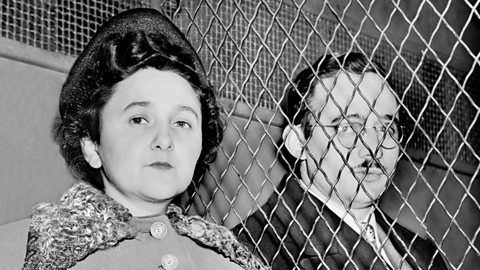
The Soviet Union tested its atomic bomb in 1949, four years after the USA used it. As this was much sooner than anyone expected, suspicions were raised that Soviet spies were working within the American and British atomic weapons research teams. These suspicions were confirmed when Klaus Fuchs, a German-born British scientist, was imprisoned in Britain for sending secrets to the Soviet Union.
The Fuchs investigation brought Julius and Ethel Rosenberg to the attention of the HUAC. They pleaded not guilty to passing secrets to the Soviet Union. However, they were found guilty and executed in June 1953. The evidence used was based on unreliable witness statements, but it has since been proved that the Rosenbergs sent coded telegrams to Soviet agents from 1944.
The Rosenbergs had refused to answer questions relating to their involvement with communism. This silence increased suspicion and maintained the Red Scare.
Government response to the HUAC’s investigations
In 1950, the Internal Security Act was passed in The legislative body of the US government, made up of the Senate and the House of Representatives. It was also known as the McCarran Act, named after the anti-communist senator Pat McCarran.
President Truman strongly opposed the act. However, 80 per cent of Congress voted to pass it. The act required all known communist organisations, such as the Communist Party, to register their members with the US Department of Justice. It also put legal restrictions on each individual registered, such as:
- no communist could own a US passport
- no communist could work in the defence sector
- the president had the power to place communists into detention camps in an emergency
- all members of communist organisations had to log their fingerprints with the government
More guides on this topic
- African Americans c.1945-1954 - Cambridge OCR A
- Civil rights in the USA 1954-1964 - Cambridge OCR A
- Broadening of the campaigns for civil rights - Race - Cambridge OCR A
- Broadening of the campaigns for civil rights - Women's rights - OCR A
- Broadening of the campaigns for civil rights - Gay rights - OCR A
- Politics and protest - Cambridge OCR A
- Social problems and attempts to tackle them - Cambridge OCR A
