Investigative policing and the Whitechapel murders
Between August and November 1888, five women were murdered in Whitechapel: Mary Ann ‘Polly’ Nichols, Annie Chapman, Elizabeth Stride, Catherine Eddowes and Mary Kelly. Their murderer became known as Jack the Ripper and was never caught. The Metropolitan Police in Whitechapel were criticised for failing to capture the murderer.
Investigative policing in Whitechapel
The police in Whitechapel used a range of techniques to try to capture the murderer.
Careful observation
From the early 1880s, police used a set of instructions designed by the head of the Criminal Investigation Department (CID) to improve the way they collected evidence, known as the Police Code. Constables were required to:
- keep the crime scene clear of onlookers before an inspector or detective arrived.
- ensure that evidence was not disturbed.
- keep a careful note of the scene, including any bruises or marks on dead bodies.
This was not always possible. On the night of Mary Nichols’ murder in Buck’s Row, the doctor on duty called for an ‘ambulance’, which was like a wheeled stretcher, to transport the body to a Where dead bodies are kept before they are cremated or buried. before careful notes about the crime scene could be taken. However, the inspector’s report does contain a detailed description of what Nichols was wearing at the time of her murder.
Photography and sketches
At the end of the 19th century, the Metropolitan Police made limited use of photography. However, during the investigation into the Whitechapel murders, they increased their use of photography because they were working alongside the City of London Police, who used photography more often.
- Photographs were taken at the scene of Mary Kelly’s murder, both outside and inside her apartment, to record the crime scene.
- The City of London Police collected detailed drawings of Mitre Square, where Catherine Eddowes was killed.
- The doctor who attended after her murder made a sketch of the scene.
Newspapers also created several sketches of the murderer known as Jack the Ripper, but these were never part of the official investigation and we do not know what information was used by the newspapers to create them.
Interviews
The police worked hard to track the murderer. For example:
- they visited a number of houses, pubs and mental health hospitals.
- they questioned sailors in the docks and businesses in the areas around where the bodies were found.
- they interviewed many people. Following the murders of Elizabeth Stride and Catherine Eddowes, they interviewed more than 2,000 people.
- following these interviews, the police followed up on 300 lines of enquiry and arrested 80 people across London for further investigation and questioning.
The Police Code outlined that witness statements should be written using only the words of the witness and must be read back to them. Errors had to be crossed out so that the original words could still be seen, and each page had to be signed.
Problems catching the murderer
The Whitechapel police faced many difficulties investigating the Whitechapel murders, which is perhaps why they never caught the murderer.
Problems caused by rivalry between police forces
During the Whitechapel murders investigation, different divisions of the Metropolitan Police sent men to patrol the beat in Whitechapel. In general, there was cooperation between the City of London and Metropolitan Police forces. However, there was a point during the investigations when the cooperation broke down and division rivalries surfaced.
On the night of the Elizabeth Stride and Catherine Eddowes murders, police found some anti-Jewish graffiti written in chalk. Two City of London Police detectives had seen the chalk graffiti and insisted it be recorded by a photographer. However, Warren made a copy of the graffiti and then ordered that the writing be washed from the wall because he wanted to prevent a The organised persecution (including murder) of ethnic or religious group, for example in Eastern Europe in the 1880s against Jews. or anti-Semitic riot against Jewish people and their property, as these had increased during the investigation.
Many people had decided that the crimes against the women were being committed by a Jewish man and violence towards the Jewish community in Whitechapel increased. Warren’s actions caused problems and were criticised in the press. Some historians argue that Warren washed off the graffiti because Eddowes’ body was found within the boundaries of the City of London. They say that he did not want the City of London Police to take over the investigation and capture the killer first. The rivalry between the police forces had caused problems in police investigations in and around Whitechapel.
Nevertheless, there is evidence that H Division learned a lot from the City of London Police during the investigation, especially how to preserve and record a crime scene.
Problems caused by the media
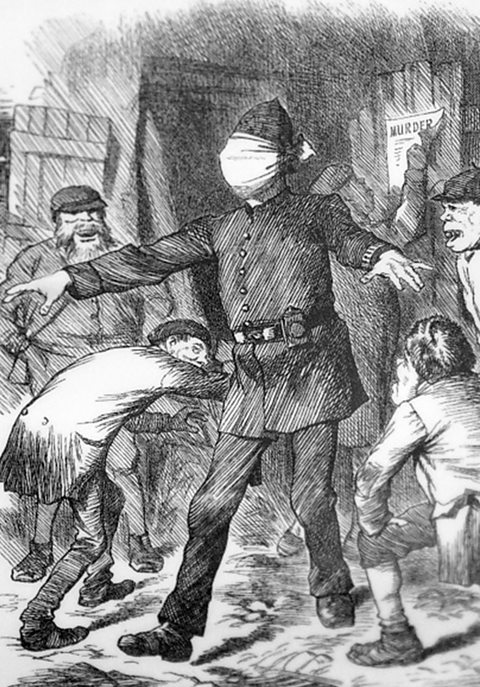
The police worked hard to find the Ripper murderer, but their efforts were never reported in the press. Instead:
- The newspapers criticised the police and said that they should have been doing more to catch the murderer.
- The newspapers printed cartoons that presented the police as incompetent and highlighted their inability to catch the murderer.
The Whitechapel murders were an opportunity for the newspapers to sell copies, and so they sensationalised the stories and details of the murders using fake witness statements. The newspapers exaggerated the numbers of victims of the murderer, known as Jack the Ripper, even though the details of the other murders could not be matched to his five victims. The press also relied on speaking to the people of Whitechapel because the police did not give them very much information. This led to them printing many details and stories that were not true or were exaggerated.
The rumours that the newspapers printed led to dead ends and suspects going into hiding. One example was John Pizer, a Jewish cobbler also known as ‘Leather Apron’. The papers reported a story claiming that a person of this name was the murderer and Pizer was arrested while hiding at the home of a family member. Pizer had an alibi and was released, but the accusation in the papers took police time away from the investigation.
The Whitechapel Vigilance Committee
The Whitechapel Vigilance Committee was set up by a builder from Whitechapel called George Lusk. He was a deeply frustrated businessman who was annoyed by the failure of the police to offer a reward for information leading to the Ripper’s arrest. The Home Secretary, Henry Matthews, had refused to approve the reward as he believed it would encourage ‘time-wasters’ with false leads.
Action taken by the Whitechapel Vigilance Committee
The committee was unhappy that the police had not been able to catch the killer. They decided to take the matter into their own hands:
- They employed two detectives to investigate the killings.
- They published posters offering a small reward for leading them to the killer.
- They went out each evening armed with hobnailed boots and burning planks in the hope of catching the Ripper in the act of murder.
Lusk became well known and received hoax letters from people claiming to be the killer.
Another viewpoint suggests that the Whitechapel Vigilance Committee wanted to embarrass the police and government in the run-up to the London County Council elections. It is argued that they aimed to disrupt the police’s work, filling their time with false leads and increased criticism of them in the local press.
More guides on this topic
- Crime and punishment in Britain overview - Edexcel
- Crime and punishment in medieval England, c.1000-c.1500 - Edexcel
- Crime and punishment in early modern England, c.1500-c.1700 - Edexcel
- Crime and punishment in 18th- and 19th-century Britain - Edexcel
- Crime and punishment in modern Britain, c.1900 - Edexcel
