Investigating and recording Whitechapel
Historians learn the history of the past from sources. From these Where something came from originally. of Information or material that shows something is true. they construct their view of historical events that took place in Whitechapel in the late 19th century. When studying crime and policing in Whitechapel, historians have access to official documents, such as records of trials at the Old Bailey and local police records.
Historians use a range of sources because different types of sources give them different information.
Local sources
Local sources cover the history of Whitechapel in the late 19th century. These include housing and employment records, council records, census returns, a survey conducted by Charles Booth in 1889, workhouse records, local police records, An official responsible for investigating violent or suspicious deaths.’ reports, photographs. The strengths and weaknesses of these sources will be influenced by the nature of the enquiry that they are being used for.
Housing and employment records
| Strengths | Weaknesses |
| Give details of where individuals stayed and worked in Whitechapel. | Homeless people in Whitechapel would not be able to be traced. |
| Employers, such as sweatshop owners, kept records of their workers. | Relies on individuals using the correct name and employers keeping records up to date. |
| Lodging houses kept records of who rented a room for a night. |
| Strengths | Give details of where individuals stayed and worked in Whitechapel. |
|---|---|
| Weaknesses | Homeless people in Whitechapel would not be able to be traced. |
| Strengths | Employers, such as sweatshop owners, kept records of their workers. |
|---|---|
| Weaknesses | Relies on individuals using the correct name and employers keeping records up to date. |
| Strengths | Lodging houses kept records of who rented a room for a night. |
|---|---|
| Weaknesses |
Council records
| Strengths | Weaknesses |
| Provide information about council meetings, public demonstrations, building inspections, and housing stock, sewers, toilets and street lighting. | Unlikely to provide information about the views and experiences of individuals, especially those of poorer residents in Whitechapel, including migrants. |
| Give historians information about the details of events in Whitechapel. |
| Strengths | Provide information about council meetings, public demonstrations, building inspections, and housing stock, sewers, toilets and street lighting. |
|---|---|
| Weaknesses | Unlikely to provide information about the views and experiences of individuals, especially those of poorer residents in Whitechapel, including migrants. |
| Strengths | Give historians information about the details of events in Whitechapel. |
|---|---|
| Weaknesses |
Census returns
The census takes place every 10 years. Census records are now digitised and available online so that anyone can access them. It can provide a snapshot of the population in the Whitechapel area every ten years.
| Strengths | Weaknesses |
| Show who was living where at the time the census was taken. | Not completely accurate. Individuals in Whitechapel moved around a lot and can be difficult to trace using a census. |
| Provide people’s names, ages, sexes and occupations. | Some people may have used false names, and in some cases the people who wrote out the records made mistakes. |
| Historians can find out how many people lived in a house and see evidence of overcrowding. | Lodging house residents may not have been listed in records if their stay, of eight hours, did not take place overnight. |
| Strengths | Show who was living where at the time the census was taken. |
|---|---|
| Weaknesses | Not completely accurate. Individuals in Whitechapel moved around a lot and can be difficult to trace using a census. |
| Strengths | Provide people’s names, ages, sexes and occupations. |
|---|---|
| Weaknesses | Some people may have used false names, and in some cases the people who wrote out the records made mistakes. |
| Strengths | Historians can find out how many people lived in a house and see evidence of overcrowding. |
|---|---|
| Weaknesses | Lodging house residents may not have been listed in records if their stay, of eight hours, did not take place overnight. |
Charles Booth’s survey, 1889
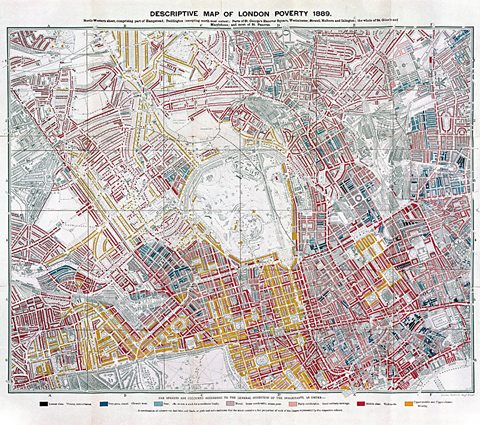
In 1889, Charles Booth employed 80 researchers to record poverty and living conditions across London. The researchers also interviewed many of London’s policemen to find out their views on districts in London. From this research, Booth produced a series of maps to show how poor each area of London was.
| Strengths | Weaknesses |
| The maps show where the poor lodging houses were in Whitechapel and where Jewish migrants settled in ghettos. | Do not give any detail about housing or living conditions. |
| The key to each map shows how the residents of each area were viewed. For example, the poorest areas of Whitechapel were described as “vicious, semi criminal”. | Do not record the experiences of individuals who lived in the different areas of London. |
| Do not give the reasons or causes of wealth or poverty. |
| Strengths | The maps show where the poor lodging houses were in Whitechapel and where Jewish migrants settled in ghettos. |
|---|---|
| Weaknesses | Do not give any detail about housing or living conditions. |
| Strengths | The key to each map shows how the residents of each area were viewed. For example, the poorest areas of Whitechapel were described as “vicious, semi criminal”. |
|---|---|
| Weaknesses | Do not record the experiences of individuals who lived in the different areas of London. |
| Strengths | |
|---|---|
| Weaknesses | Do not give the reasons or causes of wealth or poverty. |
Workhouse records
| Strengths | Weaknesses |
| Tell us where workhouses were located, who stayed in them, how long for and the work carried out. | Do not tell us about individual experiences of inmates or how they came to find themselves in need of a workhouse. |
| Tell us who sought help at the workhouse and their illnesses and physical state, and whether any residents needed the infirmary. | Do not tell us what happened to people after they left the workhouse. |
| Some individuals may have used a false name to register in a workhouse because many found it humiliating. |
| Strengths | Tell us where workhouses were located, who stayed in them, how long for and the work carried out. |
|---|---|
| Weaknesses | Do not tell us about individual experiences of inmates or how they came to find themselves in need of a workhouse. |
| Strengths | Tell us who sought help at the workhouse and their illnesses and physical state, and whether any residents needed the infirmary. |
|---|---|
| Weaknesses | Do not tell us what happened to people after they left the workhouse. |
| Strengths | |
|---|---|
| Weaknesses | Some individuals may have used a false name to register in a workhouse because many found it humiliating. |
Local police records
| Strengths | Weaknesses |
| Provide information about crimes committed in Whitechapel, witness statements and information about victims. | Not all information about the conditions leading up to a crime would be recorded. |
| Reveal the numbers of police officers working in the area compared to the population, who was recruited, how long they served, where they came from. | Witnesses might not have told the full story (eg if they were drunk), and the policeman may not have recorded all details. |
| Shows what was expected of officers in terms of conduct and duties, and beat maps. | Police records may not include reasons why officers left the force or any records of negative conduct. |
| Strengths | Provide information about crimes committed in Whitechapel, witness statements and information about victims. |
|---|---|
| Weaknesses | Not all information about the conditions leading up to a crime would be recorded. |
| Strengths | Reveal the numbers of police officers working in the area compared to the population, who was recruited, how long they served, where they came from. |
|---|---|
| Weaknesses | Witnesses might not have told the full story (eg if they were drunk), and the policeman may not have recorded all details. |
| Strengths | Shows what was expected of officers in terms of conduct and duties, and beat maps. |
|---|---|
| Weaknesses | Police records may not include reasons why officers left the force or any records of negative conduct. |
Coroners’ reports
Coroners’ inquests are official meetings where a coroner reports back on an investigation into a suspicious death. Although The use of scientific knowledge in solving crimes. was not well developed, coroners’ reports were useful in the Whitechapel murder investigations.
Question
What are the strengths and weaknesses of coroners’ reports in the Whitechapel murder investigations?
| Strengths | Weaknesses | |
| Coroners’ reports | Provide information about the condition of bodies found in Whitechapel and the reasons for the death. | Would not provide information about the events leading up to the death. |
| Coroners’ reports | |
| Strengths | Provide information about the condition of bodies found in Whitechapel and the reasons for the death. |
| Weaknesses | Would not provide information about the events leading up to the death. |
Photographs
Question
What are the strengths and weaknesses of using photography in the Whitechapel murder investigations?
| Strengths | Weaknesses | |
| Photography | Provide a visual image of history, for example the living and working conditions in Whitechapel, and an accurate record of crime scenes. | Can be staged to show a more positive image and so may not be completely reliable. |
| Photography | |
| Strengths | Provide a visual image of history, for example the living and working conditions in Whitechapel, and an accurate record of crime scenes. |
| Weaknesses | Can be staged to show a more positive image and so may not be completely reliable. |
More guides on this topic
- Crime and punishment in Britain overview - Edexcel
- Crime and punishment in medieval England, c.1000-c.1500 - Edexcel
- Crime and punishment in early modern England, c.1500-c.1700 - Edexcel
- Crime and punishment in 18th- and 19th-century Britain - Edexcel
- Crime and punishment in modern Britain, c.1900 - Edexcel
