Measuring the distribution of a species
Collecting organisms
Organisms can be collected using a variety of methods. These methods include:
- sweep nets
- pooters
- pitfall traps
Pitfall traps
A pitfall trap is often used to get a sample of small An animal without a backbone. living on the ground, such as beetles, spiders and slugs.
It consists of a container, such as a yoghurt carton, buried in the ground. The top of the container is level with the soil surface, and it is covered by a piece of wood with a slight gap to allow insects to climb in. It is important to check the trap regularly to avoid the animals escaping or being eaten before they are counted.
Counting organisms
It is often impractical to count all the organisms in a All of the members of a single species that live within a geographical area.. For example:
- animals may move into - or out of - an area during counting
- some may die during the time it takes to complete the counting
- it may be difficult to find all the animals during counting
As a result, biologists have developed different ways to estimate the size of a population, including the use of a quadrat.
Quadrats
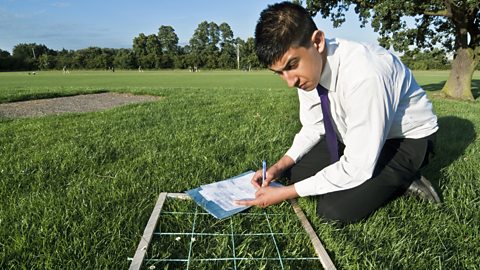
A quadrat is usually a square made of wire. It may contain further wires to mark off smaller areas inside, such as 5 × 5 squares or 10 × 10 squares. The organisms underneath, usually plants, can be identified and counted. Quadrats may also be used for slow-moving animals, eg slugs and snails.
Worked example
There are four dandelion plants inside a 0.25 m2 quadrat. The whole field is 50 m2 in area. The estimated population size of dandelions in the field would be:
4 × (50 ÷ 0.25) = 4 × 200 = 800
When using a quadrat:
- it should be placed randomly so that a representative sample is taken
- the The extent to which a measurement, test or observation can be repeated or reproduced to get similar data to support a conclusion. and How likely something is to be accurate and trustworthy. of the results increases as the results from more quadrats are analysed
