Conscientious objectors in the 20th century
A A person who refuses to fight in wars because of strong personal beliefs against war. is someone who refuses to fight in war for moral reasons. A change in legislation led to this becoming a crime during two 20th-century conflicts.
World War One
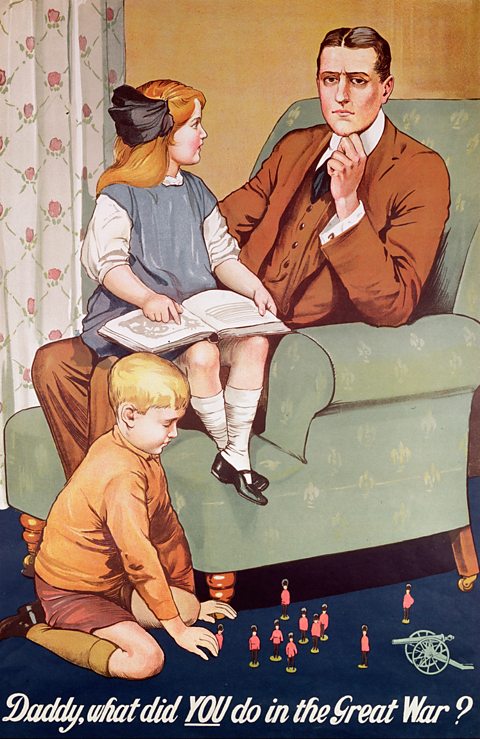
At the start of World War One, the government relied on volunteers to fight. Over 1 million men signed up after a recruitment drive. However, as the war continued and the number of casualties increased, the government introduced A system where people are required to join a country’s war effort by law.
Examples of those exempt from conscription were the medically unfit, clergymen, teachers, and some labourers, miners, farmers and industrial workers. Some men refused to fight for the following reasons:
- Some men refused to fight due to their religious beliefs. Many Christians justified this using the commandment ‘Thou shalt not kill’.
- Some men argued that the war was a disagreement between the ruling classes of Europe rather than the ordinary people. They did not believe it was right to fight.
- Some men refused to fight but did volunteer to support the army in non-combat roles, including as stretcher bearers, ambulance drivers or distributors of food.
- Some men refused to fight for political reasons, disagreeing with the aims of the war.
Those who were against the war completely were called Conscientious objectors who not only refused to accept military service but also refused to cooperate with any alternative (non-military) compulsory service. and were most likely Someone who is completely opposed to any kind of violence and will not participate in any aspect of war. Those who were not prepared to fight but did support the war effort in other ways were called alternativists.
Treatment of conscientious objectors
The majority of the British people supported the war effort and so were hostile to conscientious objectors. Some members of the public accused conscientious objectors of cowardice and physically attacked them. The government response included:
- Around 16,500 conscientious objectors had to present their reasons for not fighting to local tribunals, which were special courts made up of retired soldiers and unsympathetic individuals.
- Men who refused to accept the decision of the tribunal were imprisoned and experienced When a prisoner is locked in a cell and isolated from others. hard labour and long sentences.
- Some men were given alternative work at home that supported the war effort.
- Some men were punished by being sent to the front lines of the war in France. If they refused to follow orders, they were again sentenced by a military court.
- A small number were sentenced to death. However, the prime minister stepped in and reduced the sentence to 10 years’ imprisonment.
- After the war, conscientious objectors were not allowed to vote until 1926.
World War Two
In 1939, conscription was introduced again. However, conscientious objectors were treated differently by the government in World War Two:
- Tribunals continued but did not include ex-soldiers on the panel that made decisions.
- There were some court cases against conscientious objectors, such as members of the Peace Pledge Union, a pacifist organisation. However, these were usually dismissed by judges.
- More emphasis was placed on providing conscientious objectors with alternative work that supported the war effort, such as roles in munitions factories and farming.
- Information, often biased or misleading, designed to persuade people to adopt a particular point of view. was used to build support for government action.
- Conscientious objectors were imprisoned as a last resort.
The British public’s attitudes towards conscientious objectors were similar during World War Two to what they had been during World War One. Conscientious objectors were attacked in newspapers, openly accused of cowardice and attacked in the streets. Many lost their jobs with employers who disagreed with their actions.
More guides on this topic
- Crime and punishment in Britain overview - Edexcel
- Crime and punishment in medieval England, c.1000-c.1500 - Edexcel
- Crime and punishment in early modern England, c.1500-c.1700 - Edexcel
- Crime and punishment in 18th- and 19th-century Britain - Edexcel
- Crime and punishment in Whitechapel, c.1870-c.1900 - Edexcel
