Policing since c.1900
The police in modern Britain continue to catch criminals using their power to question, search and arrest suspects. However, since c.1900, the role of the police has developed, working to prevent crime.
Changing attitudes in society, an increase in the range of criminal offences and developments in technology have led to changes in the police force in modern Britain.
Specialist units
As the range of crimes has increased and become more complicated, and as a response to changes in society, the police force has needed to specialise. The police force in modern Britain includes several specialist units, including:
- drug squads
- counter-terrorist squads
- dog handlers
- fraud squads
- bomb squads
A national police training college was set up in 1947. In the present day, police recruits now receive more guidance and typically undertake around 18-22 weeks of classroom-based training as well as other addditional training before serving as officers. Some officers are specifically trained to use weapons (such as guns and tasers) or to ride police horses or police motorbikes. Every police force also has its own special branch, which responds to national terror and security threats. They liaise directly with MI5 to detect, intercept and prevent terror attempts, and inform local police of their actions.
Impact of science and technology
Developments in science and technology since c.1900 have led to a range of changes to policing in modern Britain:
- The police have used fingerprints and chemical analysis of blood samples to catch criminals since blood groups were discovered in 1901.
- Two-way radios have been used since the 1930s to enable police officers to communicate with one another.
- The 999 emergency number has been used since 1937 to enable members of the public to report a crime.
- Police cars and motorbikes have been used to transport police officers since the 1930s.
- Police helicopters are used to track suspects and support police officers on the ground.
- Pepper spray and CS gas are used to control violent suspects.
- DNA was first used as evidence (for a murder conviction) in 1988.
- CCTV recordings are used to identify and convict suspects.
- Breathalysers and speed cameras are used to prevent some car crimes, such as drink driving and speeding.
- Automatic Number Plate Recognition (ANPR) cameras are used to read the registration plates of cars and retrieve information about the owners from a database.
Representation in the police force
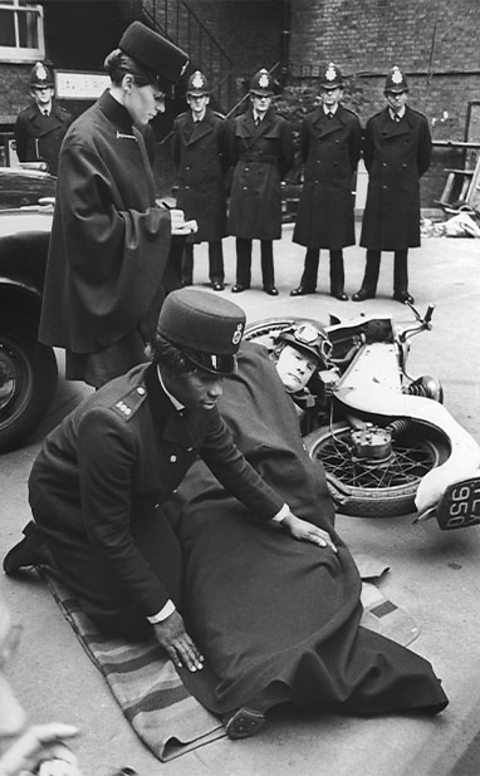
Women were present in the police force during World War One, servicing in volunteer and matron roles. Sofia Stanley became the Metropolitan Police’s first official female recruit in 1919. Women were initially not given the same powers of arrest and duties as their male colleagues.
Harry Daley joined the Metropolitan Police aged 24 and was open about his sexuality at a time when homosexuality was illegal. By the outbreak of World War Two in 1939, Daley had been promoted to the position of sergeant. He played a key role during the A period when London was repeatedly bombed at night time during World War Two by Nazi Germany, from September 1940 to May 1941. Daley retired from the Metropolitan Police in 1950 and died in 1971. He described his experience as a gay police constable in modern Britain in his autobiography, This Small Cloud which was published after his death in 1986.
Improved representation
Data collected in March 2020 showed that:
- 31.2 per cent (just over 40,000) of police officers in England and Wales were female, increasing from 28.6 per cent in March 2016.
- 92.7 per cent of police officers were white and 7.3 per cent were from Asian, black, mixed race or other ethnic backgrounds.
- The number of police officers from Asian, black, mixed or other ethnic backgrounds had increased from the previous year.
Changing role
Throughout the period from c.1900 to the present day, the role of the police force has increasingly become one of preventing crime alongside catching criminals. Police officers today also manage non-crime-related issues, such as anti-social behaviour, drunkenness, child protection, preventing people-trafficking and incidents where people may be at risk. Police officers are also used to control crowds and keep order at public demonstrations, large gatherings and football matches.
Police community support officers (PCSOs) have been used since 2002 to patrol the streets within the community. They do not have the same powers as police officers and cannot arrest people. However, they are able to stop and search, take photos of people, seize vehicles, carry out car checks and control traffic.
More guides on this topic
- Crime and punishment in Britain overview - Edexcel
- Crime and punishment in medieval England, c.1000-c.1500 - Edexcel
- Crime and punishment in early modern England, c.1500-c.1700 - Edexcel
- Crime and punishment in 18th- and 19th-century Britain - Edexcel
- Crime and punishment in Whitechapel, c.1870-c.1900 - Edexcel
