Significant places and features of worship
Places of worship
Different Buddhist places of worship serve different purposes:
- Temple – a building allowing many people to come together to learn, meditate, celebrate and offer devotions. A temple will contain a A small and special place usually dedicated to the Buddha, where Buddhists may worship alone or as families. and space for community activities.
- A Buddhist monastery, literally 'dwelling place' which is open to the community for study, meditation and worship. – a monastery for monks or nuns who have devoted themselves to the Buddhist path. Members of the wider community earn positive Actions, and the consequences of actions. An important concept in Buddhism, Hinduism and Sikhism. from supporting the vihara. The vihara in return supports the community in their spiritual growth.
- Shrine – the site of a statue or image of the The founder of Buddhism, Siddhartha Gautama, after his enlightenment. It is a title which means the enlightened or awakened one., either within a temple or vihara, or alone. Offerings (such as flowers, food and incense) are often made to the statue or image to show gratitude and respect.
- A burial mound or shrine built to house relics of the Buddha or an important disciple or teacher. – a structure in the shape of a burial mound built to house relics of the Buddha or other important Buddhist teachers. People walk around them while chanting to aid concentration.
- Meditation halls – meditation is very important in Buddhism. It is essential for growth of understanding and developing a calm, ‘Buddha-like’ mind (The ability to become enlightened.). Whether at a temple or a vihara, Buddhists require large spaces dedicated to calm and concentration.
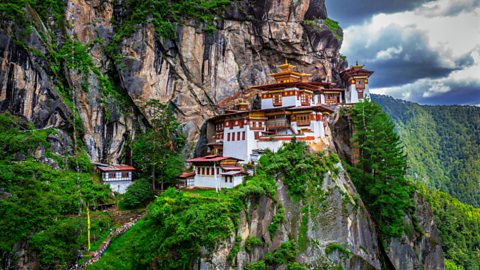
- A hall or building where Buddhists meditate. – this Tibetan institution combines a shrine, a vihara and a meditation hall. Some contain facilities for study and learning.
Buddharupas
Images of the Buddha are a universal aid to Buddhist practice. These are called A statue or image of a Buddha, often Gautama Buddha (the founder of Buddhism).. They can be large or small, inside or outside, plain or ornate, and single or multiple.
Buddharupas display aspects of the Buddha’s own path as well as symbols of Buddhist philosophy. For example, a Buddharupa with elongated ears represents the Buddha’s former life as a prince, and a bump or top-knot on his head represents wisdom and enlightenment. He is sometimes shown reclining, denoting his final passing into An indescribable state, held by Buddhists to be the ultimate goal of religious practice, involving breaking free from the cycle of samsara.. Hand gestures (eg raised hands) represent aspects of the Dhamma is Buddhist doctrine about the nature of existence and includes the teachings of the Buddha..
Mudras
From the An ancient language that is the root of most Indian languages. meaning ‘gesture’, Meaning ‘gesture’, hand gestures of Buddhas or Hindu deities with symbolic meaning. are symbolic hand gestures displayed in images or statues of the Buddhas and In Mahayana Buddhism the bodhisattva is one who has vowed to obtain enlightenment for the benefit of all beings.. Some examples of these include:
- Meditation mudra - the hands rest on the lap, fingers resting on each other and palms upwards. Gautama Buddha (another name for the Buddha) and A Buddha in the Mahayana tradition. He created a pure land after achieving enlightenment. are often shown in this pose.
- Generosity mudra - one hand is held downwards with the palm open and the fingers pointing downwards. This symbolises welcome, generosity and compassion. The Bodhisattvas Tara and Avalokitesvara are shown in this gesture.
- Wisdom mudra - in this pose the thumb and finger touch to form a circle.
Question
What is a mudra?
Mudra means ‘gesture’. It is the symbolic hand gestures displayed in images or statues of the Buddha and Bodhisattvas.
