Death and mourning
Death is a significant time in Buddhist culture. The dead person’s soul is believed to move on to a new existence in the cycle of In Hinduism, Buddhism and Sikhism, this is the cycle of life, death and rebirth.. At the point of death, a person’s karmic status (how much positive and negative Actions, and the consequences of actions. An important concept in Buddhism, Hinduism and Sikhism. they have accumulated) determines how they will be reborn. For the mourners, death is a powerful reminder of samsara, the Dhamma is Buddhist doctrine about the nature of existence and includes the teachings of the Buddha. and their own karmic status. The A diagram that depicts the different realms of rebirth. It is often found at the entrance of monasteries in Mahayana Buddhism. is a way of picturing the beliefs of samsara.
Six realms of rebirth
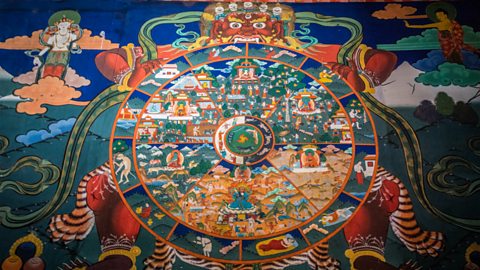
In Buddhist belief, there are six realms of rebirth. The realm in which a person is reborn depends on the positive and negative karma they have accrued during their lifetime:
- Realm of the Gods or ‘Devas’ – rebirth in this realm is the result of good karma. Devas enjoy pleasure and relaxation. However, it is a realm of attachment and does not lead to An indescribable state, held by Buddhists to be the ultimate goal of religious practice, involving breaking free from the cycle of samsara..
- Realm of the Demi-Gods – these beings are powerful but angry. Their anger keeps them in the cycle of samsara.
- Human Realm – although some human lives are hard, because a human can learn and understand, this realm holds the potential of The realisation of the truth about life. In Buddhism it releases a person from the cycle of rebirth. and nirvana.
- Animal Realm – animals are driven by survival, hunger and competition. Their existence is impulsive, and they cannot attain wisdom or insight.
- Realm of the Hungry Ghosts – these beings are never satisfied and always hungry. They live in a perpetual state of craving that is never satisfied.
- Hell Realm – a lifetime of greed, anger and hatred leads to the Hell Realm, where those inside suffer in various ways.
Dhammapada 170-1
These verses remind Buddhists that freedom from rebirth lies in coming to understand the Not lasting forever. of the The five components or aggregates that make an individual self - body, perception, conception, volition, and consciousness., or the aspects of being human. Emotions, consciousness and the physical body will all change and die. For Buddhists, understanding the temporary nature of these things frees the mind from physical and emotional craving.
Theravada traditions
In Meaning ‘teachings of the elders'. It is primarily focused on the Arhat path to enlightenment. This branch of Buddhism can be found in Sri Lanka and South East Asia. traditions, in order to assist the dead person’s transfer to another rebirth, relatives will offer charity to monks and nuns or a monastery in order to gain positive karma for the deceased. In Sri Lanka, cloth is given to monks to be used for robes on behalf of the deceased.
The body is cremated as the The founder of Buddhism, Siddhartha Gautama, after his enlightenment. It is a title which means the enlightened or awakened one. was cremated. At the funeral ceremony, A sacred (holy) prayer or word which often is chanted or sung rather than just spoken. are spoken that reminds people of the impermanence of life. At one week, three months and one year after the death, monks visit the home of the relatives and lead ceremonies to increase the deceased’s person’s positive karma.
Mahayana traditions
In One of the major schools of Buddhism, it includes Tibetan and Zen Buddhism. traditions, when someone is dying, relatives or loved ones whisper the name of the Buddha into their ear so it is the last name they hear.
The body is cremated. The funeral often takes place after a few days to allow the first stage of rebirth to occur. In Mahayana traditions, rebirth takes up to 49 days (seven weeks).
In Japan, after the body has been cremated, relatives take the bones from the ashes and place them in a burial urn, feet first so they are not upside down. The urn is then buried in a family grave or temple.
Obon in Japan (Mahayana)
The festival of Obon, meaning ‘good dance’, is celebrated in Japan. It is an opportunity for people to clean their deceased relatives’ graves and honour them at household shrines. The name comes from the story of a monk who saw his deceased mother suffering in the Realm of the Hungry Ghosts. He made offerings on her behalf, and also began to understand her selfishness in life. She was released from this realm and he danced for joy. During Obon, Japanese Buddhists perform dances and think about death, karma and rebirth.
Tibetan (Mahayana) traditions
A book called the A book read by Tibetan Buddhists to a recently dead person, believed to guide them through the bardo states. is read to people who are dying and recently deceased. Even if the person has died, it is believed to assist the departed soul in moving between rebirths. Not all Tibetan traditions use the Book of the Dead, but all chant guidance and wisdom to the dead and dying to assist the soul towards its next rebirth.
Tibet is mountainous and finding suitable burial sites as well as enough firewood for cremation can be hard. Therefore, the body may be fed to vultures in a ‘sky burial’. This is regarded as a lesson in impermanence as the body is given up, and also a last act of generosity in feeding the vultures. Monks chant mantras around the body.
Question
Why do monks chant to a deceased person?
The soul is moving between rebirths and the chanting assists the departed soul to its next rebirth.
