Hindu worship in the temple
A Hindu temple is called a The word many Hindus use for a place of worship - a shrine or special place in the home or a building used by the community for worship and other events.. It is a Holy, related to God. Connected to a religious purpose. place for Hindu worship. There are hundreds of mandirs in the UK. In India, where most Hindus live, there are temples in almost every village. Temples often honour the gods and goddesses whose A statue of a god or goddess which has been made holy through a special ceremony; a term for any statue of a god or goddess. live inside them with beautiful decoration, sculpture and lighting. Hindu worship can also happen in open-air Tomb or monument to a saint or other holy person., which are more common in India than in the UK.
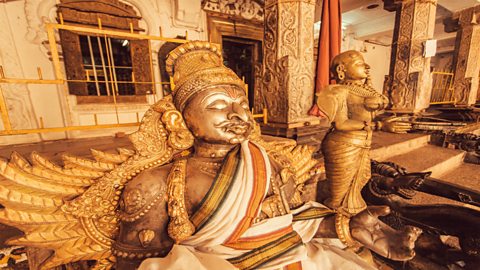
How the different gods and goddesses are represented in mandirs
Historically in India, mandirs were devoted to only one Hindu god or goddess. Hindus who focus their worship on the god Vishnu. temples housed a central image of Vishnu and murtis of associated gods and goddesses, such as Rama, Sita or Krishna. Hindus who focus their worship on the god Shiva. temples housed images of Shiva and murtis of the goddesses associated with Shiva, including Parvati, Shakti, Durga and Kali.
In India, where there are many Hindus, it is often still the case that mandirs are devoted to only one god or goddess. However, in the UK, many mandirs include lots of different shrines to all the gods and goddesses worshipped in the local community.
What happens inside a mandir
When they enter a mandir, a Hindu worshipper typically removes their shoes as a sign of respect and cleanliness in the house of the In Hinduism, deity is one god or goddess. Deities is the word for gods and goddesses many Hindus believe are different aspects of the one Supreme Spirit, (Brahman).. The worshipper then enters the shrine room and rings a bell at the shrine of one of the gods or goddesses. This is a symbol of awakening the deity but it also acts to focus the worshipper’s mind. They may then walk around the shrine while singing, Repeating religious phrases or quotations from sacred texts. or praying. They may also present an offering, such as fruit, milk or money.
The purpose of worship in the mandir is to ‘have Meaning ‘sight/viewing’. In Hinduism the aim of worship is to experience seeing a deity, and a deity seeing the worshipper and, because of this, blessing them. ’ of (or see) the gods and goddesses. Worship enables the devotee to clearly see – and be seen by – the divine. Prayers and hymns (such as bhajans) help the devotee to experience the divine presence. Hindu teaching says that worship comes from human hearts and minds, and is expressed in actions.
The daily services of the mandir usually include morning and evening An act of worship and of adoration, using diva lamps made from cotton wool and ghee (purified butter). ceremonies led by a A Hindu social group with the duty of teaching others, sharing wisdom and performing sacred rituals, which includes educators and priests. priest. The priest’s role is to look after the murtis of the gods and goddesses in the temple by washing them and clothing them each day. The priest also feeds the gods by placing blessed food, called Food that is offered to deities (often as part of worship) and believed by some Hindus to therefore carry divine blessings. at their feet. This food is then shared out with worshippers in the temple or given to people in need.
Question
What does it mean to ‘have darshan’ of the gods and goddesses?
Darshan is sight. It means to see the gods and goddesses through devoted practice of worship, and to be seen by the gods and goddesses.
