Hindu gods – the trimurti
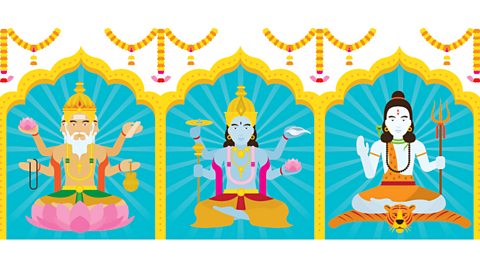
Three of the most significant forms of In Hindu belief, the absolute reality that is the true essence of all existence, God. are A Hindu deity, considered one of the Trimurti, and in charge of creative power; not to be confused with Brahmin or Brahman. Not widely worshipped by Hindus., A Hindu deity. The aspect of Brahman responsible for destruction and renewed creation. Some Hindus regard Shiva as the one Supreme Deity. and Vishnu is the aspect of Brahman responsible for the preservation of the world. Vishnu forms one part of the Trimurti, along with with gods, Brahma and Shiva.. These three gods are key aspects of Brahman, the Hindus believe that Brahman is the Ultimate Reality – the source of all life in the universe and the basis of all reality and existence. Brahman is uncreated, infinite and all-embracing.. The word ‘trimurti’ means ‘three forms’. In the trimurti, Brahma is the creator, Vishnu is the preserver and Shiva is the destroyer.
In a Hindu temple, there are no images of Brahman. However, there are many images of gods and goddesses, which are aspects of the Divine One.
Brahma the creator
Images, or A statue of a god or goddess which has been made holy through a special ceremony; a term for any statue of a god or goddess., of Brahma have four heads, seeing in all directions at once and symbolising the four Knowledge. Specifically refers to the oldest and most sacred Hindu texts and scriptures, written in Sanskrit. Any teaching which is consistent with these scriptures is also accepted as Vedic (ie in the same group of scriptures as the Vedas). . Brahma’s four arms carry symbols of power – a goblet, a bow, a sceptre and the Vedas. In Hindu creation stories, Brahma brings the universe into being. Brahma is not worshipped by many Hindus today, in comparison to the other two murtis.
Vishnu the preserver
Murtis of Vishnu express splendour and power. His four arms carry symbols of power – a discus, a lotus flower, a conch shell and a mace. Vishnu, god of light and enlightenment, has appeared on Earth through The Hindu word for incarnation of a god in a human (or animal) form on Earth. The spelling ‘avatara’ comes from the Sanskrit.. Vishnu (and his avataras, including Hindu deity, an avatar of Lord Vishnu. There are many tales of him as a mischievous but loving child.) are worshipped by many millions of Hindus today.
Shiva the destroyer
Murtis of Shiva vary. He is often pictured dancing and with four arms. He holds a drum and a flame, and he points to his dancing feet with one hand and holds in the other hand a pen, meaning ‘fear not’. His necklace of cobra snakes is another sign of power. Shiva is worshipped by many millions of Hindus today.
Why do most Hindu worshippers use murtis of the gods and goddesses?
| Source of wisdom and authority | What does it mean? |
| “For those whose minds are attached to the unmanifest, the path of realisation is full of tribulations. Worship of the unmanifest is exceedingly difficult for embodied beings. (Bhagavad Gita 12.5)” | The ‘unmanifest’ is Brahman, Ultimate Reality (God), with no form or qualities. This verse of scripture recognises that almost all humans (‘embodied beings’) need a form, such as one of the gods or goddesses, to worship if they are to make progress along the path towards spiritual reality. |
| Source of wisdom and authority | “For those whose minds are attached to the unmanifest, the path of realisation is full of tribulations. Worship of the unmanifest is exceedingly difficult for embodied beings. (Bhagavad Gita 12.5)” |
|---|---|
| What does it mean? | The ‘unmanifest’ is Brahman, Ultimate Reality (God), with no form or qualities. This verse of scripture recognises that almost all humans (‘embodied beings’) need a form, such as one of the gods or goddesses, to worship if they are to make progress along the path towards spiritual reality. |
What the Hindu scriptures say about the trimurti
| Source of wisdom and authority | What does it mean? |
| “Brahma decided to start creation afresh but discovered that the earth was submerged in water. How would his creations survive if there was no earth? He therefore requested Vishnu to bring up the earth from under the water. (Kūrma Purana 1.6)” | There are many Hindu scriptures that tell creation stories. This short extract narrates the making of the universe and shows that two of the trimurti gods played cooperative parts. Brahma as creator led this process, but Vishnu used his power in the creation as well. |
| Source of wisdom and authority | “Brahma decided to start creation afresh but discovered that the earth was submerged in water. How would his creations survive if there was no earth? He therefore requested Vishnu to bring up the earth from under the water. (Kūrma Purana 1.6)” |
|---|---|
| What does it mean? | There are many Hindu scriptures that tell creation stories. This short extract narrates the making of the universe and shows that two of the trimurti gods played cooperative parts. Brahma as creator led this process, but Vishnu used his power in the creation as well. |
| Source of wisdom and authority | What does it mean? |
| The Kūrma Purana (1.9) tells a Hindu story of creation, summarised here: Brahma and Vishnu together killed the demons that wanted to sabotage the creation of the universe. After being frustrated in his creative work, Brahma cried, and died, but then Shiva was born from Brahma – who revived. Shiva lived in all of the elements, including the sun, water, sky, fire, wind and trees. | This creation story emphasises the role of each of the gods of the trimurti in the making of the universe. |
| Source of wisdom and authority | The Kūrma Purana (1.9) tells a Hindu story of creation, summarised here: Brahma and Vishnu together killed the demons that wanted to sabotage the creation of the universe. After being frustrated in his creative work, Brahma cried, and died, but then Shiva was born from Brahma – who revived. Shiva lived in all of the elements, including the sun, water, sky, fire, wind and trees. |
|---|---|
| What does it mean? | This creation story emphasises the role of each of the gods of the trimurti in the making of the universe. |
Question
How are the three forms of god in the trimurti related to Brahman, the Ultimate Reality?
They represent three important aspects of Brahman (the Divine One, or God).
