Brahman/Bhagavan – nirguna and saguna
Hinduism teaches that human minds cannot fully understand In Hindu belief, the absolute reality that is the true essence of all existence, God.. The Hindu scriptures have two ways of thinking that help with this understanding. The first of these is Brahman can be known as Nirguna, a being without form or shape that has always existed., which means ‘without form’ and ‘without qualities’. The second way of thinking of Brahman is Brahman can be known as Saguna, which means that Brahman exists with form and shape and so can be seen., which means ‘with form’ and ‘with qualities’.
Nirguna Brahman
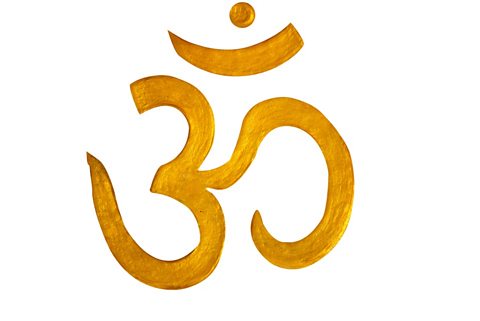
One way in which Hindus think of Brahman is as Nirguna Brahman. This is the idea that Hindus believe that Brahman is the Ultimate Reality – the source of all life in the universe and the basis of all reality and existence. Brahman is uncreated, infinite and all-embracing. (God) has no shape or form. One of the ways Nirguna Brahman is represented is by the Hindu Known as the 'sacred syllable', this sound and symbol is used by many Hindus to convey how deep and complex the divine is. symbol, which is used in Thinking quietly as a spiritual or religious exercise. Connection of the mind and soul with the Divine using breathing and other techniques. In Buddhism, using one of a set of techniques or exercises for calming the mind, developing positive emotions and understanding the way things are.. Hindus believe that aum is the sound that began the universe.
Saguna Brahman
A second way in which Hindus think of Brahman is as Saguna Brahman. In this idea, Brahman has a form and qualities that can be understood. In this representation of Brahman, the thousands of gods and goddesses that are worshipped by Hindus across the world are seen as manifestations of Brahman. There is no god or goddess that is wholly Brahman, but each of them has qualities of Brahman. Hindus believe that by worshipping the forms of Brahman, they can begin to understand Brahman and gain spiritual insight into the nature of Ultimate Reality.
But you cannot see me [Brahman] with your present eyes, therefore I will give you divine eyes. Behold My mystic opulence!
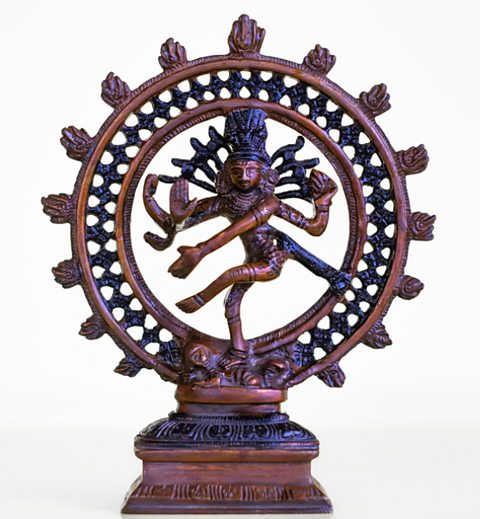
A statue of a god or goddess which has been made holy through a special ceremony; a term for any statue of a god or goddess. are images or statues that Hindus worship as representations of Saguna Brahman. Devotion to the image enables the worshipper to see Ultimate Reality more clearly.
Shiva Nataraja, the Lord of the Dance, is an example of a murti. In one hand he carries a drum to beat out the rhythm of time. It is a reminder that Brahman, seen here as A Hindu deity. The aspect of Brahman responsible for destruction and renewed creation. Some Hindus regard Shiva as the one Supreme Deity. is in charge of time.
Two key words – monotheism and monism
Hindus have different ways of expressing their philosophy, or their view of Ultimate Reality. These two words are both important to different parts of the Hindu community.
- Belief in one God. means ‘belief in one God’. Some Hindus use this word to describe their views. The Hindu version of monotheism sees all of the different gods and goddesses as aspects of the ‘one’ god.
- From the Greek ‘mono’, meaning ‘one’. The belief that reality consists of one fundamental, ultimate essence or substance. In monism, everything is ultimately one thing. Therefore, monists believe that God and the universe are the same thing. means ‘belief that everything is one’. Most Hindus are monists and believe in the idea that everything is Brahman and Brahman is everything.
Question
Do Hindus think Brahman has a form and shape or not?
Both. Hindu teaching says it is helpful in some ways to think of God as formless, but it is also helpful to think of the many gods and goddesses, whose qualities can show the truths about Brahman.
