Commercial processes
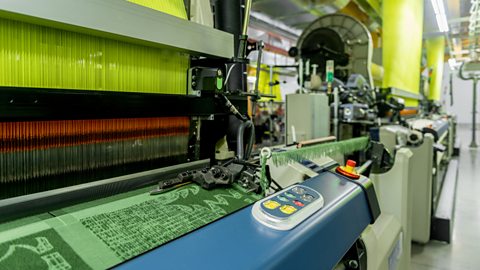
Weaving
Large, automated industrial Machine for weaving threads. are controlled by CAD software that allows colour schemes and The pattern made when weaving threads in different colours or styles. to be controlled.
Dyeing
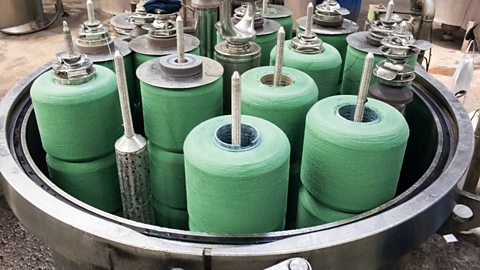
There are several different ways of dyeing fabrics:
- stock or yarn - dyes the fibres before they become fabrics
- piece - dyes pieces of fabric
- garment - dyes clothing once it is made
Dyeing usually takes place in large Large container. before being heated and dried.
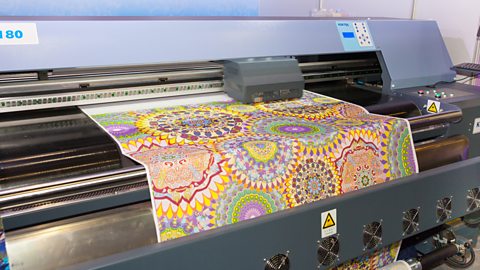
Printing
Commercial printing prints pattern onto the top surface of fabrics. There are a variety of printing methods available:
Screen printing
A screen with the stencil of the pattern has dye wiped over it to produce an accurate, repeatable print. A separate screen for each colour is required.
Roller printing
Roller printing can be used for long, striped patterns. A roller for each colour has a pattern To stamp a pattern onto a surface so that it stands out. on it. As the fabric passes through, the pattern is added.
Sublimation printing
A dye suspended in a liquid for printing on to hard surfaces. is printed onto coated paper. Once heated, the image is transferred onto fabric.
Digital printing
Digital printing allows fabric to be printed on directly from an inkjet head. It is expensive but offers a wide range of colours.